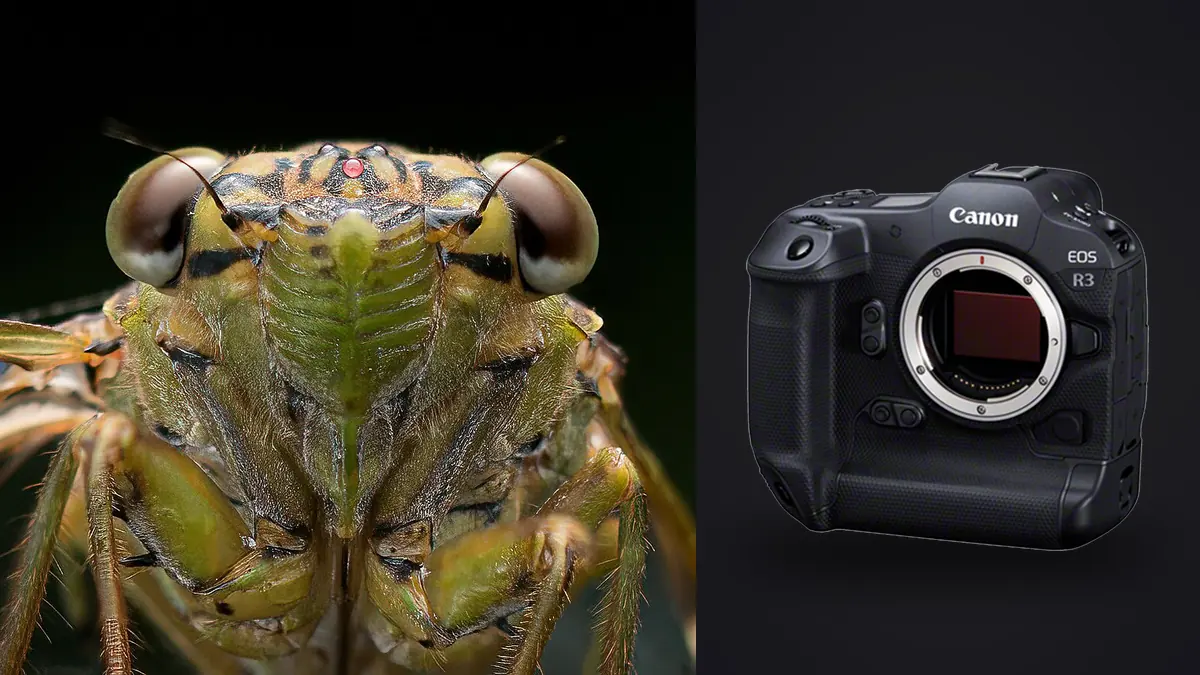
The Canon EOS R3 was never marketed as a macro camera. Canon built it for sports and photojournalism, sold it on a 30fps electronic shutter and a stacked sensor that barely rolling-shutters even under a strobe. So when a friend at a local macro club showed up to a dragonfly shoot with one bolted to a Canon RF 100mm f/2.8L Macro, half the group assumed he'd wasted his money. Three hours later, after watching him track a hawker dragonfly patrolling a pond edge at 1:2000s while the rest of us fumbled with manual focus on stationary damselflies, nobody was laughing anymore.
This isn't a spec sheet regurgitation. I've spent the better part of two summers shooting insects with the R3, borrowed for some sessions and rented for others, against my usual Canon 90D and a Panasonic G9 with a Laowa 50mm probe lens. The R3 is not the obvious macro choice on paper, and in some ways it still isn't, but the reasons it works are specific enough that they deserve a real explanation rather than a marketing recap.
Why a sports body ends up in a macro photographer's bag
Insect macro work has one persistent problem that landscape and portrait shooters never deal with: the subject moves faster than your depth of field can keep up, and it does so unpredictably. A bee working a lavender spike shifts its whole body every 200 milliseconds. A jumping spider tracks your lens and repositions its front legs before you've even locked focus. At magnifications above 1:1, your effective depth of field can shrink to less than a millimeter, so the tiniest twitch throws the eyes out of the plane of focus. Most photographers solve this by working at narrower apertures, using flash to freeze motion, and accepting a low hit rate. The R3 attacks the problem differently: rather than compensate for a slow autofocus system, it tracks the subject's eye continuously through burst shooting, refocusing between frames faster than the insect can reposition. That's the entire pitch, and it either matters to your specific subjects or it doesn't.
Where it matters most in my experience: dragonflies and damselflies in flight, jumping spiders (their eyes are enormous relative to body size and the R3's eye-detection algorithm locks onto them almost embarrassingly well), and bees or hoverflies working flowers in wind, where the flower itself is moving independently of the insect. Where it matters least: static subjects like resting moths, dew-covered spiders at dawn, or anything you're photographing with a focus rail on a tripod. For that second category, a cheaper body with manual focus and a good rail will get you the same result for a fraction of the cost.
Autofocus behavior at high magnification
Canon's Eye Control AF, the system that lets the camera focus wherever you're looking through the viewfinder, gets a lot of attention for sports and portraits. It is close to useless for macro. At 1:1 or greater, the difference between "the eye" and "the wing" from a viewfinder glance is smaller than the eye-tracking hardware's margin of error, and I ended up disabling it entirely for insect work in favor of a single small AF point moved manually with the joystick. What does work is subject-detection AF set to "animals" with eye priority, combined with Servo AF and a burst rate dropped to roughly 10-15fps rather than the full 30. Full-speed electronic shutter bursts fill a card fast and, more importantly, don't give the AF system enough time between frames to meaningfully re-evaluate focus at extreme magnification, so you end up with a hundred nearly identical frames instead of a spread of focus positions. Slowing down the burst rate paradoxically increases your usable hit rate. One caveat worth flagging: past roughly 2:1 magnification (achieved with extension tubes or a dedicated high-magnification macro lens), the R3's animal-eye detection starts missing more often than it hits, because the "eye" it's trained to recognize no longer resembles a normal eye shape at that scale. Past that point you're back to manual focus and focus rails regardless of what body you're using.
Battery and buffer behavior in the field
The stacked sensor and continuous eye-tracking draw more power than you'd expect from spec sheets alone. On a humid August morning shooting handheld bursts of hoverflies for about three hours, I burned through roughly 60% of a single LP-E19 battery, noticeably more than the same body did shooting a soccer match at a similar frame rate. My guess is that macro autofocus hunting (racking through a much larger focus range per shot than a distant sports subject requires) taxes the AF motor and processor harder than tracking a runner 30 meters away. Carry a spare battery if you're planning a full morning session, which for insect photography usually means arriving before sunrise while dew keeps subjects sluggish.
Lens pairings that actually make sense
The RF 100mm f/2.8L Macro IS USM is the obvious pairing and the one Canon designed the R3's AF system around, but it's not automatically the right choice for every insect subject. Here's how the realistic options break down for R3 owners specifically:
| Lens | Max magnification | Working distance at max mag | Best suited for | Where it struggles on the R3 |
|---|---|---|---|---|
| RF 100mm f/2.8L Macro IS USM | 1.4:1 | ~13.5cm | Bees, butterflies, larger beetles, general insect work | Skittish jumping spiders need more distance than 13.5cm allows |
| RF 85mm f/2 Macro IS STM | 0.5:1 | ~23cm | Portrait-style insect shots, dragonflies at rest | Not enough magnification for small subjects like ants or gnats |
| EF 180mm f/3.5L Macro (adapted) | 1:1 | ~48cm | Nervous subjects, dragonflies in flight, wasps | Adapted AF is noticeably slower than native RF glass, undercutting the R3's tracking advantage |
| Laowa 100mm f/2.8 2X Ultra Macro (manual) | 2:1 | ~15cm | Extreme close-ups, eyes and mouthparts | Fully manual, so the R3's AF tracking is irrelevant, you're paying for a body feature you can't use |
The 180mm is the one I keep coming back to for anything that flies, because the extra working distance means you're not casting a shadow over the subject or triggering a flight response before you've got the shot. The tradeoff is real: EF-to-RF adapted AF, even Canon's own adapter, is visibly slower to acquire focus than native RF motors, and on fast-moving subjects that gap costs you frames. If Canon ever releases a native RF 180mm or 200mm macro, it'll probably become the default answer for this camera.
What the R3 doesn't fix
It's worth being honest about the limits here, because a lot of macro marketing overpromises. The R3 does not extend your depth of field. At f/11 and 1:1 magnification you're still working with a sliver of sharp focus a millimeter or two deep, and no amount of eye-tracking autofocus changes that physics. For genuinely static subjects where you want the entire insect sharp from antennae to abdomen, you still need focus stacking: a tripod, a focus rail or in-camera focus bracketing, and 15-40 frames blended in post. The R3 has focus bracketing built in and it works fine, but so does the feature on cameras costing a quarter of the price. The other thing it doesn't fix is diffraction. Insect macro tempts you toward narrow apertures (f/16, f/22) to claw back depth of field, and diffraction softening kicks in earlier at high magnification than most photographers expect, often visibly by f/11 depending on the lens. No sensor stack changes that either. The R3 solves the tracking-a-moving-subject problem. It does not solve the fundamental optics of macro photography, and buying one expecting it to compensate for aperture and stacking technique is going to be a disappointing purchase.
Culling a week's worth of dragonfly bursts
The unglamorous part of this whole approach is what happens after the shoot. A single three-hour session shooting 10-15fps bursts of dragonflies patrolling a pond edge routinely leaves me with 2,000 to 4,000 frames, and the overwhelming majority are near-duplicates: the same dragonfly hovering in roughly the same spot, wings in slightly different positions, focus drifting by a few millimeters between shots. Sorting that by eye, frame by frame, at 100% zoom to check which one actually nailed the compound eyes, is a multi-hour chore that kills the enthusiasm for the next shoot. This is where I've started leaning on imagic instead of doing it manually. It runs its sharpness scoring locally on the machine, so a folder of RAW dragonfly bursts gets ranked by actual focus accuracy without anything leaving my laptop, which matters to me since some of these shoots are on land I don't have blanket permission to publish images from until I've decided what's usable. The burst and duplicate clustering groups near-identical hover sequences together automatically, so instead of scrolling through 40 nearly identical frames of one dragonfly I'm looking at one cluster with the sharpest frame already flagged. It's cut my culling time on a big macro session from most of an evening down to maybe 40 minutes, which is the difference between actually wanting to shoot again the next morning and dreading the backlog. If you're coming from a different culling workflow and want a sense of how local sharpness scoring compares to the older manual-flagging approach, there's a broader rundown at how AI photo culling works that goes into the mechanics beyond just my macro use case.
Editing consistency across a season of shoots
The other workflow habit worth mentioning: insect photography edits tend to need the same handful of adjustments over and over (shadow lift on the underside of wings, a slight desaturation pull on oversaturated green backgrounds, sharpening tuned for fine hair and setae rather than skin or fabric). Rather than rebuilding that from scratch every session, I trained imagic's apply_my_style feature on a batch of macro edits I was already happy with, so new imports from a shoot get a starting point that matches my usual look before I go in and do the shot-specific work. It's not doing anything creative on its own, it's just applying the pattern from edits I've already made, which saves the repetitive part without taking over the parts that actually need a human eye (crop, which frame in a stack to feature, whether the composition needs the background pushed further out of focus).
Is the price actually justified for this use case
At its current street price, the R3 costs roughly four to five times what a competent APS-C body with decent continuous AF would run you, and for insect photography specifically, that gap is hard to justify unless flying and jumping subjects are a meaningful part of what you shoot. If your macro work leans toward flowers, static fungi, dew-covered webs, and cooperative subjects at dawn when insects are too cold to move much, a cheaper body on a focus rail will get you results that are indistinguishable in the final image, and you'll have several thousand dollars left over for lenses, a proper macro flash setup, or a diffuser rig. Where the price starts making sense is a specific, narrower case: photographers who already shoot the R3 for sports or wildlife and want the same body to double as their macro rig without carrying two systems. If you're buying a camera purely and only for insect macro, there are more cost-effective paths to the same photos.
Frequently Asked Questions
Does the R3's in-body stabilization actually help with handheld macro shots?
Yes, more than I expected going in. At 1:1 magnification handheld, camera shake is magnified along with everything else, and the combination of IBIS with the RF 100mm's own IS gets you roughly 2-3 stops of usable shutter speed reduction. That's the difference between needing 1/500s and getting away with 1/125s in the same light, which matters a lot if you're not using flash and relying on ambient morning light. It won't stop subject motion (a bee's wings blur regardless of how stable your camera is), but it meaningfully cuts down on camera-shake-induced softness in the rest of the frame.
Is the electronic shutter safe to use around insects, or does it disturb them?
The R3's electronic shutter is silent, which is a genuine advantage over any mechanical-shutter body for skittish subjects like jumping spiders and dragonflies, both of which will bolt at a mechanical shutter clack from a foot away. I've had noticeably better luck holding a jumping spider's attention for a full burst sequence with the electronic shutter than I ever did with a DSLR. The one thing to watch for is banding under certain artificial light (rare outdoors, more relevant if you're doing studio insect work under LED panels), which the mechanical shutter avoids.
Can I use extension tubes with the RF 100mm Macro on the R3 without losing autofocus?
Canon's RF extension tubes (the EF12 II and EF25 II require the EF-to-RF adapter, but native RF extension tubes exist too) do maintain electronic contacts, so autofocus keeps working, though it slows down noticeably as you stack more tube length and the effective aperture narrows. Past about 25mm of added extension the hunting becomes frequent enough that I switch to manual focus anyway, so the AF preservation matters more for moderate magnification boosts than for pushing toward 2:1 and beyond.
How does the R3 compare to a dedicated wildlife body like the R5 for this specific use?
The R5's higher resolution sensor (45MP versus the R3's 24MP) gives you more room to crop into a frame after the fact, which matters if you can't physically get as close as you'd like to a subject. But the R3's stacked sensor rolls through frames with essentially no rolling shutter distortion and the AF system reacquires faster between bursts, which I've found matters more for erratically moving subjects like dragonflies than the extra resolution does. If your insect subjects tend to sit still for a portrait-style shot, the R5's resolution edge is the more useful trait. If you're chasing things that fly unpredictably, the R3's tracking speed wins out.