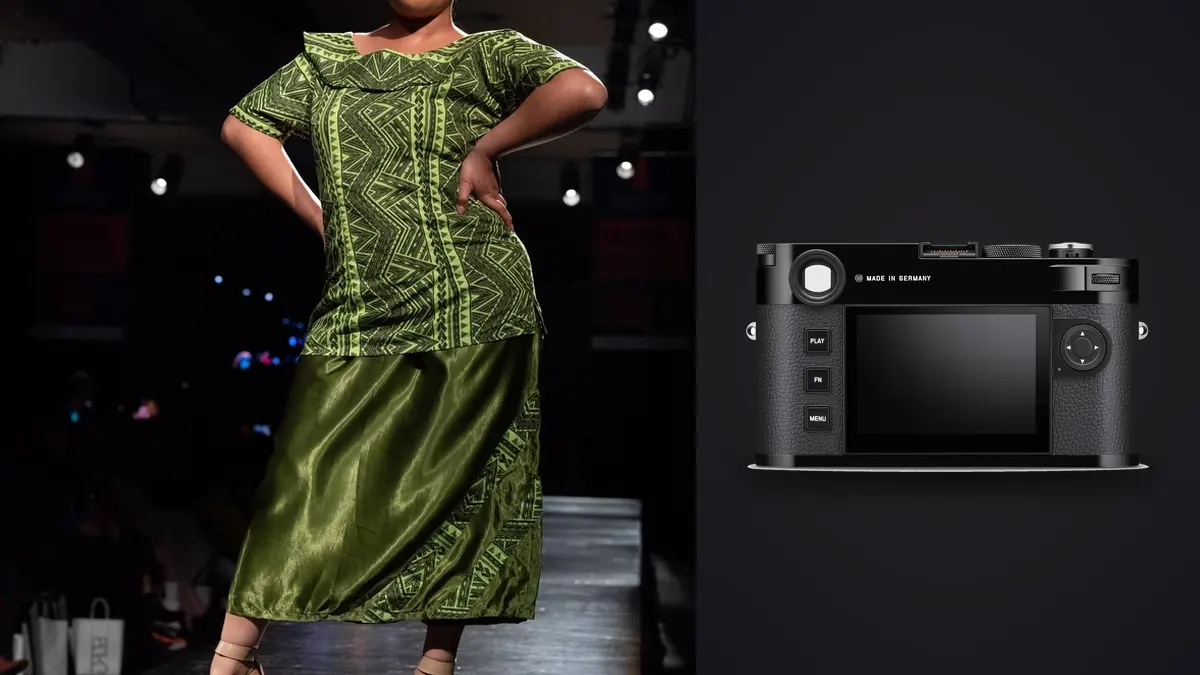
Picture getting talked into shooting a twelve-look lookbook on a Leica M11 by an art director who owns one and never uses it for client work. Her logic was simple: the brand wanted images that didn't look like every other e-commerce lookbook shot on a mirrorless body with eye-AF locked on and a 50 f/1.2 wide open. She wanted some grain in the shadows, some imperfection in the focus, something that looked shot rather than manufactured. You say yes before you've thought through what that actually means for a day with six outfit changes, two locations, and a same-week delivery deadline. It means a lot more work than the brief lets on, and also some genuinely good pictures you wouldn't have gotten any other way.
Why anyone would bring a rangefinder to a commercial set
The honest answer is aesthetic, not practical. Nothing about the M11 makes a lookbook shoot easier. There's no continuous autofocus, no eye detection, no tracking, no burst mode worth mentioning at 4.5fps with a shallow buffer. What it gives you instead is a rendering character from the M-mount glass and the way the sensor handles skin and fabric that a lot of clients (and a lot of photographers, if we're honest) find more flattering than the clinical sharpness of a modern autofocus system stopped down for guaranteed focus. Leica glass, the 35mm Summilux and Summicron especially, has a falloff and a color signature that reads as "photographed" rather than "captured," and for a lookbook trying to look like editorial rather than catalog, that distinction matters to art directors even when they can't articulate why.
It's also quiet. A leaf-shutter M body barely makes a sound next to a talent's ear, which matters more than people expect when you're doing thirty setups in a small studio and the model has to hold a pose while you fire six frames to find the one where the fabric falls right. Mirrorless bodies with mechanical shutters aren't loud exactly, but there's a rhythm to shutter clatter that models notice and sometimes perform to. The M11 removes that entirely.
The focus problem, and how you actually solve it
This is the part nobody warns you about clearly enough. Manual rangefinder focusing on a static subject is fine, even meditative. Manual rangefinder focusing on a model who's shifting weight, adjusting a sleeve, and turning toward a fan every four seconds is a different exercise entirely. I missed focus on roughly one in six frames during the first hour of that shoot, which is a miss rate that would get you fired on a job where you can't reshoot.
What worked was pulling back the working aperture. I'd planned to shoot most of the day at f/1.4 for the look, and ended up living at f/2.8 to f/4 for anything with movement, saving the wide-open frames for genuinely static moments between poses. The M11's focus peaking through the EVF (I used the Visoflex, not the optical rangefinder patch, for anything past a static three-quarter shot) helps, but it lags enough that you're focusing for where the subject was a fraction of a second ago. The fix that actually changed my hit rate was pre-focusing on a mark, a piece of tape on the floor or a stand at the model's working distance, and having her hit that mark on cue rather than chasing focus as she moved. It's a throwback to how this was done before autofocus existed, and it works, but it changes the pace of the shoot. You're directing blocking as much as you're directing expression.
Lens choices that actually held up
On a typical lookbook day, the 35mm Summicron f/2 ASPH does most of the work. It's fast enough for available light indoors, forgiving enough on focus-by-zone technique, and the field of view sits close to how a fitting looks to the eye, which suits the "how it actually looks on" shots. The 50mm APO-Summicron comes out for tighter beauty crops and close-up fabric detail, and its focus throw is short enough that manual correction on the fly is realistic in a way it isn't on the 35. A 90mm gets used rarely. On a moving subject at that focal length, the depth of field at working apertures is thin enough that even zone focusing struggles, and I wouldn't plan a lookbook day around it unless the subject is genuinely static.
Files, storage, and the part that eats your evening
The M11's 60-megapixel sensor with its triple-resolution capture (60, 36, or 18 megapixels, chosen before you shoot rather than cropped after) is genuinely useful for lookbook work because most clients want a mix of full-body flats and tight crops from the same frame, and 60 megapixels gives you real cropping latitude without falling apart. I shot the full day at the native 60MP DNG setting in compressed mode, which lands around 40 to 55MB per frame depending on scene complexity. Across six outfits, two locations, and a habit of shooting six to ten frames per pose to catch a clean expression and clean fabric fall, I came home with just under 3,100 frames and roughly 145GB on two cards.
Base ISO on the M11 is 64, which is lovely for dynamic range in daylight-adjacent studio lighting but means you're either adding light or accepting slower shutter speeds than you'd like when working indoors without strobes. On the location half of the day, shooting near a window with continuous light only, I was pinned between motion blur risk and noise past ISO 800, which on this sensor is still clean but not infinite. That tradeoff is worth planning around before the day, not during it.
Going through 3,100 manually focused frames by eye, looking for which ones actually landed sharp on the eyes and which ones were soft enough to kill, is not a reasonable way to spend an evening after a twelve-hour shoot day. I ran the take through imagic and let its local sharpness scoring flag the soft ones before I looked at anything, since on a manual-focus body that scoring is doing real work rather than confirming what autofocus already nailed. It also clustered the burst groups from each pose so I wasn't scrubbing through eight near-identical frames of the same outfit one at a time. Everything runs on the machine, nothing gets uploaded before a fashion client has seen or approved a single frame, which the brand's PR team actually asked about directly given the collection hadn't been announced yet.
How the M11 stacks up against what most lookbook shooters actually reach for
Most commercial lookbook work in 2026 gets shot on autofocus mirrorless bodies for good reason. Here's how the M11 compares against the two cameras you'd otherwise bring to that job, specifically on the things that matter for a moving-subject lookbook day rather than generic spec-sheet categories. For a look at how a similarly deliberate, high-resolution body handles the same brief, our Fujifilm GFX 100 II fashion lookbook piece covers that side of the argument.
| Factor | Leica M11 | Sony a7R V | Fujifilm GFX100S II |
|---|---|---|---|
| Autofocus on moving talent | None, zone-focus or pre-focus only | Real-time eye tracking, reliable at f/1.4 | Subject-detect AF, slower to lock than Sony |
| Effective resolution | 60MP (60/36/18 selectable) | 61MP fixed | 102MP (medium format) |
| Typical raw file size | 40-55MB compressed DNG | 60-90MB compressed raw | 100-130MB compressed raw |
| Shutter sound on set | Near silent | Quiet electronic option, some rolling shutter risk | Quiet, slight mechanical clack |
| Base ISO | 64 | 100 | 80 |
| Realistic keeper rate, moving subject, wide open | 60-75% with pre-focus technique | 95%+ | 85-90% |
| Reason to choose it for a lookbook | Rendering character, no substitute for the look | Speed and reliability on a tight schedule | Resolution for large-format print or heavy cropping |
None of these numbers make the M11 the sensible choice for a lookbook on paper. They explain why it's the choice you make when the brief specifically wants what it produces, and why you budget extra time and extra frames-per-pose to get there.
What I'd change about how I ran that day
I'd cut the shots-per-pose ratio and slow the whole thing down rather than trying to burst my way to a keeper. Shooting six to ten frames hoping one lands sharp is autofocus thinking applied to a manual-focus tool, and it doesn't actually raise your hit rate much once you're past three or four attempts at the same focus distance. What raises the hit rate is committing to the pre-focus mark and directing the model to hit it, which turns the day into something closer to a still-life setup with a person in it. Clients don't notice the difference in your process. They notice that half your frames are usably sharp instead of a third.
I'd also negotiate the delivery timeline differently. A same-week turnaround on a manual-focus shoot with this much culling overhead is tight in a way it isn't on an autofocus body, and the client didn't know to ask about that because they were thinking about the shot, not the sorting.
On a job like this, two things make the back end survivable rather than brutal. One is using imagic's duplicate and burst clustering so that instead of opening 3,100 individual thumbnails you review roughly 400 grouped pose sets and pick the strongest frame from each, which is a completely different amount of decision fatigue. The other is building an apply_my_style preset trained on a set of earlier lookbook-style edits with a similar color story, so the 400 selects pulled forward get a consistent starting grade automatically instead of you manually matching white balance and contrast across six different outfits and two lighting setups by eye. You would still hand-finish the hero frames picked for the lead image, but the bulk pass that used to eat half a day takes under twenty minutes.
Frequently Asked Questions
Is the Leica M11 actually fast enough to keep up with a fashion lookbook schedule?
It keeps up with the schedule, not with the subject's movement in real time. A lookbook day is mostly waiting between setups, styling adjustments, and directed poses rather than continuous action, so the M11's slow burst rate rarely costs you time. What it costs is your ability to shoot loosely and trust autofocus to save a frame. Budget for more directed, static-hold poses and fewer walking or in-motion shots unless you've built real zone-focus speed with the lens you're using.
Which M-mount lenses make sense for commercial lookbook work specifically?
A 35mm at f/2 or f/1.4 covers full-length and three-quarter looks and its shorter focus throw makes manual correction realistic on a moving subject. A 50mm APO handles tighter beauty and fabric-detail shots well because depth of field at typical working distances is more forgiving than people assume. Longer glass like a 90mm looks gorgeous in a still frame but becomes a liability the moment the subject shifts weight, since the depth of field at wide apertures gets thin enough that even experienced zone-focusing misses.
How do you handle culling thousands of manually focused frames without burning a full day on it?
Sort for focus first, before you look at expression or fabric, because a soft frame is dead regardless of how good the pose is. I run the full card through imagic's local sharpness and focus scoring before touching anything by hand, which flags the technically soft frames automatically, and its burst clustering groups the multiple attempts from each pose so you're comparing four or five near-duplicates against each other instead of scrolling a flat grid of three thousand thumbnails. It all runs locally on the machine, which matters when a collection hasn't been announced yet and nothing should touch a server before the client has approved it.
Does the lack of tethering or reliable live view autofocus make the M11 impractical for client-present shoots?
Live view on the M11 works fine for review between setups, and tethering to a laptop is supported, but neither replaces the instant chimping and continuous preview a client expects from a mirrorless or DSLR set. If the client or brand team needs to approve frames in real time as you shoot, build that into the pace of the day explicitly, shoot a pose, pause, review on a tethered screen or the rear LCD, adjust, continue, rather than trying to shoot through it the way you would on a faster system.