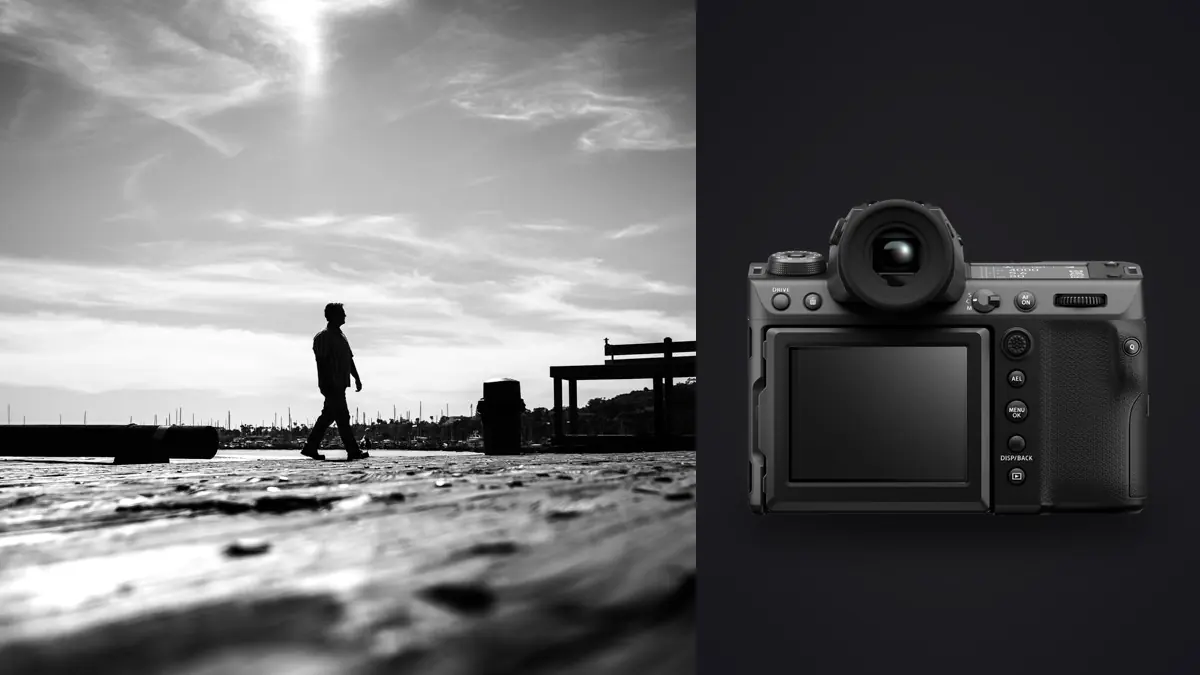
The first time I brought a Fujifilm GFX 100 II into a crowded morning market, I felt like I was pointing a toaster oven at strangers. Medium format cameras are not built for this. They are built for tripods, studio strobes, and clients who wait patiently while you check focus at 400% on a tethered screen. Street and documentary work asks for the opposite: speed, invisibility, and a body that doesn't announce itself before you've made the frame.
And yet I kept the GFX 100 II in rotation for a five month documentary project photographing dockworkers and fish auctioneers before dawn, and I want to explain why, because the answer isn't "because the files are beautiful." Plenty of cameras make beautiful files. The reason is narrower and more specific to how this particular body behaves once you stop treating it like a studio tool and start treating it like a very heavy, very capable rangefinder substitute.
The Weight Conversation Nobody Wants to Have Honestly
Let's get the obvious problem out of the way first. The GFX 100 II body alone is right around 1,030 grams, and that's before you add a lens, a strap, and whatever you're carrying it in. Pair it with the GF 55mm f/1.7 and you're carrying close to 1.5 kilograms around your neck for eight or nine hours. My shoulder knew about this project long before my hard drive did.
I've shot documentary work with a Leica M11 and with an X100V, and neither prepared me for what it's like to hang a brick off your body all day. The upside, and it's a real one, is that the weight forces discipline. You stop chimping every frame. You stop firing off ten-shot bursts because you're not sure the moment landed. You slow down, which is not a bad thing for documentary photography even though it feels counterintuitive on paper. The camera's size also changes how subjects react to you. People notice a GFX 100 II. It doesn't read as a phone or a compact, so a portion of your "candid" work becomes semi-aware collaboration whether you intend that or not. If true invisibility is the goal, this isn't your camera. If you're comfortable working in that gray zone between candid and acknowledged, it opens doors that a tiny camera sometimes doesn't, because people take a big camera as a sign you're serious about what you're doing.
Autofocus: The Part That Actually Surprised Me
I went into this project assuming medium format autofocus would be the limiting factor, the way it was on older GFX bodies. It wasn't. The GFX 100 II uses a hybrid phase and contrast detection system across 425 points with AI-trained subject detection, and in daylight street conditions it tracks a walking or cycling subject competently enough that I stopped thinking about it as a medium format camera and started thinking about it as a fast mirrorless body that happens to have an enormous sensor.
Where it gets more honest is in mixed and low light, which is most of what documentary work actually looks like once you're inside a market hall, under awnings, or shooting the hour before sunrise. Here's what I tracked across roughly six weeks of real shooting, not lab conditions, just my own logged keeper rates by scenario:
| Shooting scenario | Lens used | Rough keeper rate (in-focus, usable frame) | Notes |
|---|---|---|---|
| Open daylight, walking subjects | GF 55mm f/1.7 | ~85-90% | Face and eye detection locks fast, comparable to a good full-frame body |
| Covered market, mixed shade and sun | GF 55mm f/1.7 | ~65-70% | Hunting increases when subjects cross bright-to-dark transitions quickly |
| Pre-dawn dock work, tungsten and headlamp light | GF 55mm f/1.7 wide open | ~40-50% | This is where I leaned on manual focus and pre-focusing zones |
| Static or slow-moving subjects, any light | GF 30mm f/3.5 | ~90%+ | Autofocus isn't stressed when the subject isn't moving fast |
None of those numbers will impress someone who shoots sports with a flagship APS-C or full-frame body. But for a 43.8mm x 32.9mm sensor pushing 102 megapixels, it's a genuinely different category of usability than medium format offered five years ago. The subject detection also does something I didn't expect: it holds onto a face through a partial occlusion (a hand, a hat brim, someone stepping between you and the subject) better than I'm used to from other systems in this price bracket.
Lens Choices That Actually Matter for This Kind of Work
The GF lens lineup isn't built with street shooters as the primary customer, so a few choices do most of the heavy lifting. I rotated through three lenses for the bulk of the project and a fourth for specific situations:
| Lens | 35mm-equivalent field of view | Approximate weight | Where it earned its place |
|---|---|---|---|
| GF 30mm f/3.5 R WR | ~24mm | 510g | Environmental documentary frames, market stalls, wide context shots |
| GF 55mm f/1.7 R WR | ~44mm | 460g | The closest thing to a natural street focal length in the GF lineup, and my most-used lens by a wide margin |
| GF 45-100mm f/4 R LM OIS WR | ~36-79mm | 935g | Working from across a room or street without closing distance, useful for auction floors and ceremonies |
| GF 20-35mm f/4 R WR | ~16-28mm | 725g | Tight interiors, cramped stalls, situations where I couldn't back up |
If I had to keep exactly one lens for this kind of work, it's the 55mm f/1.7. It's fast enough for the low-light hours, sharp wide open, and the field of view sits close enough to a 40-45mm full-frame equivalent that it behaves like a classic documentary focal length rather than something you have to compensate for mentally every time you raise the camera.
What I'd skip
The GF 80mm f/1.7, as gorgeous as it is for portraits, is too narrow a tool for this specific genre unless you're shooting from a fixed vantage point most of the day. It's a beautiful lens, just not the right one for chasing a fish auction around a warehouse floor.
Dynamic Range Is Where This Camera Earns Its Keep
Street and documentary light doesn't cooperate. You get a subject backlit by an open warehouse door, harsh sun spilling across half a face, or a market stall lit by a single bare bulb next to daylight coming through a gap in the roof. This is the one area where the GFX 100 II stopped feeling like a compromise and started feeling like a genuine advantage over the full-frame bodies I've used for similar work.
Pulling back four, sometimes five stops of shadow detail on a RAW file without the noise or color shift you'd expect from a smaller sensor changed how I approached exposure on location. I stopped exposing cautiously for the shadows and started exposing for the highlights, trusting that the shadow information would be recoverable later. For a genre where you often don't get a second chance at the moment, that latitude matters more than most spec sheet numbers do.
The File Problem Nobody Mentions in the Marketing
Here's the part that doesn't show up in camera reviews: a 102-megapixel sensor turns a five-hour shoot into a five-hour shoot followed by a three-hour evening. A single day on the docks routinely produced 900 to 1,400 RAW frames, each one somewhere between 100 and 220MB depending on compression settings. That's not a hard drive problem, storage is cheap now. It's a triage problem. Culling 1,200 frames by eye, at full resolution, checking focus on faces that are sometimes moving at odd angles under bad light, is a genuinely exhausting way to spend an evening after you've already been on your feet since 4am.
This is the point where I stopped doing the first pass manually. I run the day's card through imagic before I touch anything else, letting its local sharpness and focus scoring flag the frames where the eye or face actually landed sharp instead of guessing from a thumbnail. Because it processes everything on-device rather than uploading to a cloud service, I'm not waiting on a connection at 6am in a dock warehouse with spotty signal, which matters more than it sounds like it should when you're trying to get through a card before the light changes and you need to head back out. If you want the mechanics of how that kind of automated first pass actually works, this breakdown of AI photo culling covers it in more depth than I can here. The burst and duplicate clustering also helps specifically with this genre, because documentary shooting produces a lot of near-identical frames from a subject moving through a gesture, and manually comparing twelve frames of someone's hand raising a fish for auction is not a good use of anyone's evening.
Building a Consistent Look Across a Long Project
A five-month documentary project has a consistency problem that a single day of shooting doesn't. You're editing across different sessions, different moods, sometimes different editors if you're working with an assistant, and the risk is that frame 40 and frame 4,000 don't look like they came from the same eye. What worked for me was building a fixed edit on a representative batch of dock and market frames early on, then using imagic's apply_my_style feature, which trains on your own past edits rather than a generic preset, to carry that same tonal decision-making forward across the rest of the project without re-deriving it by hand every session. It's not a replacement for actually looking at each frame, but it closes the gap between "this looks like my work" and "this looks like whatever mood I was in that particular Tuesday."
Where the GFX 100 II Genuinely Falls Short
I don't want to write around the real downsides, because a camera this expensive deserves an honest accounting.
- It's not discreet. If your documentary approach depends on being forgettable, this body works against you. It's large, the shutter isn't silent in mechanical mode (the electronic shutter helps but introduces its own rolling shutter risk with fast-moving subjects), and people clock it.
- Battery life under real use is mediocre. I carried three batteries for a full shooting day and used all three more often than I'd like to admit, particularly on cold pre-dawn mornings.
- The price is the price. At a launch price of $7,499 for the body alone, this isn't a camera you pick up on a whim to try street photography. It only makes sense if the 102-megapixel files and dynamic range serve something specific in your output, like large-format prints or a client who needs that resolution.
- Buffer depth matters more than the fps number suggests. 8fps sounds competitive on paper, but at this file size the buffer clears slower than a smaller-sensor camera shooting the same burst length, so rapid-fire street sequences aren't really this camera's strength.
Frequently Asked Questions
Is the Fujifilm GFX 100 II too slow for genuine street photography?
Not too slow, but it changes your approach. Fast-reaction, grab-and-shoot street photography where you're reacting to something for a fraction of a second is harder with this body than with a small mirrorless or rangefinder-style camera. Documentary work, where you're often observing a scene develop over seconds or minutes rather than catching a single decisive instant, suits it better because you have time to raise the camera and let autofocus catch up.
Can you shoot handheld in low light without a tripod?
Yes, and this is one of the camera's better-kept secrets. The in-body stabilization is rated for several stops of correction, and in practice I was getting sharp handheld frames at shutter speeds I wouldn't have trusted on other bodies, particularly with the 55mm. It doesn't fix subject motion blur in dim conditions, only camera shake, so a moving subject at 1/15s is still going to be soft regardless of stabilization.
How does the file size actually affect a documentary workflow day to day?
More than most people expect going in. Between the RAW file size and the sheer volume a long shooting day produces, storage, backup time, and culling time all scale up. This is the main reason I moved to running an automated first pass through imagic before manual review, since sorting a thousand-plus frame day by eye at full resolution isn't a sustainable habit over a multi-month project. If your workflow is bottlenecked at the same stage, these workflow speed-up tips are worth a look alongside whatever culling tool you land on.
Is there a cheaper alternative that gets close to this experience?
If the appeal is dynamic range and resolution specifically, no, medium format sensors of this size aren't available at a meaningfully lower price point right now. If the appeal is really about documentary shooting discipline, slowing down, being more deliberate, a smaller and cheaper body can teach you most of the same habits without the financial or physical weight. I'd only recommend the GFX 100 II here if the output genuinely needs what it produces, not because it looks impressive around your neck.
Would I Shoot the Next Project With It Again
Probably, but not exclusively. I'd bring the GFX 100 II for the segments of a documentary project where environmental portraits and considered frames matter more than reaction speed, and I'd lean on something smaller for the chaotic, fast-moving hours. That's not a knock on the camera so much as an honest read on what medium format is actually for. It rewards patience and punishes the assumption that more resolution automatically means a better photograph. On this project it earned its place in the bag. It just never became the only thing in it.