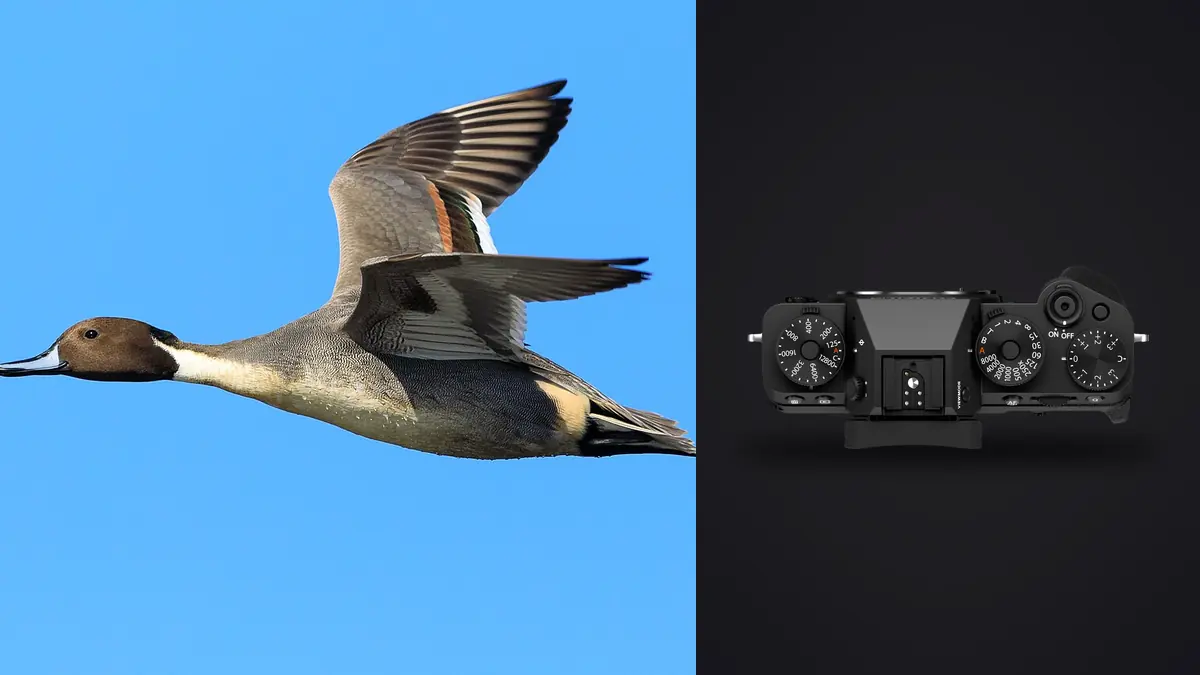
Fujifilm never pitched the X-T5 as a wildlife camera. That job belongs to the X-H2S, with its stacked sensor and blackout-free viewfinder. And yet walk any decent shorebird estuary or raptor migration site in autumn and you'll find X-T5s slung over shoulders next to the bigger bodies, often with a 150-600mm hanging off the front. There's a reason for that, and it isn't just price. After a full season of dragging one through wetlands, quarries, and one memorably muddy heron colony, I have opinions about where it earns its keep for birds in flight and where you need to compensate for what it lacks.
The 40-Megapixel Trade-Off Nobody Explains Properly
The X-T5 shares its 40.2MP X-Trans CMOS 5 HR sensor with the X-H2, and that resolution is the single biggest reason birders gravitate toward it. A bird that fills a third of the frame at 600mm can still be cropped to a tight portrait and hold up on a monitor, sometimes even for a modest print. That matters enormously in this genre, where you rarely get as close as you want and half your "reach" ends up coming from post-crop rather than glass.
But that resolution cuts both ways. Every focus miss, every trace of atmospheric heat shimmer, every bit of shutter shake from a fence-rail brace shows up more obviously at 40MP than it would on a 24MP body. I've had frames that looked perfectly sharp on the X-T5's rear LCD turn soft the moment I pulled them into a real editor at 100%. The sensor is unforgiving of sloppy technique in a way that a lower-resolution wildlife-focused body simply isn't. If your shutter speed floor or your panning technique is even slightly off, this sensor will show you.
Autofocus and Subject Detection: Good, With Caveats
Fujifilm's bird detection mode (added via firmware and refined since) does a genuinely solid job locking onto a bird's head and eye once the subject is reasonably large in frame and reasonably isolated against sky or open water. Where it struggles is exactly where you'd expect any contrast-plus-phase hybrid system to struggle: a small bird weaving through reeds, a raptor banking against a cluttered treeline, or anything backlit hard enough to flatten contrast. In those situations the camera will happily lock onto a branch instead of the bird sitting three feet in front of it.
My working setup is Zone AF rather than Wide/Tracking for anything unpredictable like swifts or terns, because a smaller active zone gives the algorithm less background clutter to get confused by. For soaring raptors against open sky, Wide/Tracking with bird detection on is close to foolproof. I keep two of the six AF-C custom presets configured differently, one biased toward "ignore obstacles, keep tracking" for birds cutting behind branches, and one set to react instantly for subjects that change speed erratically, like a kingfisher's stop-start hover. Switching between them with a function button beats digging through menus mid-flight.
Frame Rates, Crop Modes, and the Buffer Reality
The X-T5 offers 15fps on the mechanical shutter at full 40MP, or up to 20fps electronic if you accept a 1.29x sensor crop, which also happens to hand you extra reach for free. That crop mode gets underused by people who buy this camera and never touch the setting, and it's genuinely useful for BIF work: you trade some resolution for both frame rate and effective focal length, which is exactly the trade a lot of birders want.
Where the X-T5 shows its non-wildlife-flagship roots is the buffer. Dual UHS-II SD slots, not CFexpress, mean sustained bursts at 40MP fill the buffer faster than you'd like and clear slower than a stacked-sensor body would. On a fast-moving raptor pass I've had the camera stutter mid-burst on a long sequence, right at the moment the bird banked into the best wing position. The fix that works for me is shooting in shorter, more deliberate bursts rather than holding the shutter down for ten uninterrupted seconds, and switching to lossless compressed RAW instead of uncompressed to buy back some headroom.
| Shooting mode | Max frame rate | Sensor crop | Reach with a 600mm lens | Best for |
|---|---|---|---|---|
| Mechanical shutter, full sensor | 15 fps | None (40MP) | 900mm equivalent | Perched birds, slower soaring flight, maximum detail for cropping |
| Electronic shutter, 1.29x crop | 20 fps | 1.29x (roughly 24MP) | ~1161mm equivalent | Fast, erratic flight where extra reach and frame rate matter more than resolution |
| Electronic shutter, full sensor | 10 fps | None (40MP) | 900mm equivalent | Rarely worth it for BIF; mechanical usually wins at the same crop and rate |
Lenses That Actually Make This Combination Work
The camera is only half the story. The XF150-600mm F5.6-8 R LM OIS WR is the lens most serious X-T5 birders end up with, and for good reason: at roughly 1.6kg it's light enough to handhold for hours, it's weather sealed, and the built-in OIS pairs well with the body's in-body stabilization for handheld panning shots down to surprisingly slow shutter speeds. It's not a fast lens wide open at the long end, which matters on overcast days or in shaded canopy, but in decent light it's the lens I reach for most.
The XF100-400mm F4.5-5.6 R LM OIS WR is the lighter, brighter alternative, useful if you're hiking long distances to a hide or shooting from a kayak where every gram counts, at the cost of losing that last 200mm of reach on distant subjects. The budget option, the XF70-300mm F4-5.6 R LM OIS WR, is genuinely capable for garden and park birding but starts to feel short once you're working a lake edge or a cliff colony from any real distance. One caveat worth flagging: the older XC 50-230mm is not weather sealed, which matters more in this genre than almost any other, since birding often means standing in drizzle or salt spray for hours.
| Lens | Focal range | Approx. weight | Weather sealed | Where it fits |
|---|---|---|---|---|
| XF70-300mm F4-5.6 R LM OIS WR | 105-450mm equiv. | 580g | Yes | Backyard and park birding, entry point into the system |
| XF100-400mm F4.5-5.6 R LM OIS WR | 150-600mm equiv. | 1,375g | Yes | Hiking-friendly, brighter glass for shaded or overcast conditions |
| XF150-600mm F5.6-8 R LM OIS WR | 225-900mm equiv. | 1,605g | Yes | Default choice for serious BIF work, best reach-to-weight balance |
| XF200mm F2 R LM OIS WR + 1.4x TC | 420mm equiv. at f2.8 | 2,865g (with TC) | Yes | Low light, isolation, when weight and cost aren't the constraint |
Handling the Kit in the Field
The X-T5 body alone is under 560g, which changes how a session feels compared to a full-frame equivalent rig. Paired with the 150-600mm, the whole setup handholds comfortably for a two or three hour stretch without a monopod, something I couldn't say about the heavier bodies I used before switching. The seven-stop IBIS doesn't replace a fast shutter speed for freezing wingtips, but it does let me pan at 1/200 or slower for a deliberate motion-blur shot of a heron's wingbeat without the frame turning into mush from hand shake alone.
Battery life is the honest weak point. The NP-W235 gets you through a normal outing, but a morning of sustained high-fps bursts chasing terns will drain it faster than the numbers on the box suggest. I carry two spares as a matter of course now, after being caught with a dead battery during what turned out to be the best light of the day.
What Happens After You Get Home
Nobody warns new birders about the volume problem until they're staring at it. A single good session with the shutter set to 15 or 20fps easily produces two or three thousand frames, most of them near-duplicates from the same burst, and at 40MP that's a serious chunk of storage and an even more serious chunk of your evening if you're culling by eye, one image at a time, zooming in on each to check focus.
This is where I stopped doing it manually. I run everything through imagic before it touches a folder structure, letting its local sharpness and focus scoring flag which frame in a ten-shot burst actually nailed the eye, and its duplicate and burst clustering group the rest so I'm reviewing one representative frame per sequence instead of scrolling through all of them. Because it runs entirely on-device with no cloud upload, I can do this culling pass on a laptop at the trailhead or in a hide with no signal, which matters more in birding than in almost any other kind of photography, since you're often nowhere near a usable connection. Once the keepers are sorted, I lean on the apply_my_style preset, trained on my own past edits, to get a consistent first pass across a folder of the same species shot in similar light, rather than re-inventing the grade for every single frame. If you're new to the idea of software doing the first cull pass instead of your own eyes, how AI photo culling works is a reasonable place to start.
A Few Settings I'd Change on Day One
Turn on electronic front curtain shutter for anything mechanical to shave off a hair of shutter lag. Set your AF-C custom settings before you need them, not while a bird is already airborne, since the menu diving costs you the shot. And set your minimum shutter speed with real intent: 1/2000 for small fast fliers like swallows, 1/1000 is often enough for larger, slower raptors, and anything below that should be a deliberate creative choice rather than something you land on by accident because the camera's Auto ISO ceiling was set too conservatively. If your workflow before this camera was built around a slower cadence, it's also worth a look at general pacing advice like 10 tips for a faster photo workflow, because a body that shoots 20fps demands a review process that can keep up with it.
Frequently Asked Questions
Is the X-T5 actually fast enough for birds in flight, or should I save for the X-H2S?
For most flight photography outside of professional sports-style assignments, yes, it's fast enough. The X-H2S wins on buffer depth, blackout-free viewfinder tracking, and CFexpress write speed, all of which matter more the longer and faster your bursts get. But for a birder shooting in shorter, more deliberate bursts rather than machine-gunning every pass, the X-T5's 15-20fps and its subject detection cover the vast majority of real situations, and the extra resolution is a genuine advantage the X-H2S doesn't have.
Do I need to shoot in the 1.29x crop mode all the time for birding?
No, and I'd argue against it as a default. Keep the full 40MP sensor active for perched birds, slower flight, and anything where you might want to crop hard later. Switch to the 1.29x crop specifically when you need the extra frame rate or the extra reach, like a fast raptor pass at distance, and switch back afterward. Leaving it on permanently just throws away resolution you'll want on calmer days.
What's a reasonable first lens if the 150-600mm is out of budget right now?
The XF70-300mm is a legitimate starting point and will get you real keepers on garden birds, gulls, and anything approachable. It won't compete on distant subjects, but it's weather sealed, light, and cheap enough that you can save toward the 150-600mm without feeling like the lens was wasted money once you upgrade.
How much storage should I actually expect a serious birding trip to use?
Plan for more than feels reasonable at first. A few thousand frames at 40MP in compressed RAW routinely adds up to well over 100GB from a single strong outing, and that's before you've deleted anything. Culling that volume down to the handful of frames worth editing is really the bigger bottleneck than storage capacity itself, which is the whole reason I no longer try to do it by scrolling through a folder manually.