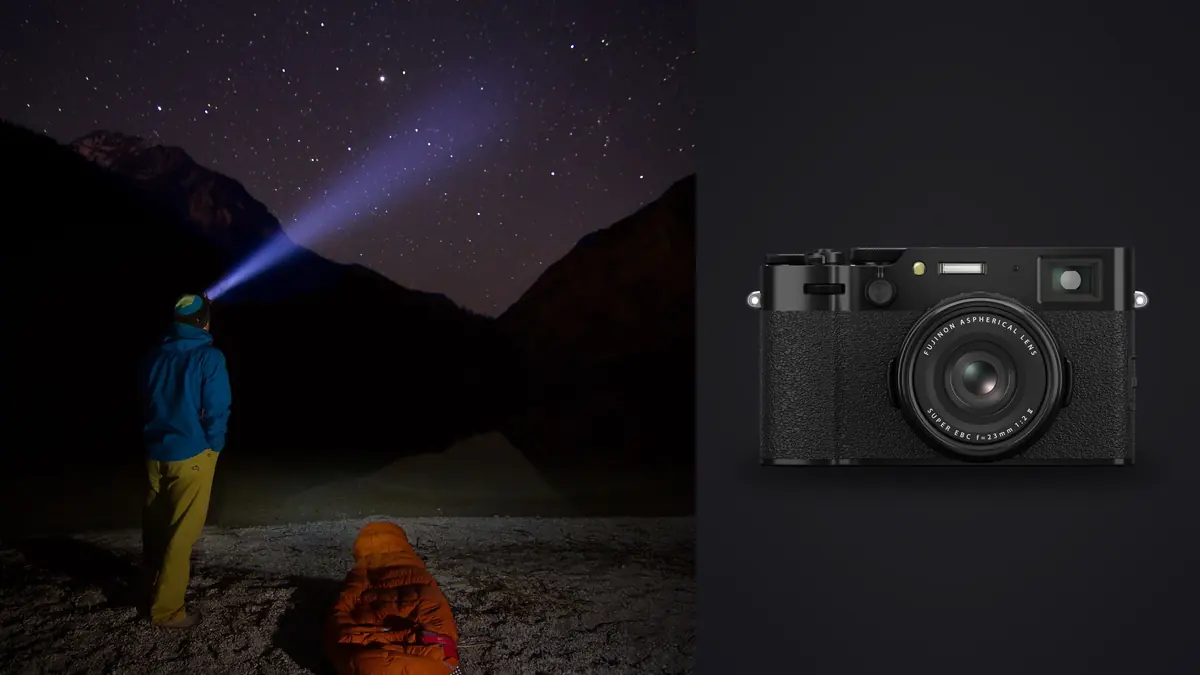
I took the X100VI to a Bortle 3 site in the high desert expecting to be disappointed, mostly because everything I'd read about it treated the camera as a street shooter's toy: fixed 23mm lens, leaf shutter, a hybrid viewfinder built for candid work in cities. Nobody talks about pointing it straight up. After three nights of actually trying, my opinion split in two directions at once. The sensor and lens combination is more capable under a dark sky than the marketing suggests, but the camera fights you on workflow in ways that an interchangeable-lens body simply doesn't, and if you're going in expecting a dedicated astro tool you'll be annoyed within the first ten minutes.
The compact camera nobody expects at a dark sky site
Walk into any astrophotography forum and you'll see the same short list of recommended bodies: full-frame mirrorless with a fast wide prime, or a dedicated cooled astro camera bolted to a star tracker. A fixed-lens APS-C compact doesn't come up, and for good reason. Most of them cap out around f/2.8, have middling high-ISO performance, and give you no room to swap in something wider when you actually see the Milky Way core rising and realize your framing is wrong.
The X100VI dodges some of that. The 23mm f/2 lens (35mm equivalent once you account for the APS-C crop) is genuinely fast for a fixed-lens design, and the 40-megapixel X-Trans sensor holds detail well enough that you can crop into a frame afterward without the image falling apart. What it can't do is replace a proper wide-angle astro setup. If you're chasing an expansive foreground-to-Milky-Way composition with a 14mm rectilinear lens, this camera was never going to get you there, and no amount of enthusiasm changes that. Where it earns its keep is star trails, moonlit landscapes, and Milky Way shots where a 35mm-equivalent field of view is actually what you want.
What the sensor, lens, and shutter actually give you at night
The 23mm f/2 lens is fast enough, not fastest
f/2 collects noticeably more light than the f/2.8 to f/4 range you'll find on most fixed-lens compacts, and it's a full stop and a third slower than the f/1.4 primes serious night shooters reach for. In practice that difference shows up as roughly an extra stop of ISO you have to eat to hit the same shutter speed. On a 20-second exposure of the core, I was landing around ISO 4000 to 5000 to get a histogram I was happy with, where a f/1.4 lens on the same body would have let me shoot two stops lower. That's not a disaster, but it means noise reduction and the quality of your stacking software matter more here than they would with faster glass.
In-body stabilization does nothing once you're on sticks
The X100VI's in-body stabilization is one of the more talked-about additions over the previous generation, and it's genuinely useful for handheld low-light work. For star photography it's irrelevant, and worse, I'd turn it off entirely. IBIS systems can introduce a very faint drift or micro-jitter when the camera is tripod-mounted and the system has nothing to correct against, which shows up as very slight softness over a long exposure. Fujifilm cameras generally handle this better than older generations that needed IS switched off religiously, but I still killed it for every long exposure after noticing marginally sharper stars with it disabled on a side-by-side test.
The leaf shutter buys you something real: silence and vibration
This is the part of the X100VI that actually helps at night in a way most cameras in this class can't match. A leaf shutter has no shutter curtain slapping around inside the body, so there's less mechanical vibration transmitted into the lens during exposure. On a lightweight travel tripod in a breeze, that matters more than people give it credit for. I noticed fewer soft frames from micro-shake compared to a focal-plane shutter body on the same tripod under the same wind conditions.
Building a star sequence without an in-camera stacking mode
Here's the part that trips people up coming from other brands. Some cameras (a few Olympus and OM System bodies in particular) have a live composite mode that stacks star trails for you in-camera, updating the exposure on the back screen in real time. The X100VI doesn't have anything like that. What it does have is a built-in interval timer, and that's what you're actually going to use.
My approach for a star trail sequence: manual exposure, manual focus locked at infinity (checked and rechecked with focus peaking, because temperature drift on a lens barrel is a real thing over a two-hour session), and the interval timer set to fire back-to-back frames with the shortest possible gap between exposures. Any gap between frames shows up as a visible break in the trail once you stack everything together, so getting that interval as close to zero as the camera allows is worth the fiddling.
| Scenario | Shutter | ISO | Aperture | Notes |
|---|---|---|---|---|
| Milky Way core, no tracker | 15-20s | 3200-6400 | f/2 | Past 20s at 23mm you start seeing slight elongation on bright stars |
| Star trail sequence (2hr+) | 25-30s per frame | 1600-3200 | f/2.8 | Stopping down one stop cuts coma at the corners, worth it for trail work |
| Moonlit landscape w/ stars | 10-15s | 800-1600 | f/2.8-f/4 | Moonlight acts like a giant softbox, ISO drops a lot |
| Foreground blend frame | 60-120s | 400-800 | f/4-f/5.6 | Shot separately, blended in post rather than part of the stack |
One thing I'll flag: the built-in 4-stop ND filter is a fantastic feature for daytime long exposures and does absolutely nothing for you at night. Make sure it's switched off before you start a sequence. I forgot on my second night and burned twenty minutes wondering why my histogram was reading three stops darker than my test shot.
Turning a few hundred frames into one usable image
A two-hour star trail session at a 27-second exposure with a two-second gap works out to roughly 250 frames. None of that gets stacked in-camera, so you're moving everything to a computer and running it through dedicated stacking software. Sequator and Starry Landscape Stacker (Mac only) both handle a sequence like this well, aligning on the stars and letting you choose whether to stack for pinpoint stars or let them trail. DeepSkyStacker is the free option most people start with, though its interface shows its age.
The X-Trans sensor's color filter array has historically given some third-party RAW processors trouble with fine detail rendering, star fields being a good stress test since you're looking at thousands of tiny points of light against a smooth background. I didn't run into anything alarming, but if you're seeing odd worm-like artifacts in the corners of a stacked frame, try processing through Fujifilm's own software or Lightroom's current Adobe Camera Raw engine rather than an older third-party RAW converter, since X-Trans demosaicing algorithms vary a lot in quality between tools.
Where the culling actually happens
Two hundred and fifty nearly identical frames is exactly the kind of pile that makes people quit on a stacking project halfway through, not because the photography failed but because sorting the good frames from the ones ruined by a passing satellite, a gust of wind, or a bug crawling across the lens is tedious. This is the part of my workflow where I lean on imagic. It clusters a burst like this automatically instead of making me scroll through frame after frame trying to spot the two or three that got jostled, and its local sharpness scoring flags the handful where focus drifted or a moth flew through the frame right as the shutter opened, which is exactly the kind of subtle softness that's brutal to catch by eye at 1:1 across 250 images. If you want the mechanics behind how that scoring works, I broke it down in how AI photo culling actually works.
It also runs entirely offline, which is not a small thing when you're processing a night's shoot from a cabin with no signal, or you just don't want a few gigabytes of RAW files touching a cloud service before you've even reviewed them. Once I've got the keepers picked out and the stack merged in dedicated stacking software, I bring the result back through imagic's apply_my_style feature, trained on my own past night-sky edits, to get the color grading roughly consistent from one session to the next rather than eyeballing white balance and shadow tone from scratch every time. It's not going to replace the actual stacking step (that's not what it's built for), but it removes the part of the process I actually resented, which was culling.
Mistakes worth skipping if you try this yourself
A few things I got wrong across three nights that are worth naming plainly rather than folding into a generic tips list:
I trusted autofocus once, right at dusk before it got fully dark, and never rechecked it after switching to manual. Two hours of star trail frames came back with every single star rendered as a tiny fuzzy blob. There's no fixing that in post. Lock focus at infinity using focus peaking against an actual star, not the infinity mark on the lens barrel, which on this copy was slightly off from true infinity.
I also underestimated battery drain. The X100VI's battery is small to begin with, and a hybrid viewfinder plus a screen that stays semi-active during interval shooting eats through it faster than you'd expect from the daytime numbers Fujifilm publishes. I now carry three spares for anything over ninety minutes of continuous shooting, where I used to carry one.
Last one: I left the electronic level on for my first sequence, which is fine, except the tripod head crept very slightly over two hours as the ground settled (I was on soft desert sand, not a hard pad), and I didn't notice until I was stacking and saw the horizon line had shifted across the sequence. A quick check of the level every twenty minutes or so during a long sequence would have caught it early rather than costing me the whole session's usability for a horizon-inclusive composition. Building any of this into a repeatable checklist helps, and it's the same instinct behind these faster workflow habits that save time long after the shutter stops clicking.
Frequently Asked Questions
Is the X100VI's fixed 23mm lens too narrow for Milky Way photography?
Narrower than the wide primes serious night photographers prefer, yes, but not unusable. A 35mm-equivalent field of view works well for a tighter composition on the galactic core itself, or for pairing a foreground subject that doesn't need a huge amount of sky around it. If your goal is a sweeping horizon-to-zenith panorama, you'll want a wider lens, but plenty of strong Milky Way images are shot at 35mm or even tighter.
Do I need to buy a star tracker to get good results from this camera?
Not for star trails, since the whole point there is letting the stars move across the frame. For pinpoint Milky Way shots without any trailing, you can get reasonably clean single frames up to about 15-20 seconds at 23mm before elongation becomes visible, which is enough for a solid single exposure without a tracker. A tracker would let you push exposure time and drop ISO significantly if you want cleaner detail in the core, but it's an added piece of gear this camera wasn't really designed around.
Why does my stacked star trail image have gaps or dashes instead of one continuous line?
That's almost always the interval gap between frames. If your camera pauses even half a second between exposures to write the file to the card, that gap shows up as a small break in the trail once everything is stacked. Shooting compressed RAW or a smaller file size can shorten that write time and tighten the interval, and using a fast card helps too.
Does the built-in ND filter cause problems for night exposures?
Only if you forget to turn it off. It's a genuinely useful tool for daytime long exposures in bright conditions, but it has no purpose after dark and will just eat stops of light you need. Get in the habit of confirming it's disengaged as part of your setup checklist before a night session, right alongside checking focus and turning off image stabilization.