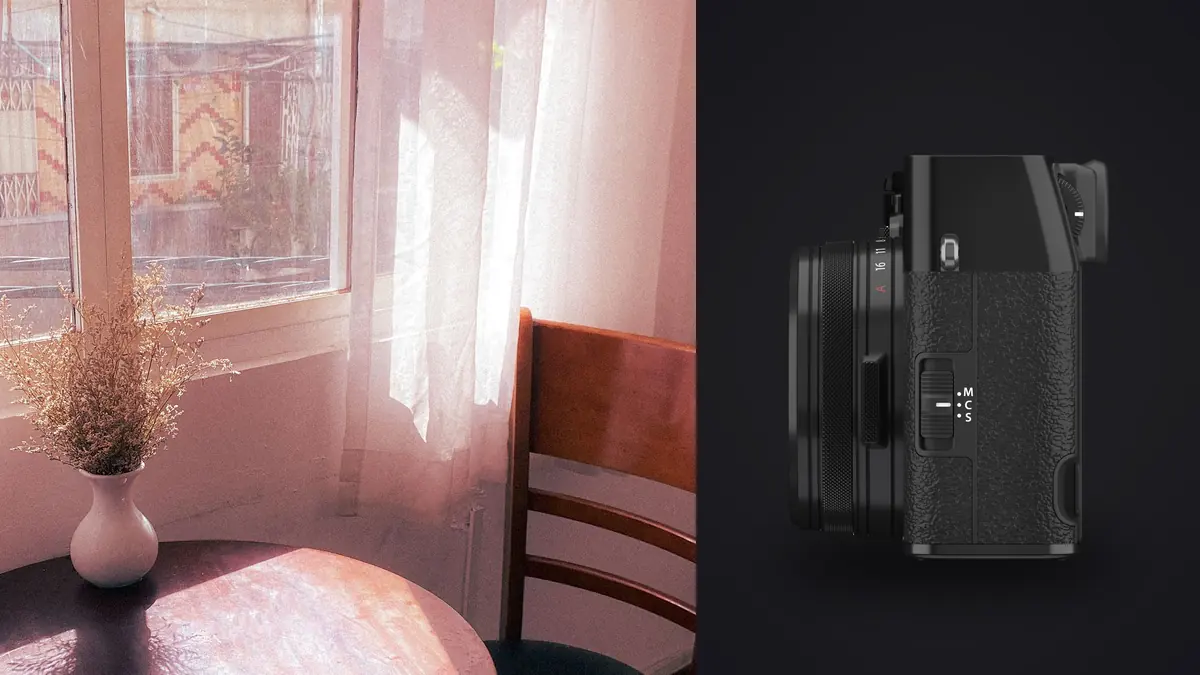
The Fujifilm X100VI does not let a portrait photographer solve a cramped room by changing lenses. Its fixed 23mm f/2 lens gives an angle of view similar to a 35mm lens on full frame, so camera distance, wall clearance, mirrors, and the amount of environment in the frame must be planned before the subject arrives. That constraint can support intimate environmental portraits, but it is not a shortcut to every close beauty crop.
This Lens and Location Guide treats the fixed lens as the starting point for boudoir location selection. It covers room depth, flattering working distance, window direction, privacy, conversion and crop choices, leaf-shutter lighting, and secure local review. The emphasis is a calm, consent-led set in which the camera never dictates an uncomfortable pose or boundary.
Choose a room for the 23mm lens, not for decor alone
A beautiful bed, window, or wall can fail if there is nowhere to stand. Measure the distance from likely subject positions to the opposite wall, then subtract space for furniture, a light, a reflector, and a safe walking lane. The camera often needs to move farther back than expected for a full-length vertical, especially when the subject extends an arm or leg toward the edge.
Photograph the empty room from X100VI height with the final delivery crops overlaid. Check whether the frame includes unwanted ceiling, floor, doorways, alarms, vents, and reflective surfaces. A wider environmental view can be intentional, but hiding a cramped room through severe cropping leaves little flexibility and may exaggerate the nearest body parts.
Favor locations with multiple clear sight lines instead of many small decorative corners. One wall with controllable light, a bed that can be approached from two sides, and a chair with background separation can produce more coherent coverage than a suite packed with immovable furniture. Confirm what may be moved and who must restore it.
| Feature | Opportunity | Check before booking |
|---|---|---|
| Large window | Directional natural light and reflections | Opposite buildings, privacy, and direct-sun timing |
| Deep room | Full-length views at a natural distance | Furniture and crew do not consume the retreat |
| Mirror | Layered composition and alternate viewpoints | Unwanted reflections and identifiable details |
| Neutral wall | Simple seated or standing portraits | Color cast, marks, and permission for contact |
| Small hotel room | Compact story and available furnishings | Commercial policy, guest privacy, and limited distance |
Use camera distance to protect proportions
Perspective is determined by camera position. Moving very close for a head-and-shoulders frame makes the nearest features appear larger relative to those farther away. Cropping a frame made from a more comfortable distance preserves that perspective, although it reduces final pixel dimensions. The X100VI's 40.2 megapixel sensor provides crop room, but delivery size and skin detail still need a representative test.
Mark a minimum close distance for faces and another for three-quarter portraits. Compare the result on a full-size monitor, not only the rear screen. If the framing requires the camera to enter the subject's personal space, choose a wider composition, crop moderately, or use a different camera system rather than normalizing discomfort.
Keep hands, feet, knees, and shoulders away from corners when they extend toward the lens. Wide-angle stretching is strongest near the frame edge. A small lateral or height change can bring limbs into a calmer region without asking for an unnatural pose.
Camera height communicates as much as distance. A low position can lengthen legs but may also reveal more ceiling or look upward into clothing. A high position changes torso and head relationships. Agree on the visual intent and subject comfort before using an angle, then show a reference frame if review is part of the consent process.
Plan full, three-quarter, and detail coverage honestly
The fixed lens is well suited to a person within a room, seated portraits, movement, and frames that include meaningful surroundings. It is less naturally suited to tight facial crops made from across a large suite. Build the shot list around what the angle of view does well rather than pretending one camera replaces a portrait kit.
Digital crop modes change framing and output, not optical perspective or physical working distance. They can help preview a tighter composition, but the source and recording behavior depend on file mode and camera settings. Confirm what is retained in RAW and what is applied only to an in-camera derivative before relying on a crop for delivery.
Fujifilm offers compatible wide and tele conversion options for the X100 system. A tele converter can produce a tighter angle without moving closer, while a wide converter needs more edge and privacy control. Verify current compatibility, frame-line behavior, focus performance, and balance for the exact accessory. An unfamiliar converter should not appear for the first time on a sensitive set.
Make detail photographs of fabric, hands, jewelry, hair, or room elements only when they belong to the agreed brief. The lens focuses close, but moving near skin or clothing changes the social distance. Explain the frame and receive a clear yes before entering that space.
Map window light and every exterior sight line
Visit at the intended hour. Direct sun can move across a bed quickly, while open shade may remain stable. Note which window gives front, side, or backlight from each set. Sheer curtains can soften light but may reveal a silhouette from outside at night. Blackout fabric changes both privacy and exposure.
Stand outside where legally possible and inspect the window from neighboring buildings, gardens, corridors, and public paths. Inside, check gaps around curtains, mirrored wardrobes, glossy televisions, glass doors, and bathroom reflections. Close or cover cameras, smart displays, and devices that are not part of the production.
Agree on who may enter the location and place a clear notice outside without identifying the nature of the shoot. Locking a fire exit is not acceptable; use a production assistant or agreed access control instead. Keep robes, water, temperature control, and a genuinely private changing area available.
Use mirrors as compositions, not surprises
A mirror doubles the sight lines in a small room. From the selected camera mark, inspect its entire surface for the photographer, assistants, lights, cases, labels, windows, and adjacent spaces. Then repeat the check from any lower or higher angle. A composition that is clean at eye level can reveal private material when the camera tilts.
Autofocus may choose the reflected face or the direct subject unpredictably. Decide which plane should be sharp and place a controlled focus area there. At f/2, the physical subject and reflection may not both fall within acceptable depth. That can be used deliberately, but it should be visible in the test rather than discovered later.
Clean only with products approved for the surface and avoid leaning equipment against glass. If a mirror includes artwork, hotel branding, security features, or identifying room details, obtain permission or compose them out before capture. Retouching is not a substitute for a privacy inspection.
Balance leaf-shutter flash with ambient light
The X100VI uses a leaf shutter in its lens, which can support flash at shutter speeds that are unusual for many focal-plane systems, subject to aperture, flash, trigger, and camera-mode limits. This can help control a bright window while keeping a small flash setup. Consult current manuals for the exact equipment and test the full range before production.
A fast shutter does not make a large modifier safe in a small room. Stands need weighted bases, clear cable routes, and enough distance from the bed or movement path. Bounce surfaces may add strong color casts. If the room cannot hold equipment safely, use window light, a handheld reflector managed by an assistant, or a simpler location.
Installed LEDs, dimmers, and decorative bulbs can flicker. Test them with the selected shutter mode and speed. Turn off sources that create unstable color unless they serve the concept, but ask before unplugging hotel or property equipment. Capture a neutral reference under each final light arrangement.
Create a consent-led shot map
Discuss wardrobe level, posing boundaries, publication channels, image-review expectations, and who will be present before the session. Consent is specific and can be withdrawn during capture. A signed release does not justify pressure, surprise poses, or publication beyond what was explained.
Organize sets from more covered and simple to more intimate only if the subject wants that progression. Build private breaks into the schedule and keep the camera down during changes. No behind-the-scenes recording should occur without separate permission, including phones used by assistants or venue staff.
- Confirm the closed set, privacy screens, and emergency access.
- Review agreed boundaries and the first wardrobe in private.
- Make a neutral standing or seated reference at the primary mark.
- Complete environmental, three-quarter, and detail frames by agreed set.
- Pause for image review only at the subject's requested intervals.
- Check the required list without proposing unapproved escalation.
- Secure cards before anyone outside the set enters the room.
Configure the compact body for calm operation
Disable unnecessary sounds, lamps, wireless connections, and automatic image display to external devices. Confirm that no phone or tablet is receiving files. Use a simple focus-area setup and a second option for mirror work. Face and eye detection can help, but it does not decide which reflection or foreground plane carries the portrait.
In-body stabilization can support slower handheld frames when the subject is still, but it cannot stop breathing, fabric movement, or a turning pose. Choose shutter speed from the subject and final output. Watch highlights on pale skin and light fabric, and inspect individual color channels under saturated room light.
Use tested SD cards with enough capacity for the agreed session. The camera has a single card slot, so there is no in-camera second copy. Make planned secure backups during breaks if the production risk calls for them, without leaving files visible on an unattended computer.
Keep private RAF files local and access controlled
Move the card directly to an encrypted, access-controlled workstation and make a verified backup according to the agreement. Restrict previews, contact sheets, and cloud synchronization unless explicitly authorized. Delete only under the retention policy and after confirming that required backups or approved deliveries are complete.
imagic desktop can scan supported RAF folders before local analysis, group similar frames, and store non-destructive culling statuses without deleting originals. Automated scores cannot interpret consent, permitted wardrobe, approved publication, or a subject's request to withhold a frame. Maintain a separate, authoritative restriction list.
Reselecting re-ranks saved scores and does not reanalyze. Check freshness and reanalyze stale photos when needed. Style application requires a learned profile, and export applies stored edits to new files rather than overwriting the RAW. Send only approved exports through the agreed delivery channel. Related methods appear under AI and Technology.
The X100VI works best for boudoir when its fixed 23mm lens is treated as an environmental portrait tool. Adequate room depth, respectful camera distance, screened windows, controlled reflections, and explicit consent make the limitation productive rather than intrusive.
Frequently Asked Questions
Is the X100VI lens too wide for boudoir portraits?
It is useful for environmental and full-to-three-quarter portraits when camera distance is controlled. Tight facial framing may require a moderate crop, a compatible converter, or another camera and lens.
Do X100VI digital crop modes change portrait perspective?
No. Perspective comes from camera position, while a digital crop narrows the recorded or previewed frame. Confirm how the selected file mode handles the crop before delivery.
Why does room depth matter with a fixed lens?
Depth provides enough retreat for full-length framing without moving the camera uncomfortably close or forcing limbs into the edges. It also leaves safe space for light, movement, and privacy control.