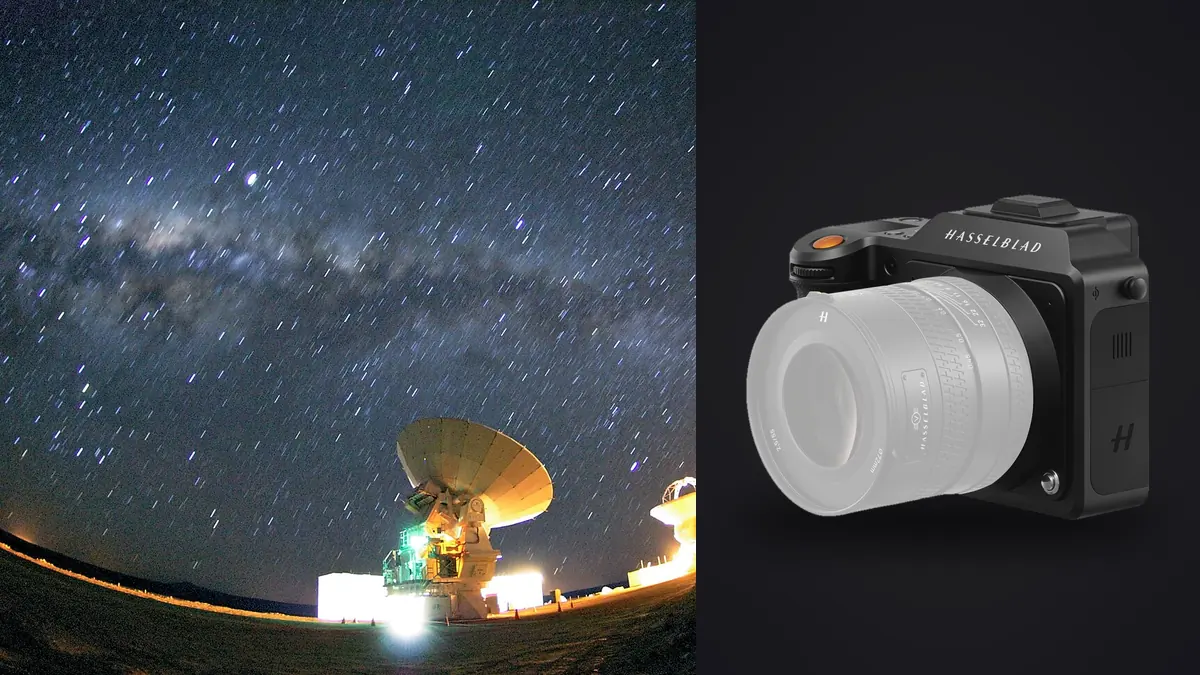
The Hasselblad X2D 100C was not designed with astrophotography in mind. Hasselblad builds it for studio and landscape work, for photographers who want 16-bit color depth and a sensor big enough to print a billboard from a single frame. Nobody at the company was thinking about star trails or dark frame subtraction when they spec'd it. And yet I keep bringing mine out to dark sky sites, because the parts of this camera that make it strange for everyday work (the enormous sensor, the total absence of a mechanical shutter, the color science) turn out to matter a lot once the sun goes down.
This isn't a camera I'd recommend to someone starting out in night photography. It's expensive, it's heavy, and it lacks features that a $1,200 mirrorless body has had for a decade. But if you already own one for other work and you're curious whether it holds up under a Milky Way core, or you're weighing it against a dedicated astro-modified body, here's what actually happens when you point it at the sky.
A Medium Format Body That Wasn't Built For This
Start with the sensor. The X2D 100C uses a 100-megapixel CMOS sensor measuring 43.8 by 32.9mm, noticeably larger than full frame (36 x 24mm). That extra area doesn't automatically mean better star images. What matters more is the pixel pitch, which lands around 3.76 microns, the same spacing used on several 60-plus megapixel full-frame sensors. In practice this means the X2D resolves fine star fields with enormous detail, but it also inherits the downside of high pixel density: every bit of tracking error, wind-induced vibration, or focus drift shows up clearly at 100 percent. A star that looks like a clean point on a 24-megapixel body can show a visible smear on this sensor at the same focal length and shutter speed.
The bigger structural difference is the shutter. The X2D 100C has no mechanical focal-plane shutter at all. Every exposure is read electronically off the sensor. For daylight work this mostly shows up as rolling shutter risk with fast motion, which doesn't matter for a fixed tripod at night. For astro work it's a real advantage: there's no shutter shock to worry about, no mirror slap, nothing mechanical to introduce vibration during a 20 or 30 second exposure. Exposures start and stop electrically clean, which matters more than people expect once you're chasing pinpoint stars at 100 megapixels.
Base ISO is 64, and Hasselblad's Natural Colour Solution profiling does something genuinely useful for nightscapes: it holds onto subtle color separation in the sky gradient, the transition from deep blue near the horizon to near-black overhead, better than most cameras I've used for this. Airglow, which shows up as faint green and magenta bands across a dark sky camera roll, is visible in single frames here in a way it usually isn't unless you're already stacking.
Where It Falls Short of a Dedicated Astro Setup
None of that changes the fact that this camera is missing tools that dedicated night photographers rely on. There's no built-in intervalometer worth using for a long stacking sequence. Hasselblad expects you to tether to Phocus Mobile 2 over Bluetooth or Wi-Fi for interval work, and in the field, at a dark site with your phone in airplane mode to save battery and avoid stray light from the screen, that's an awkward workflow. Most nights I end up using an external intervalometer cable through the camera's port instead, which works fine but adds one more piece of gear to keep charged and tracked.
Battery life is the other real constraint. CIPA rates the X2D battery modestly to begin with, and cold nights at altitude cut that further. A full stacking session for a Milky Way panorama, say 40 to 60 frames plus calibration frames, will often burn through a battery and a half once you factor in the rear screen staying on for focus checks between subs. I carry three batteries now for any planned overnight session, which is not something I'd have said about my old full-frame body.
There's also no in-camera long-exposure noise reduction mode that's actually usable for stacking, and that's fine. You don't want the camera doing automatic dark frame subtraction when you're planning to do it manually in stacking software anyway. But it means every session requires you to remember to shoot your own darks with the lens cap on at matching ISO, temperature, and shutter speed, since the camera won't prompt you or do it for you.
Lens Choice and How Long You Can Actually Expose
Because the X2D's sensor is bigger than full frame, the same focal length in millimeters produces a wider field of view than it would on a 35mm body. The rough conversion factor is 0.79x, so a 55mm XCD lens frames roughly like a 43mm lens would on full frame. That matters for star trailing math too, because trailing depends on the actual focal length and the sensor's angular resolution per pixel, not the full-frame-equivalent number people usually quote.
Here's what I've settled on after a few dozen nights out with three lenses, checking stars at 100 percent crop rather than trusting a formula:
| Lens | Actual focal length | Full-frame equivalent | Max clean exposure (static tripod) | Field note |
|---|---|---|---|---|
| XCD 21mm f/4 | 21mm | ~17mm | 14 sec | Widest field, but f/4 forces high ISO for Milky Way core detail |
| XCD 30mm f/3.5 | 30mm | ~24mm | 10 sec | Good balance of coverage and speed for foreground-inclusive shots |
| XCD 38V f/2.5 | 38mm | ~30mm | 8 sec | My default for Milky Way work, fastest usable aperture in the line |
| XCD 55V f/2.5 | 55mm | ~43mm | 5 sec | Tight enough that a star tracker stops being optional |
Those numbers are conservative, based on what holds up at full resolution rather than what looks fine shrunk down for social media. Push past them and you'll still get usable images if you're downsizing for a print or a web post, but if you're stacking for a large final print, trailing that's invisible at 25 percent becomes obvious once you're layering a dozen frames and sharpening the result.
At f/2.5 to f/4, none of the XCD lenses are what I'd call fast glass by astro standards. A dedicated wide-angle astro lens at f/1.4 or f/1.8 lets you cut exposure time or ISO substantially. The tradeoff is that XCD glass is sharp into the corners at wide apertures in a way a lot of cheap fast primes aren't, so a stack of slightly noisier frames from the X2D can still out-resolve a single cleaner frame from a soft lens once you're pixel peeping the final composite.
Building the Actual Stack
The X2D writes 3FR raw files, and it's worth knowing before you commit to a night of shooting that Hasselblad's own tools are basically nonexistent for this. Phocus handles single-frame development well, including reasonably good noise reduction on individual subs, but it isn't a stacking application. For the actual alignment and stacking of the sky I export as 16-bit TIFF and run everything through Sequator or Starry Landscape Stacker, depending on whether I'm separating a static foreground from the sky. For deep sky targets shot on a tracker, PixInsight handles the 3FR files fine after a DNG conversion, though the file sizes make the initial registration pass noticeably slower than it would be on smaller full-frame raws.
File size is the practical headache nobody warns you about going in. A single compressed 3FR from the X2D runs somewhere between 90 and 120MB depending on scene complexity. A stacking session with 40 light frames, 15 darks, 10 flats, and a handful of bias frames adds up to 6 to 8GB before you've exported a single TIFF. Across a four-night trip that's routinely 30GB of raw files on top of whatever other work is already sitting on the camera's internal 1TB SSD. I've had to offload mid-trip more than once, at a campsite with no signal, which is where something that runs entirely on the laptop without needing to upload anywhere actually matters. I use imagic for that part now: it scores sharpness locally across the batch, which is useful for flagging subs that got knocked soft by wind or a tracker hiccup before they go into the stack (worth reading how that local scoring actually works if you're curious), and it clusters near-identical frames from bracketed sequences so I'm not scrolling through 60 nearly identical thumbnails by hand at 2am. A lot of the general habits that speed up any high-volume shoot carry over directly to a night session like this, and it's worth reviewing general workflow habits even if most of them were written with daytime shoots in mind.
Once the stack is assembled and I'm back to normal editing on the blended composite, the other place imagic earns its spot in the workflow is consistency across a season's worth of nightscape edits. I trained its apply_my_style preset on a batch of my own past Milky Way edits, the color balance I tend to land on for the core, how much I usually pull back the horizon glow, and it saves a step when I'm working through a folder of similar compositions from different nights rather than rebuilding the same grade by hand each time.
Is It Worth Carrying Into the Field for This
If you already own the X2D 100C for portrait, product, or landscape work and you're wondering whether it's worth the extra pack weight on a dark sky trip, my honest answer is yes, but bring a second, lighter body if the hike in is long. The image quality once you're through the stacking pipeline is genuinely excellent, more resolution and cleaner color than you need for most output sizes, and the electronic shutter's total lack of vibration is a real, if underrated, advantage over cameras with mechanical shutters left in electronic first-curtain mode.
What it isn't is a convenient astro camera. There's no dedicated astro mode, no built-in intervalometer worth trusting on its own, mediocre battery life in the cold, and a body and lens kit that will run well into five figures before you've bought a tracker. If your goal is simply the best star images per dollar, a used full-frame body with a fast wide prime and an equatorial mount will get you further, faster, for a fraction of the cost. The X2D makes sense specifically for photographers who already have the system, understand its quirks from daytime work, and want to push the same color and resolution into a genre it wasn't built for.
Frequently Asked Questions
Does the Hasselblad X2D 100C need a star tracker for good results?
Not for wide-field Milky Way shots at 21mm to 38mm, where a static tripod and a stacked sequence of 8 to 14 second exposures produces a clean result. Once you're working at 55mm or longer, or shooting a genuine deep sky target like a nebula rather than a wide nightscape, the pixel density on this sensor makes trailing obvious quickly, and a tracking mount becomes close to mandatory.
How many frames should I stack for a typical Milky Way session with this camera?
Somewhere between 15 and 40 light frames is a reasonable range for most wide-field work, matched with 10 to 15 dark frames shot at the same ISO and shutter speed with the lens capped. More frames reduce noise further, but given the file sizes involved, I've found returns flatten out past about 30 lights for a typical nightscape rather than a dedicated deep sky target.
Is the lack of a mechanical shutter a problem for long exposures?
No, it's actually a benefit. Without a mechanical shutter there's no shutter shock to introduce blur during the exposure, which matters more than usual given how easily this sensor's resolution reveals any vibration. The tradeoff shows up elsewhere, in battery drain and heat management during very long single exposures, not in exposure quality itself.
Can I shoot bulb exposures longer than 60 seconds directly from the camera body?
You can, but the in-camera controls for extended bulb exposures are limited compared to dedicated intervalometer-equipped bodies. Most nights I'm using an external remote release or tethering through Phocus Mobile 2 to run a proper sequence, rather than relying on the camera's native long-exposure controls alone.