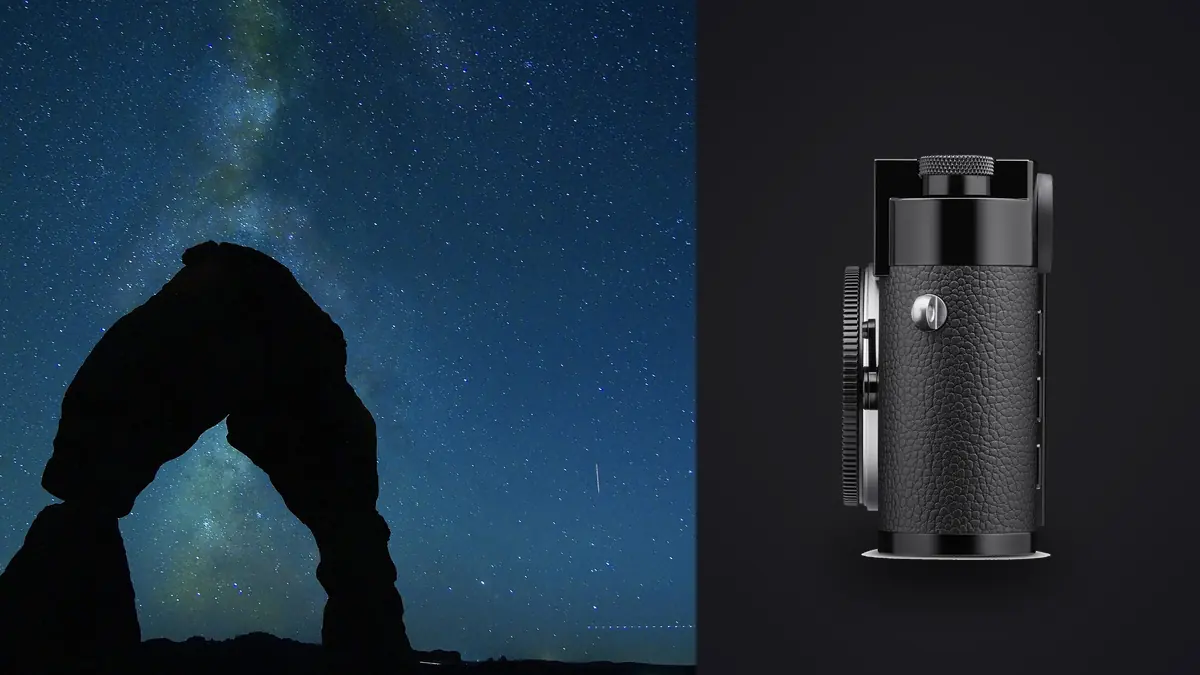
The Leica M11 is not a camera anyone would design from scratch for astrophotography. No autofocus, no in-body stabilization, and a rangefinder focusing system built around split-image coincidence that becomes close to useless once the thing you're trying to focus on is a point of light several hundred light-years away. And yet a fair number of M-mount owners end up pointing their M11 at the sky anyway, usually because it's the camera already in the bag on a clear night, not because anyone specifically recommended it for the job.
I've run enough stacked sequences through this particular body, mostly on the west coast of Ireland with a couple of trips to Chile thrown in, to have real opinions about where it holds up and where it just makes an already fiddly process more annoying. This isn't a spec rundown. It's what actually happens when you try to build a clean star stack with a rangefinder that was never built with this in mind.
A 60-megapixel sensor with no low-pass filter, and what that changes
The M11's sensor is a 60-megapixel BSI CMOS unit with no anti-aliasing filter, which is a genuinely good combination for pulling fine detail out of a Milky Way core or a well-lit foreground ridge line. What it isn't automatically good at is high ISO cleanliness, because more megapixels on a full-frame sensor means smaller photosites, and smaller photosites mean more per-pixel noise before any processing happens.
Leica built the M11 around a dual gain sensor design, so noise doesn't scale in a straight line as you push ISO up. There's a point in the ISO range where the second gain stage takes over and shadow noise actually gets a bit better rather than worse, which matters for star stacking because you're deliberately underexposing individual frames and relying on the stack to build up signal. In practice I stopped trying to shoot astro at base ISO 64 on this camera years ago. It's clean, but it forces exposure times long enough that stars trail badly on a static tripod, and I'd rather shoot at ISO 3200 to 6400 with more frames than chase a base-ISO number that doesn't actually serve the technique.
The other thing worth knowing is the triple resolution DNG system. The M11 can output the native 60-megapixel file, or downsample in-camera to 36 or 18 megapixels. This isn't sensor-level pixel binning, it's an in-camera reprocessing step on the same 60MP capture, but the 36MP files do come out visibly cleaner at higher ISO and are roughly half the file size. For a 30 to 50 frame stack, shooting in 36MP mode saves real disk space and stacking time without giving up meaningful resolution once you've combined the frames and downsampled for output anyway.
Focusing on stars without the rangefinder patch
Why the coincidence patch doesn't help you here
The rangefinder mechanism that makes the M-series fast to focus in daylight is close to worthless at night. The coincidence patch needs contrast and brightness to register a shift, and a star is neither bright enough nor large enough in the frame to give you a usable double image most nights, especially through a hazy sky or with any moon glow at all. I've tried it on Jupiter and a handful of first-magnitude stars and gotten it to work occasionally, but I wouldn't build a workflow around it.
What actually works instead
The practical approach is the rear screen or an accessory EVF (I use a Visoflex 2), magnified 5x or 10x, with focus peaking turned on. Point at the brightest star you can find, zoom in digitally, and turn the focus ring until the peaking highlight snaps onto the point of light. It's slower than daylight rangefinder focusing but it's reliable, and it's the same basic technique you'd use on any mirrorless body at night.
A faster starting point is the distance scale engraved on most M lenses. Set the ring to the infinity hard stop, then fine-tune from there using live view magnification on a star, rather than hunting for infinity from scratch in the dark. All-metal M lenses also creep slightly as the barrel contracts in cold air, so on a long stacking session I'll recheck focus every 20 to 30 minutes rather than trusting a lock set at the start of the night. I've lost entire stacks to a half-stop of focus drift that only became obvious once I was looking at frame 40 next to frame 4 at 100%.
Lenses that actually make sense on this body
Wide and fast is the general rule for star fields, but a few M-mount options are better suited to the M11's resolution than others.
The Leica Summilux-M 21mm f/1.4 ASPH is the lens I reach for most. Coma is visible in the corners wide open on a 60-megapixel sensor, more than it ever was obvious on lower-resolution M bodies, but stopping down to f/2 cleans most of it up while still gathering enough light to keep exposure times reasonable. The Super-Elmar-M 21mm f/3.4 ASPH is smaller and lighter if you're hiking to a site, but the slower aperture pushes you toward longer exposures or higher ISO to compensate, which matters more on this sensor than it would on a lower-megapixel one.
For something wider, the Voigtlander Super Wide-Heliar 15mm f/4.5 is sharp across the frame and cheap relative to the Leica glass, but f/4.5 is slow enough that you're either stacking a lot more frames or accepting more noise per frame. I'd avoid the ultra-wide, ultra-slow options like a 12mm f/5.6 for anything beyond a wide nightscape with a lit foreground. At f/5.6 you're pushing ISO high enough that the extra field of view stops paying for itself once you look at the noise floor.
Exposure limits at 60 megapixels
Here's the part that surprises people coming from lower-resolution cameras: the old "500 rule" for star trails doesn't hold up on a 60-megapixel sensor. A point source that looks sharp at 24 megapixels will show visible trailing at 100% on the M11's files well before the 500-rule number would suggest, simply because you're resolving finer detail and any drift becomes more apparent.
The table below uses the M11's actual pixel pitch (around 3.8 microns at full 60MP resolution) run through the standard NPF calculation for a target near the celestial equator, checked at 100% on screen. Treat these as a starting point, not gospel. Declination, how far you're willing to crop or downsample, and how forgiving you are about trailing at the pixel level will all shift these numbers.
| Lens (M-mount) | Focal length | Max aperture | Single-frame limit* | Suggested ISO | Frames for ~4 min stack |
|---|---|---|---|---|---|
| Voigtlander Nokton 35mm f/1.4 | 35mm | f/1.4 | ~4.6s | 1600-3200 | ~50 |
| Summilux-M 24mm f/1.4 ASPH | 24mm | f/1.4 | ~6.8s | 2500-5000 | ~35 |
| Summilux-M 21mm f/1.4 ASPH | 21mm | f/1.4 | ~7.7s | 3200-6400 | ~30 |
| Super-Elmar-M 21mm f/3.4 ASPH | 21mm | f/3.4 | ~11s | 6400-12500 | ~22 |
| Voigtlander Super Wide-Heliar 15mm f/4.5 | 15mm | f/4.5 | ~18s | 6400-12500 | ~13 |
| Voigtlander Ultra Wide-Heliar 12mm f/5.6 | 12mm | f/5.6 | ~26s | 12500-25000 | ~9 |
*Approximate before visible star trailing at 100% on screen, based on the M11's native pixel pitch. Real-world tolerance varies with target declination and output size.
The pattern that jumps out: on this sensor, the fast wide primes buy you more total frames per unit of sky time, not just a wider aperture. More frames per stack generally means better noise reduction once you combine them, so the faster glass earns its keep twice over here.
The M11 doesn't have a real intervalometer, and that's the actual problem
This is the thing that trips people up more than focusing or exposure math combined. The M11 has no built-in interval shooting mode in its own menu system, and no standard remote port for a third-party intervalometer. The shutter button does still accept a screw-in mechanical cable release, the traditional Leica way, but that's a single-shot tool, not something that fires a sequence of exposures on a timer.
Leica's FOTOS app can trigger the shutter over Bluetooth or Wi-Fi from a phone and has a basic interval function buried in its settings, which is the closest thing to a real solution. The catch is that Bluetooth connections get flaky in cold weather, and I've had the app drop the connection mid-stack more than once, usually somewhere around frame 20 of 30, which is exactly when you don't want to notice. On more than one night I've given up on the app entirely and just sat there pressing the shutter button by hand every 8 to 12 seconds for half an hour with a stopwatch running. It works. It's also the single biggest practical argument against the M11 as a dedicated astro body if you're comparing it against anything with a proper built-in intervalometer.
Getting fifty sub-frames home and actually usable
A single stacking session at one composition can easily produce 30 to 50 raw sub-frames, and a night out usually means two or three compositions, so you come home with a couple hundred nearly identical 60MP DNGs. Reviewing that by eye, one at a time, is where a lot of astro sessions quietly die on the memory card.
This is where I actually use imagic rather than just Lightroom's grid view. Its local sharpness scoring will flag exactly where focus drifted partway through a long sequence, which shows up as a visible step change in the score partway through a stack rather than something you'd catch by eyeballing 40 thumbnails. Because the scoring runs entirely on-device, it works fine at a dark-sky site with no signal, which matters more than it sounds like it should when you're three hours from the nearest town. The duplicate and burst clustering also groups those near-identical sub-frames together automatically, so you're reviewing five clusters instead of scrolling through fifty visually indistinguishable exposures one by one. If you haven't looked at how that scoring actually works under the hood, this breakdown of AI photo culling covers the mechanics in more depth than I will here.
Once I've picked the cleanest subs and run them through DeepSkyStacker or Sequator (imagic doesn't do the stacking math itself, it's a culling and organizing tool, not a stacking engine), and blended the stacked sky with a separately exposed foreground in Photoshop, I bring the finished composites back into imagic and run apply_my_style across the batch. That's the feature trained on my own past edits, and it saves re-grading five or six finished nightscapes from a trip one at a time so they land somewhere consistent with the rest of my portfolio instead of each one drifting slightly warmer or cooler depending on how tired I was at 2am when I finished it. For anyone whose astro sessions are eating their whole weekend in post rather than in the field, these workflow tips are a decent starting point for clawing some of that time back.
Cold, dew, and batteries
Neither the M11 nor the M11-P carry an official IP rating, and while Leica has quietly improved sealing generation over generation, I wouldn't treat either as weatherproof on a damp night. Dew forms fast on the small filter threads of most M lenses once the air cools, faster than I expected coming from bigger DSLR-mount glass, so a thin dew band around the lens barrel earns its place in the bag on any night with high humidity.
Battery life is the other quiet cost. Leica rates the BP-SCL7 around 700 shots CIPA, but that number falls off hard in cold weather and with the rear screen running continuously for focus checks, which is exactly the use pattern star stacking demands. I generally see something closer to 250 to 300 shots on a genuinely cold night once you factor in live view time between frames. USB-C charging is the one real convenience here: a phone power bank in an inside jacket pocket with a cable running to the camera keeps a session going well past what the battery alone would manage, and it's a lot less fuss than swapping cold, sluggish spare batteries with gloves on.
Frequently Asked Questions
Do you need a star tracker to get good stacks with the Leica M11?
Not strictly, but it changes what "good" means. Without a tracker you're limited to the short single-frame exposures in the table above, which caps how much signal any one frame contributes and pushes you toward higher ISO and more frames to compensate. A basic tracker lets you run 60 to 120 second subs at low ISO instead, which is a meaningfully cleaner starting point. I shoot untracked most of the time simply because I'm usually out for landscape work first and astro second, and a tracker head is one more thing to carry and align in the dark.
Does the 60-megapixel file size make stacking software slower or harder to use?
It adds real time. A 40-frame stack of full-resolution 60MP DNGs is a noticeably heavier job for DeepSkyStacker or Sequator than the same stack from a 24MP body, both in alignment time and RAM usage. Shooting in the M11's 36MP triple-resolution mode for astro sequences specifically cuts that overhead close to in half without a meaningful loss in final detail once the stack is combined and downsampled for output.
Can you use the M11's electronic shutter for star stacking instead of the mechanical one?
You can, and for exposures under a few seconds it makes no practical difference since there's nothing moving in the frame fast enough for rolling shutter artifacts to matter. I still default to the mechanical shutter out of habit more than necessity, mostly because it's one less variable to think about when I'm already juggling focus checks and manual interval timing.
Is the M11-P worth choosing over the standard M11 specifically for astro work?
Not for the reasons that matter here. The M11-P's headline differences are content credentials and a different top plate finish, neither of which changes focusing, exposure limits, or the intervalometer situation. If you already own an M11, there's no astro-specific reason to upgrade to the P variant.
None of this makes the M11 the obvious choice for star stacking. It makes it a workable one if you already own the lenses and don't mind doing the interval timing by hand. The nights it's paid off for me have mostly been the ones where the rest of the kit was already in the bag for a landscape trip anyway, and the sky just happened to cooperate.