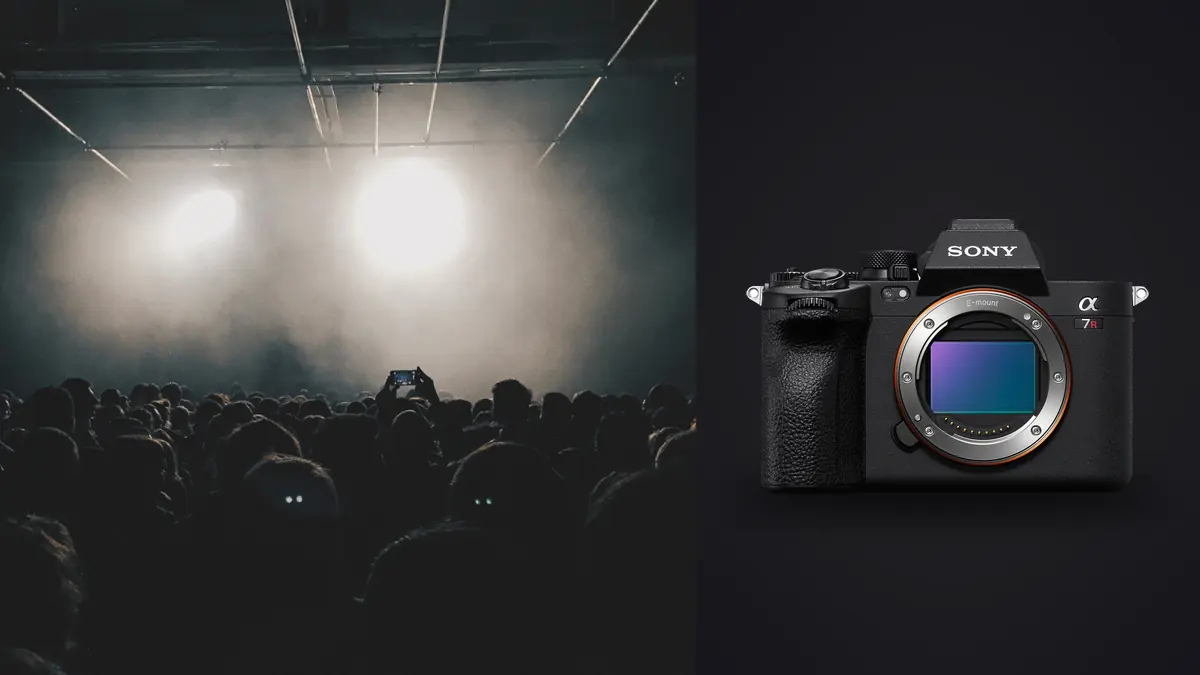
I picked up the Sony A7R V mostly for portrait and product work, but it's the camera that's been living in my bag for photo pit calls for the better part of two years now. That surprised me. A 61-megapixel body is not the obvious choice for a genre where you're often shooting three songs of chaotic, fast-changing light with zero chance to reshoot anything. Most working concert photographers I know reach for something built around speed and buffer depth first, resolution second. But the A7R V has quirks that make it genuinely useful in a pit, and quirks that make it a pain, and I want to lay out both honestly rather than write the usual "does everything well" review.
Why a high-resolution body even makes sense for live music
The case for resolution in concert photography isn't really about giant prints. It's about pit distance. Most photo pits put you three to five meters back from the stage, behind a barrier, often with a monitor wedge or a security guard's shoulder in your first two feet of frame. A 24-70mm lens at the wide end is useless from that position for a tight vocal shot, and not everyone can afford, or wants to carry, a 200mm prime into a three-band bill. What I actually do is shoot a little wider than I'd like and crop hard in post. At 61 megapixels, a 50% crop still leaves you with a 15-megapixel file, which is plenty for a magazine spread or a full-bleed social post. On my old 24-megapixel body, that same crop left me with a file too soft to sell. That's the entire pitch for me: reach without another lens.
The trade-off is obvious and I won't pretend it isn't real. Files out of this camera run 60 to 120 megabytes in compressed RAW depending on scene complexity, and a three-song set at even a modest 6 frames per second across three bands fills a card fast. I've had 160GB CFexpress cards hit their limit mid-headliner. If you're the type of shooter who holds the shutter down through a chorus, budget accordingly.
Autofocus in the dark: better than the spec sheet suggests, worse than the marketing implies
Sony's AI-driven subject recognition, which uses a dedicated processing unit separate from the main image processor, is the single biggest reason I trust this camera in a pit at all. It tracks a human subject through backlighting, hair flips, and a singer spinning away from camera in a way my older a7 III simply could not. Eye AF holds on a face through strobes more often than not, and when a singer turns their back to the crowd, the system will often pick up on shoulder and head shape well enough to keep tracking instead of hunting.
Where it struggles: guitarists. A guitar headstock moving in front of a face confuses the tracking box more than you'd expect, and drummers behind a kit with sticks flying are still the hardest subject in live music for any autofocus system, this one included. I've also had it lock onto a drum tech's face in the shadows behind the kit instead of the drummer under a hot spotlight, which tells you the recognition model is genuinely evaluating faces rather than just contrast, for better and worse.
Low-light AF sensitivity is rated down to -4 EV with a fast lens, and in practice that holds up in club-sized venues lit only by a couple of LED pars. Where it falls apart is total blackout into a single spotlight, the kind of lighting cue a lot of bands use for a ballad. In that scenario I stop trusting continuous AF entirely and go back to manual pre-focus on a mic stand position, which is a technique that predates autofocus by decades and still works better than any algorithm when the light drops to almost nothing.
Rolling shutter and the flicker problem nobody warns you about
The electronic shutter on the A7R V is fully silent, which matters more than people think. I shoot a lot of seated theater shows and acoustic sets where a mechanical shutter clacking away through a quiet verse gets you a dirty look from the front row, or worse, a talking-to from a tour manager. Silent shooting is the right call there. But readout speed on a 61-megapixel sensor is not fast, and under moving LED video walls or fast-strobing par cans, electronic shutter will absolutely give you banding or a skewed frame if a mover swings mid-exposure. I default to mechanical shutter the moment a show has any kind of LED wall or heavy strobe rig, and only drop to silent for quiet, static-lit sets.
The anti-flicker shooting mode helps with a different, more common problem: modern LED stage lighting pulses at a frequency that can create exposure banding across a burst even at a fast shutter speed. Turning it on adds a slight, sometimes noticeable shutter lag while the camera times its exposure to the light source, but for burst sequences under LED-heavy rigs it's worth the trade. I leave it on as a default now and only switch it off for tungsten-lit rooms where flicker isn't a factor.
How it stacks up against the other bodies actually showing up in the pit
I shoot alongside a rotating cast of other photographers most weekends, and this is roughly what's showing up on straps around me lately.
| Body | Resolution | Max continuous shooting | Low-light AF rating | Typical pit verdict |
|---|---|---|---|---|
| Sony A7R V | 61MP | 10 fps (mechanical & electronic) | -4 EV | Best reach for tight crops, heaviest files |
| Sony A7 IV | 33MP | 10 fps | -4 EV | Closest balance of file size and detail |
| Sony A9 II | 24MP | 20 fps electronic | -3 EV | Built for speed, weakest for tight crops |
| Nikon Z8 | 45MP | 20 fps (raw) | -9 EV (rated) | Strong all-rounder, punchier low-light claim |
The honest read: if you're shooting three photos-only songs from a fixed pit position and selling to press or the band's socials, the A9 II or a Z8 will get you more usable frames per second and smaller files to manage. The A7R V earns its keep specifically when you can't get physically closer to the stage and need to crop your way to a usable frame, or when the same body has to double as your portrait and product camera during the day. I use mine because I do both kinds of work in the same week, not because it's objectively the best pit camera on paper.
Glass that actually pairs with this body in a pit
A 61-megapixel sensor is unforgiving of soft glass, which rules out a lot of the older or budget zooms that get people through their first few gigs. What's lived on my body for most shows: a 24-70mm f/2.8 GM II for wide stage shots and full-band frames, and a 70-200mm f/2.8 GM II for the tight vocal and guitar-face shots that pit distance usually demands. For clubs where I can get right up against the barrier, an 85mm f/1.4 prime earns its spot for shallow, moody single-subject frames between the wider zoom shots. I've tried a 1.4x teleconverter on the 70-200 for arena work where the pit sits further back, and it's usable, but autofocus speed drops enough in low light that I only reach for it when the venue genuinely won't let me get closer.
Settings I actually dial in by venue size
| Venue type | Typical light level | Shutter speed | Aperture | ISO range |
|---|---|---|---|---|
| Small club | Dim, often single-color wash | 1/250 - 1/400 | f/1.4 - f/2.8 | 3200 - 12800 |
| Mid-size theater | Mixed LED, moving heads | 1/400 - 1/640 | f/2.8 | 1600 - 6400 |
| Arena | Bright, fast-changing rig | 1/500 - 1/1000 | f/2.8 - f/4 | 800 - 3200 |
| Outdoor festival, daylight set | Full sun | 1/1000+ | f/4 - f/5.6 | 100 - 400 |
I shoot aperture priority with auto ISO capped at 12800 for club work, and I'm honest with myself that anything past 6400 on this sensor needs real noise reduction in post to hold up at full resolution. Downsampled for web use, high ISO frames look far better than they have any right to, which is another quiet argument for the extra megapixels.
What happens after the last song ends
Three songs, three bands, one photographer, and you can walk out of a venue with 1,200 to 1,800 frames on a busy night. At 60-plus megabytes each that's an evening's worth of storage and an evening's worth of tedious scrolling if you're doing it by eye. This is the part of the job nobody glamorizes and it's where I stopped doing things manually. I run the take through imagic before I open Lightroom at all, since it scores sharpness and focus locally on my laptop (nothing leaves the machine, which matters backstage where venue wifi is either password-locked or nonexistent) and clusters the inevitable near-duplicate bursts, the ten frames of a singer mid-jump that are basically the same shot three times. That alone usually cuts a 1,500-frame pit take down to something closer to 300 real selects before I've touched a single edit. If you haven't looked at how that kind of local culling actually scores a frame, we've written more on how AI photo culling works that goes into the mechanics.
The other half of the workflow problem is speed under deadline. Some clients want a gallery live within two hours of doors closing. Cutting the culling step down from an hour of scrolling to ten minutes of confirming clusters is the difference between making that deadline and apologizing for missing it. We've covered some of the broader habits that help here too, in a rundown of workflow tips that apply whether you're shooting arenas or open mic nights.
Keeping a consistent look across a tour
Touring photographers run into a problem non-touring shooters don't: fifteen venues, fifteen different lighting rigs, and a client who expects every gallery in the series to look like it belongs to the same photographer. I trained imagic's apply_my_style feature on a batch of my own past concert edits, the contrasty, slightly desaturated look I default to for rock and heavier acts, and now new takes get that look applied automatically as a starting point rather than me rebuilding the same curve and split tone from scratch in every new venue. It's not a substitute for actually looking at each image, colored stage light still needs individual attention, but it kills the part of editing that's just repetitive muscle memory.
Frequently Asked Questions
Is the Sony A7R V actually worth taking into a photo pit, or is it overkill?
It depends on why you're shooting. If your final output is a tight edit for the band's socials or a live review, the resolution mostly gets thrown away on export and a lighter, faster body will serve you better. If you're selling large usage, shooting for print, or regularly stuck further from the stage than you'd like, the extra resolution buys you cropping room that a lower-megapixel body can't recover.
Does the high megapixel count hurt low-light image quality compared to a 24MP body?
Per pixel, yes, noise shows up earlier at high ISO than it does on a lower-resolution sensor of the same generation. But once you downsample a 61-megapixel file to web or even a moderate print size, the extra resolution effectively averages that noise out, and in my side-by-side tests the final output holds up close to a 24-megapixel file at the same ISO once both are scaled to the same output size.
Should I shoot mechanical or electronic shutter for a show with a lot of moving lights?
Mechanical, almost every time a rig has moving heads, strobes, or an LED video wall. Electronic shutter's slower sensor readout on this body means a real risk of banding or skew under fast-changing light. Save silent electronic shutter for quiet, static-lit sets like seated acoustic shows where the sound of a mechanical shutter would actually be a problem.
What's the realistic buffer and storage situation for a full night of pit work?
Expect 60 to 120 megabyte compressed RAW files depending on scene detail. A 10 fps burst through a three-song set for one band can eat several gigabytes in minutes, and a full multi-band bill regularly runs past 100GB. Fast CFexpress Type A cards clear the buffer quickly enough that I haven't hit a shooting-stopping bottleneck, but I've absolutely hit card capacity limits mid-show and had to swap cards between bands.