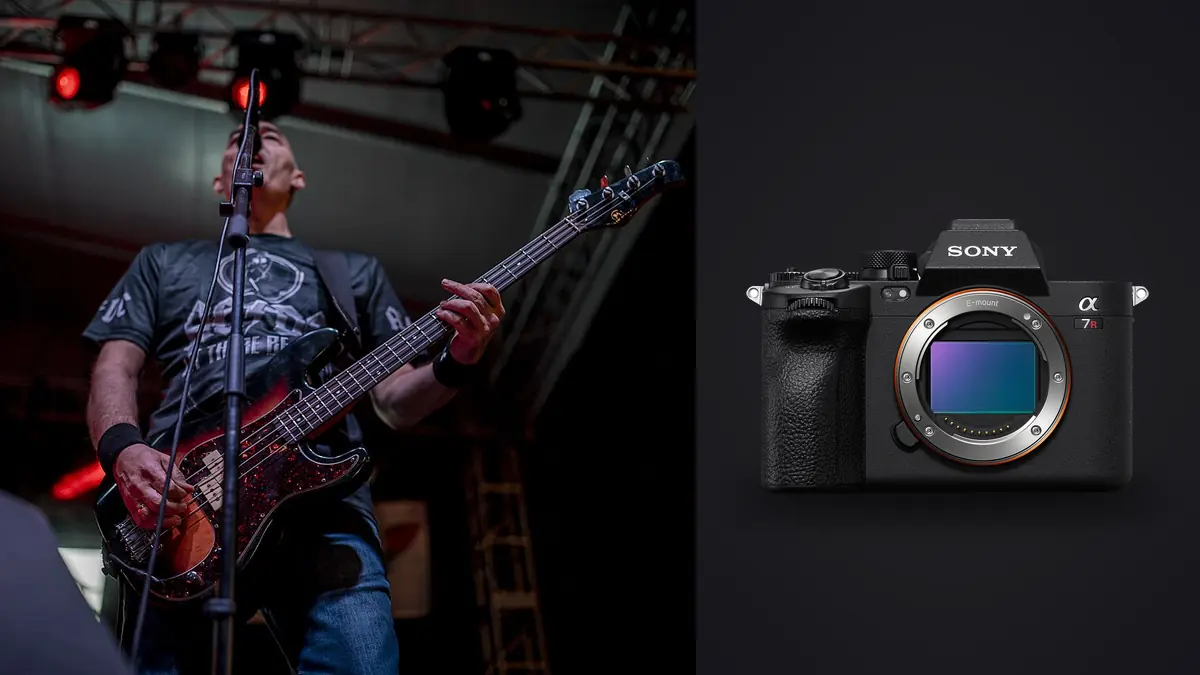
The first time I brought a Sony A7R V into a photo pit, I almost didn't. A 61-megapixel body built around landscape and studio resolution felt like the wrong tool for three songs of chaos under moving lights, security shoving photographers back from the barrier at the two-minute mark. I'd shot the previous tour on an A9 II and expected the R V to feel sluggish and fragile by comparison. It didn't, but it also didn't behave like a sports camera pretending to be one, and that distinction matters if you're deciding whether to bring this body to a show.
This isn't a spec sheet regurgitation. It's what actually happens when you point a high-resolution, non-stacked-sensor body at a stage full of moving heads, strobes, haze, and a singer who won't stop jumping.
Why this camera even comes up for concert work
The A7R V wasn't designed for photo pits. Sony built it for people who need resolution: architecture, product, landscape, portrait work destined for large prints. What changed my mind about using it for live music wasn't the sensor, it was the autofocus system Sony carried over from the A1 and A7 IV generation, plus the processing unit that runs subject recognition independently of the main image chip. That combination means the R V tracks a moving face about as confidently as bodies with far lower resolution and far higher price tags, even when a follow spot is blasting the singer from one side and leaving the other half of their face in shadow.
The other reason it comes up: touring photographers who also shoot behind-the-scenes stills, tour books, or vinyl/merch photography don't want two camera systems. A body that can do a passable job in the pit and then produce genuinely large, clean files for a gatefold print the next morning has real appeal, even with the tradeoffs I'm about to get into.
The resolution question, honestly answered
Sixty-one megapixels sounds like overkill for a photo you'll crop to a 2000-pixel web image for a festival recap gallery. In practice it solves a specific pit problem: barrier distance. Some venues let you get close enough to fill the frame with a 70-200mm. Plenty of others put the barrier ten or twelve feet back from the stage, or the artist stays on a riser at the rear for half the set, and suddenly your 200mm reach isn't enough. Having 61 megapixels of real detail means you can crop a mid-stage shot down to a tight portrait crop and still deliver a file with usable resolution for print or a full-bleed magazine spread. On the A9 II, that same crop leaves you with a file too soft to sell.
The tradeoff is obvious and worth saying plainly: bigger files mean slower buffer clearing, slower card writes, and a much heavier culling job at 1am after a four-band bill. That's the main reason I now run every card through imagic before I let myself open Lightroom at all. More on that further down.
Rolling shutter and moving stage lights
This is the part most reviews skip because they're testing the camera at a press event, not a real club show with a lighting rig running full tilt. The A7R V uses the same sensor architecture as the A7R IV, not a stacked sensor like the A9-series or A1. That means the electronic shutter reads the sensor line by line rather than all at once, and under fast-moving subjects or certain LED lighting refresh rates, you can get skew (a guitar neck that looks subtly bent mid-swing) or banding (dark horizontal bars that roll through the frame from flickering house or stage lights).
In my experience this shows up in two specific situations: fast horizontal pans following a performer running across the stage while using the fully silent electronic shutter, and shooting under cheap venue-owned LED PAR cans in small clubs that flicker at frequencies the camera's anti-flicker detection doesn't fully compensate for. The camera does have built-in anti-flicker shooting, which times the shutter release to reduce banding, and it helps meaningfully at bigger venues with better-quality rigging. At a 200-cap club with house lighting from 2011, it's hit or miss.
My workaround: mechanical shutter for anything with fast lateral motion or unpredictable house lighting, electronic (silent) shutter reserved for moments where I actually need silence, like an acoustic set, a quiet intro, or venues that explicitly ban shutter noise during quieter passages.
Autofocus in the pit, not on a bench
Eye AF on this body is genuinely good at finding a face and staying locked through partial occlusion, a mic stand crossing in front of a singer's mouth, hair whipping across their eyes, a guitar headstock swinging through frame. Where it struggles is exactly where every current mirrorless camera struggles: strong backlighting from a follow spot with almost no fill on the front of the face, and rapid silhouette-to-lit transitions when a strobe pattern fires. I've had frames where the system locked confidently onto a shoulder or a piece of stage rigging for a fraction of a second when the performer's face went briefly dark. Wide tracking area with Face/Eye priority set to Human, back-button focus, and continuous AF-C is the combination I run for every set, no exceptions.
One habit that's paid off more than any menu setting: pre-focusing on the mic stand or a fixed point on stage before the artist walks out, so the very first frames of the opening song aren't a guessing game for the AF system.
ISO ceiling and what actually stays usable
Native ISO tops out at 32000, with an extended range up to 102400, but the honest usable ceiling for delivering client-ready work is lower than that. Up to about ISO 6400 the files are clean enough that noise reduction is a formality. Push to 12800 and you start seeing chroma noise creep into shadow areas, particularly in the deep blues and purples that dominate a lot of stage lighting, but it's still entirely workable with modern noise reduction. Above that, into 25600 and beyond, I only reach for it when the alternative is no shot at all, a dark support-act set with minimal lighting budget and a shutter speed I refuse to drop below 1/320 to freeze a drummer's stick work.
Because the sensor is so dense, downsampling a 61-megapixel file for web delivery hides a surprising amount of noise that would be obvious at 100% on a native monitor. That's a real, practical advantage of the resolution that doesn't show up in a spec comparison.
Buffer depth, in the pit, with real cards
Running a fast CFexpress Type A card, I get roughly three seconds of sustained 10fps shooting in compressed RAW before the buffer starts to hitch, somewhere in the neighborhood of 25 to 30 frames. That's fine for a jump shot or a guitar-throw sequence, but it is not an A9 II or A1, and it's not meant to be. If your shooting style is holding the shutter down through an entire chorus hoping to catch the moment, this camera will punish you with a stalled buffer right when the drop hits. If your style is short, deliberate bursts around anticipated peak moments, the R V keeps up fine.
Cheaper SD cards, even fast UHS-II ones, noticeably shorten that window. This is not a camera to bring a bargain-bin card to for a headline set.
| Body | Sensor readout | Realistic pit burst | Risk under moving stage lights | Compressed RAW size | Where it actually wins |
|---|---|---|---|---|---|
| Sony A7R V | Non-stacked, line scan | ~25-30 frames @ 10fps before buffer hitch | Moderate to noticeable skew/banding on fast pans | ~55-65MB | Crop flexibility from a distant barrier, big prints |
| Sony A9 II | Stacked, near-global | Effectively unlimited at 10fps mechanical | Minimal, very safe under strobes | ~24-28MB | All-night reliability, wire transmission on deadline |
| Sony A7 IV | Non-stacked, slower readout | ~10-15 frames before slowdown | Higher risk, avoid electronic shutter for fast action | ~45-55MB | Budget second body, hybrid stills/video gigs |
| Sony A1 | Stacked, fast global-like readout | Long bursts at 30fps electronic | Very low, built for exactly this | ~50-60MB | Speed and resolution together, if budget allows |
Handling through a three-hour set
Body weight is around 723 grams, lighter than it looks on paper next to the A9 II, but pair it with a 70-200mm f/2.8 GM II and you're holding close to two kilos overhead for stretches of a headline set, especially if you're shooting from a raised platform behind the barrier rather than at ground level. A monopod earns its keep here more than at most other genres of photography, since you're often locked into one shooting position for the full allotted time rather than moving freely.
The 4-axis multi-angle screen, the one that both tilts and swings out to the side, turns out to be more useful for concert work than I expected. Shooting over a crowd of photographers packed shoulder to shoulder in a pit, being able to tilt the screen up and shoot semi-blind above the scrum has saved shots I would have otherwise missed entirely.
Lens pairings that actually make sense
For a typical club or theater pit, the 24-70mm f/2.8 GM II covers wide stage shots and tighter portraits without a lens change, which matters when you have three songs and zero time to fumble a swap. For arena or festival mainstage work where the barrier sits further back, the 70-200mm f/2.8 GM II is close to mandatory, and a 135mm f/1.8 GM earns its place in the bag for isolating a performer against a busy, distracting backdrop of rigging and screens with genuinely creamy background separation.
What happens after the set: the actual bottleneck
Here's the part that doesn't get talked about enough. A single festival day covering five or six acts at three songs each, shooting in short bursts, easily produces 1,500 to 2,500 raw files by the time the headliner walks off. At 60 megabytes a file, that's well over 100GB before you've even started editing, and a meaningful fraction of those frames are near-duplicates from burst sequences, or soft because the AF briefly caught a mic stand instead of an eye.
This is where I lean on imagic rather than scrolling through a Lightroom grid at 2am squinting at tiny thumbnails. Its sharpness and focus scoring flags which frames in a burst are actually sharp on the eyes versus which ones the AF drifted on during a strobe hit, and the duplicate and burst clustering groups a fifteen-frame jump sequence into a single stack instead of forcing you to click through each nearly identical frame one at a time. For someone shooting the same festival circuit gig after gig, the apply_my_style feature is genuinely useful too, since it trains on your own previously graded show photos rather than a generic preset pack, so a magenta-drenched arena show and a warm, amber-lit dive bar set don't both come out looking like the same Instagram filter.
It also helps that all of this happens locally, on the laptop in the tour bus or the hotel room, rather than depending on venue wifi that's usually shared with three thousand other phones. Because imagic processes everything offline instead of pushing files through a cloud service, culling unreleased tour photos doesn't mean trusting a third-party server with them before the client has even seen a select.
None of that replaces good shooting technique in the pit. It just means the three hours of culling after a festival day doesn't eat into the two hours of sleep before load-in the next morning. If you want a broader look at trimming down the editing side of a live-music workload, the tips in 10 tips for a faster photo workflow apply directly to this kind of high-volume, high-pressure shooting, and it's worth understanding how AI photo culling actually works before trusting it with a paid gig's take.
Frequently Asked Questions
Is 61 megapixels too much resolution for a three-song photo pit?
Not too much, but not free either. It buys you real cropping room when a barrier keeps you further from the stage than you'd like, and it means a magazine-quality print is possible from a frame that would look thin on a 24-megapixel body. The cost is file size: more storage, longer culling sessions, and slower buffer recovery mid-burst.
Will the rolling shutter actually ruin shots under concert lighting?
It can, but only in specific situations: fast lateral motion combined with fully silent electronic shutter, or house lighting that flickers at a frequency the camera's anti-flicker mode doesn't fully catch. Switching to mechanical shutter for anything with quick motion, and saving silent mode for genuinely quiet moments, avoids most of the problem.
How far can I push ISO before a dim club show stops looking usable?
Up to roughly ISO 6400 the files need almost no cleanup. Between 6400 and 12800 you'll see some chroma noise in shadow-heavy blues and purples but it's entirely workable. Past that, treat it as an emergency setting for a dark support-act set rather than a default.
Is the A7R V a sensible backup body alongside an A9 II or A1?
Yes, and this is arguably its best role for touring work. Running the R V as a second body for wide establishing shots and crowd or venue detail, while a faster body handles the tightest, fastest action, plays to what each camera is actually good at rather than asking one body to do everything.