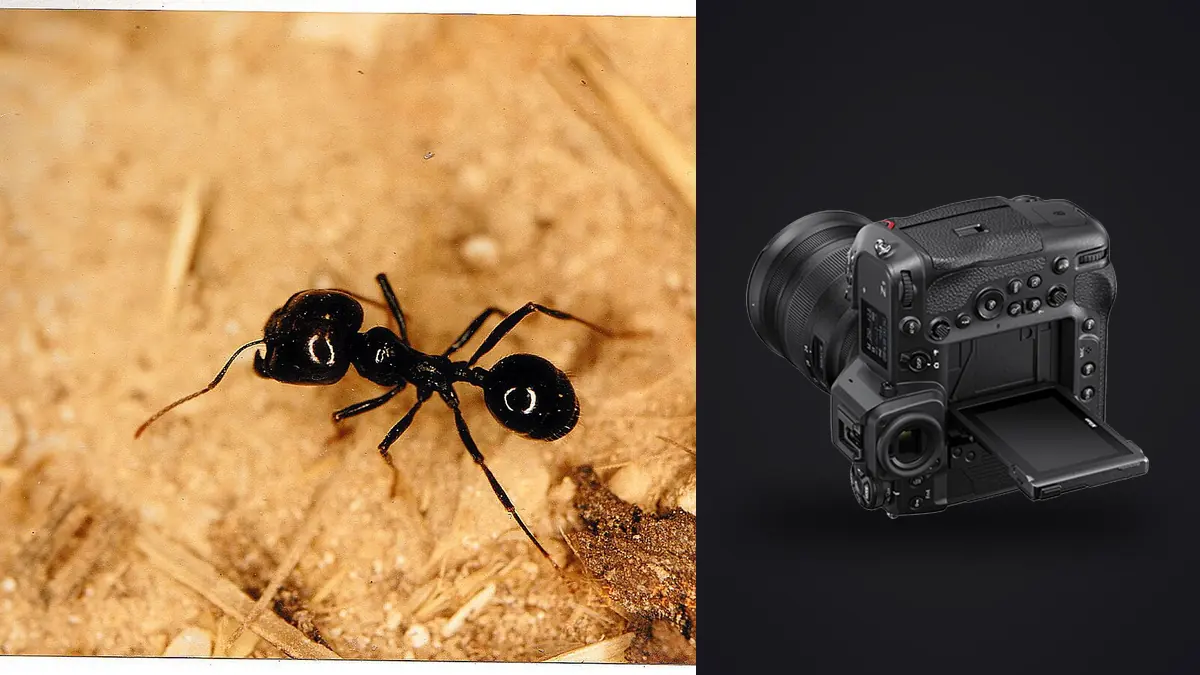
A dragonfly does not care that you just spent the price of a decent used car on a camera body. It cares about the shadow your lens hood throws across the reed a half second before you press the shutter. That is the first thing that actually changes when you take a Nikon Z9 into the field for macro insect work: the camera mostly stops being the limiting factor, and the insect goes right back to being the limiting factor, which is either liberating or humbling depending on how the morning is going.
This isn't a spec-sheet rundown. It's what changes in practice when you point a 45.7-megapixel stacked-sensor flagship at something that weighs less than a paperclip and has zero interest in cooperating: how the autofocus actually behaves on bugs (not birds, which is what Nikon tuned it for), which lens and extension combinations give you enough working distance to not spook anything with compound eyes, whether in-camera focus stacking is worth bothering with on a live subject, and what a morning of 20fps bursts does to your card and your evening editing session.
The sensor and shutter advantage nobody explains properly
The Z9 has no mechanical shutter at all. That gets mentioned constantly in sports and wildlife reviews for the frame rate it unlocks, but for macro work the more relevant effect is what it removes: shutter shock. At 1:1 magnification or higher, a body that vibrates even slightly under a mechanical shutter smacking shut will show that vibration as visible softness, because everything in the frame is magnified, including the camera's own micro-movements. Take that variable away entirely and a tripod-mounted macro rig genuinely holds still between frames in a way older DSLRs and even earlier mirrorless bodies didn't.
The stacked sensor's fast readout also mostly kills the rolling-shutter skew you'd otherwise see on fast wingbeats. Shoot a hoverfly at 1/4000 with a non-stacked sensor and you'll sometimes get a faint diagonal smear on the wings from the sensor reading top to bottom while the wing moves. On the Z9 that artifact is close to gone at any shutter speed you'd realistically use for insects. Combine that with Auto FP high-speed sync and you can run flash at speeds well past the standard 1/200 sync limit, which is the actual trick for turning a bright, cluttered noon meadow into a near-black backdrop behind a backlit fly: crank the shutter speed to starve the ambient light, let the flash do all the actual exposing.
None of this is free. The body alone is well over 1.3kg, and paired with the 105mm MC lens and a flash bracket it gets heavy fast when you're crouched over low vegetation for an hour chasing something the size of a grain of rice. I've started leaning a forearm on my knee or using a bean bag on a low wall rather than handholding the whole session, which nobody mentions when they're excited about the sensor stack.
Autofocus for bugs: where subject detection helps and where it just gets confused
Nikon built the Z9's subject detection around people, dogs and cats, birds, and vehicles. There is no dedicated insect category, and it shows. Point Animal detection at a jumping spider on bark and it will either ignore it completely or, more annoyingly, lock onto a leaf shadow that vaguely resembles an eye. It was never trained on arthropods and it behaves like it.
For anything approaching or past 1:1, I've had far more consistent results switching off subject detection entirely and using single-point or pinpoint AF-C with a small area, placed directly over the compound eyes. 3D-tracking can work reasonably well on larger, more static subjects like a perched dragonfly with decent contrast against open sky, but it falls apart on small, low-contrast subjects against busy backgrounds like leaf litter or bark, which describes most insect photography most of the time. Past about 2x magnification with a manual lens like the Laowa options below, autofocus is off the table anyway and you're focusing by rocking your whole body forward and back a few millimeters while watching the eyes sharpen through the viewfinder, an old technique that no amount of camera technology has actually replaced.
Back-button focus is worth setting up specifically for this genre, because you'll frequently want to lock focus on a static point (a flower head an insect is likely to visit) and just wait, without the shutter button re-triggering AF and hunting the moment something crosses the frame.
Lens and working distance choices that actually matter
Magnification ratio gets all the marketing attention, but working distance is the number that actually determines whether you get the shot. Anything with compound eyes and a decent nervous system clocks a lens hood entering its space from a few centimeters away and leaves. A lens that hits 1:1 at 5cm from the front element sounds impressive on paper and is nearly useless for anything skittish.
| Lens / setup | Max magnification | Approx. working distance | Best for |
|---|---|---|---|
| Nikkor Z MC 50mm f/2.8 | 1:1 | ~5cm | Static subjects on flat ground: ants, motionless caterpillars |
| Nikkor Z MC 105mm f/2.8 VR S | 1:1 | ~14cm | General field work: bees, dragonflies, most cooperative subjects |
| Nikkor Z 100-400mm + 12mm extension tube | ~0.5:1 | 40cm+ | Skittish subjects: jumping spiders, butterflies mid-approach |
| Laowa 100mm f/2.8 2x Ultra Macro (manual, FTZ adapted) | 2:1 | ~15cm | Extreme detail: compound eye structure, wing scale texture |
| Venus Optics 25mm f/2.8 2.5-5x Ultra Macro | up to 5:1 | ~4cm | Tripod-only studio work on cooperative or chilled subjects |
For most people starting out, the 105mm MC is the one to buy first and probably the only one you need. The working distance is enough to keep most insects calm, VR helps at slower shutter speeds when you're not using flash, and autofocus actually functions on it in a way it simply doesn't on the manual Laowa glass. The 100-400mm plus extension tube route isn't true macro (roughly half life-size at best), but it buys enough distance that a nervous dragonfly perched on a reed tip doesn't bolt the second you lean in, and on a 45.7-megapixel sensor you have enough resolution to crop in hard afterward and still print reasonably large.
The 2x and 5x Laowa lenses are a different category of tool entirely. Fully manual focus, fully manual aperture, no VR, no electronic communication with the body at all. They're worth owning if you want compound-eye and wing-scale detail shots, but they're not something you use on a live subject walking around in the field with any real success rate. A lot of that extreme-magnification work happens on subjects briefly chilled in a fridge to slow them down for a controlled shoot, then warmed back up and released, which is a fairly standard and harmless technique in the macro community but worth knowing before you buy a 5x lens expecting to use it the way you use the 105mm.
Handheld bursts versus in-camera focus stacking
The Z9's focus shift shooting mode lets you set up to 300 shots, a focus step width from 1 to 10, an interval between frames, and exposure smoothing to compensate for aperture-related brightness shifts across the sequence. Because there's no mechanical shutter, the whole sequence runs without the incremental vibration a shutter-equipped body would add between frames, and that matters more than it sounds like it should once you're stacking 40 or 50 frames at high magnification.
It works well on a tripod for anything that holds still: dew-slowed insects at first light, chilled subjects, dead specimens if that's your thing. It does not work on an active, warm insect in direct sun. The subject moves between frames, the stack has gaps, and most stacking software either produces visible halos or just fails outright. For live subjects in the field, I mostly abandon in-camera stacking and instead shoot a single well-exposed frame at f/8 to f/11 (past f/16 on this sensor you start losing real detail to diffraction, which somewhat defeats the point of 45.7 megapixels), or fire a short handheld burst while rocking slightly forward and back, hoping at least one frame in the sequence lands the eyes precisely in focus.
Flash, diffusion, and controlling the background
A twin macro flash or small ring flash mounted on the 105mm's filter thread solves most of the lighting problems this genre creates on its own: harsh midday sun, deep shadow under your own lens barrel, and a subject that's often only a few centimeters from the glass. Bare flash on a shiny beetle carapace blows out fast, so I start most sessions around -1 to -1.7 EV flash compensation and adjust up from there rather than trusting TTL at zero.
Diffusion material doesn't need to be expensive:
- A section cut from a translucent plastic drink cup, taped over the flash head
- A layer of tracing paper or baking parchment for a softer, less directional result
- A small fold-out diffuser dome if you'd rather not build one
Combined with Auto FP high-speed sync, you can push the shutter speed up past standard sync while keeping flash exposure exactly where you want it, which is how a background that was actually a busy, sunlit hedge ends up rendering as clean black or deep green in the final frame. It's a lighting trick more than a camera trick, but the Z9's sync behavior at high shutter speeds makes it far less fiddly than it is on bodies with a conventional mechanical shutter and a hard 1/200 or 1/250 sync ceiling.
Managing the volume once you're back at the laptop
A single productive morning of insect macro on the Z9, especially if you're running handheld focus-rocking bursts at 20fps trying to land one sharp frame per attempt, produces an absurd number of near-identical images. Three hundred frames of the same dragonfly, most of them separated by a millimeter of focus shift or a barely perceptible wing angle, is a normal outcome, not an exaggeration.
This is the part of the workflow that actually eats the time, more than the shooting itself. I run these sessions through imagic afterward specifically because its duplicate and burst clustering groups those near-identical frames automatically instead of leaving me to scrub through 300 thumbnails by eye trying to spot the one where the eyes are actually sharp. Its local sharpness and focus scoring is genuinely useful here too: when an in-camera focus stack fails because the subject moved mid-sequence, that scoring will flag which single frame in the failed attempt actually nailed focus on the eyes, so you're not stacking a broken sequence, you're just picking the best individual shot out of it. All of that runs locally on the machine, no upload step, which matters when you're culling a week's worth of field shooting from a cabin with a weak signal rather than a studio with fiber. If you haven't looked at how that kind of automated culling actually works under the hood, it's worth reading through how AI photo culling works before you assume it's just renaming files.
Keeping a consistent look across a season's worth of takes
The other place this adds up is editing consistency. If you land on a treatment you like, say a slightly warmed exposure with the flash-darkened background pushed further toward black, redoing that same set of adjustments by hand across hundreds of frames from a three-month macro season gets tedious fast. I train imagic's apply_my_style feature on a handful of shots I've already graded exactly how I want them, then let it apply that same treatment across the rest of a session's take. It's not replacing judgment on the individual hero images, it's just removing the repetitive slider work on the other 280 frames that don't need a from-scratch edit. Between the burst clustering and the style matching, a session that used to take most of an evening now takes maybe forty minutes, which is the difference between actually going out again the next morning or not. For more on tightening that loop generally, these workflow tips cover ground beyond just the macro-specific stuff here.
Frequently Asked Questions
Does the Nikon Z9 have a dedicated insect-detection autofocus mode?
No. The Z9's subject detection covers people, dogs and cats, birds, and vehicles, with no insect-specific category. Animal detection will sometimes attempt to track an insect and just as often ignores it or locks onto something else nearby. Single-point or pinpoint AF-C placed manually over the eyes is more reliable for this genre than relying on subject detection.
What aperture actually works for insect macro on a 45.7-megapixel sensor?
Somewhere between f/8 and f/11 is the practical sweet spot for most field work. Diffraction becomes visible on this sensor's pixel density from roughly f/16 onward, so stopping down to f/22 for extra depth of field, a common instinct at high magnification, actually softens fine detail across the whole frame rather than just extending focus.
Is in-camera focus-shift shooting actually usable on live, moving insects?
Rarely, in my experience. It works well on a tripod for still or chilled subjects because the sequence runs without the vibration a mechanical shutter would add. On an active insect in warm conditions, the subject moves enough between frames that the stack develops gaps and most stacking software either shows halos or fails to merge the sequence at all.
Do I need a teleconverter, or is the 105mm MC lens enough for skittish subjects like dragonflies?
For most dragonflies and larger insects, the 105mm's roughly 14cm working distance at 1:1 is enough if you approach slowly and avoid casting a shadow over the subject. For genuinely nervous subjects like jumping spiders or butterflies that flush at the slightest movement, pairing the Z 100-400mm with an extension tube trades true macro magnification for extra distance, which is often the better trade when the alternative is no shot at all.