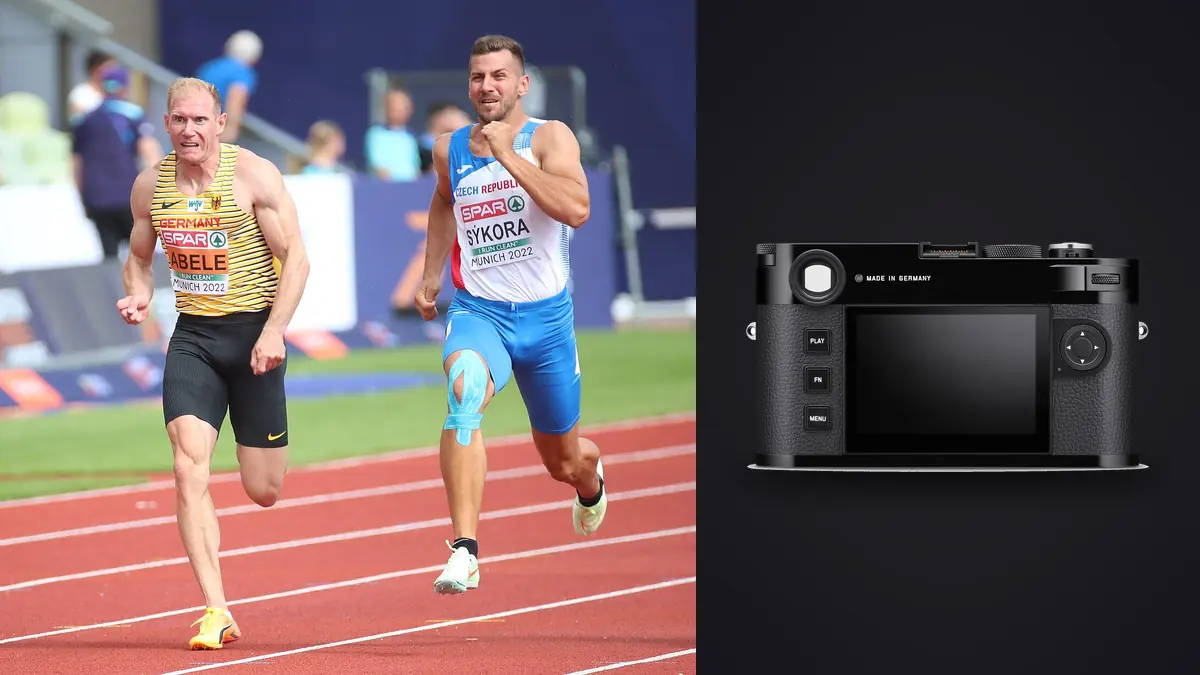
I'll say the quiet part first: a Leica M11 is not the camera anyone would recommend for shooting a track meet. There's no autofocus, no subject tracking, no 20 fps electronic burst, and the buffer runs out faster than you'd like at 60 megapixels. If you asked ten sports editors what body to bring to a regional championship, none of them would say "rangefinder." And yet I've spent two seasons shooting local and university track meets with an M11 alongside a modern mirrorless body, and the M11 files are the ones I keep going back to. This is a piece about why that's true, and how to actually make manual rangefinder focusing work at speeds where most people assume it can't.
Track and field is a strange sport to shoot for exactly this reason. Most of it happens in straight lines, on marked lanes, over fixed distances, at predictable release points. A sprinter's lane is 1.22 meters wide and doesn't move. A long jumper's board is a painted line. A pole vaulter's plant box is bolted to the runway. None of that is true of soccer, basketball, or hockey, where players change direction unpredictably and autofocus tracking earns its keep. Track gives you geometry you can exploit, and geometry is exactly what a coupled rangefinder is good at.
Why bring a manual-focus camera to begin with
Three reasons, honestly. The first is size and weight. A body with a 90mm Summicron or a 135mm APO-Telyt hanging off it is genuinely light compared to a full-frame mirrorless with a 300mm f/2.8, and after four hours standing on a infield rail with a monopod, that difference matters more than it sounds like it should.
The second is the shutter. The M11's electronic shutter is completely silent, which matters more at indoor meets than you'd expect. Indoor tracks are loud with crowd noise but eerily quiet in the moments right before a gun goes off, and a mechanical shutter slap two lanes over during a false-start review is the kind of thing meet officials notice. I've had a marshal specifically thank me for not being the guy with the motor-drive rattle during a 60m final.
The third reason is the one I didn't expect going in: manual focus makes you a better anticipatory shooter. When you can't rely on the camera to find the athlete for you, you start reading the race instead of chasing it. You watch the blocks, you watch the takeoff mark, you watch where the baton exchange zone actually is rather than where the rulebook says it should be. That skill transfers back to every other camera I own.
The core technique: focus the ground, not the athlete
Old-school photojournalists who shot the Olympics on Leicas before autofocus existed did not try to track a 100m runner through the frame with the focus ring. They picked a point on the track, focused there in advance, and waited for the runner to arrive at that point. It's the same principle as focusing a hyperfocal landscape shot, just applied to a moving subject on a known path. In practice this means: walk the venue before the meet starts (or during warmups), pick your spot, and use the rangefinder's coupled focus patch to lock distance on something at that exact spot, like a hurdle base, a lane line intersection, or the edge of the sand pit. Then don't touch the focus ring again until the subject changes. You're not tracking, you're waiting.
This only works because most Leica glass has a hard, tactile focus throw with clear distance markings on the barrel, so you can also zone focus by numbers rather than by eye if the light is flat and the rangefinder patch is hard to read. Stop down to f/5.6 or f/8 on a sprint straightaway shot from a moderate distance and your depth of field alone will cover a meter or more of travel, which is plenty of margin for a runner passing through your pre-focused zone at speed.
| Event | Where to pre-focus | Lens / distance | Aperture | Shutter speed |
|---|---|---|---|---|
| 100m / 200m sprint | A lane marker roughly 15-20m before the line you're shooting from the side | 90mm from the rail, or 135mm from the stands | f/4-5.6 | 1/2000s+ |
| Long jump / triple jump | The front edge of the takeoff board | 75mm or 90mm, shot low and square-on | f/5.6 | 1/1600s |
| Pole vault | The plant box, refocus once at the bar height for the clearance shot | 90mm, two pre-set distances | f/4 | 1/2000s |
| High jump | The near edge of the bar, side-on | 90mm | f/4-5.6 | 1/1600s |
| Discus / shot put | The front of the throwing circle | 50mm or 75mm | f/5.6-8 | 1/1000s |
| Distance / relay (moving subject toward camera) | Zone focus a 2-3m band using the depth scale, not a single point | 50mm, stopped down | f/8 | 1/1000s |
Notice the last row is different in kind from the others. Anything running roughly toward or away from the camera, like a relay leg or the home straight of a distance race, can't be caught with a single pre-focused point because the subject-to-camera distance is changing constantly. There you zone focus deliberately wide, using the depth-of-field scale engraved on the lens barrel as your actual tool, accepting a slightly softer plane in exchange for a window of several meters where focus holds. It's a trade-off DSLR shooters with continuous AF never have to think about, and it took me a full season of missed frames to internalize it.
Lens choices that actually make sense for this
A 50mm Summicron is the wrong lens for most track work unless you're shooting field events from close range or want environmental shots of the whole infield. For anything on the track itself you want reach, and Leica's M-mount telephotos are smaller than you'd expect but still optically dense and slow to focus by feel compared to a 50mm. The 90mm Summicron-M (either the older four-element or the current APO version) is the workhorse: fast enough focus throw, sharp wide open, and a natural fit for shooting from an infield position without a huge lens hanging off the body. The 135mm APO-Telyt is beautiful glass but the narrower field of view makes the pre-focus-and-wait technique less forgiving, since your margin for a slightly wrong distance estimate shrinks. I use it for finish-line shots from a fixed elevated position, never for anything I'm tracking across the frame.
If you shoot Leica R-mount glass adapted onto the M11, the rear screen with focus peaking becomes genuinely useful for field events where you have time to compose and check focus visually rather than relying purely on the rangefinder patch. It's slower, but for a pole vault clearance where the athlete is airborne for over a second, slower is fine.
Shutter, ISO, and the light problem
Outdoor day meets are easy: plenty of light, f/5.6-8, ISO 64-200, mechanical shutter up to 1/4000s covers you. Evening and indoor meets are where the M11 either earns its keep or falls apart depending on how you handle it. Indoor tracks are lit for spectators, not photographers, and the color temperature is usually an ugly mix of sodium and fluorescent that shifts between different sections of the venue. I shoot DNG always, never JPEG, specifically so I can fix white balance per-section afterward rather than trying to get it right in-camera under mixed light I can't control. ISO 3200-6400 on the M11 is genuinely usable, noticeably cleaner than older M-series sensors, and the wide native range (down to ISO 64, up past 50000 if you're desperate) gives you room to prioritize shutter speed over noise anxiety. For sprints I don't go below 1/2000s even indoors, which usually means running at ISO 4000-6400 under typical indoor track lighting. That's a real compromise on file cleanliness but a blurred sprinter is a worse outcome than a slightly noisy one.
The electronic shutter tops out at 1/16000s, which sounds irrelevant for a fast shutter speed problem but actually solves a different one: it lets you shoot wide open at f/2 in bright daylight without an ND filter, which matters for shallow-depth-of-field portraits of athletes between events when you want subject separation rather than motion-freezing speed.
Buffer reality and the culling problem this creates
The M11's continuous shooting tops out around 4.5 fps, and at full 60-megapixel DNG the buffer clears in well under two seconds of sustained shooting before it slows down. That is not a burst camera by any modern standard. What it does have going for it is the triple-resolution sensor, and for a full day of meet coverage I usually drop to the 36MP or even 18MP DNG mode. Eighteen megapixels is still more than enough for web use and most print needs from a meet, and it buys you a meaningfully deeper buffer and much faster file handling afterward, which matters when you're trying to turn around a same-day gallery for a school or club.
Because you're not spraying 20 fps bursts, you don't end up with the thousand-near-duplicate problem that mirrorless sports shooters deal with. What you do end up with is the opposite problem: fewer frames per moment, but a wider spread of "close but not quite" focus results, since manual focus at speed has more variance than a modern AF system locked onto an eye. Sorting a card of 1,200 frames from a meet, where maybe 15% missed critical focus by a hair, is a different sorting problem than sorting 8,000 near-identical AF-tracked frames. This is where I actually lean on imagic rather than eyeballing every frame on a laptop screen at the venue. Its local sharpness scoring flags the frames that are technically in focus versus the ones that look fine at thumbnail size but are half a step off, which is exactly the failure mode manual rangefinder focusing produces under pressure (I wrote up the general mechanics of that kind of scoring in more detail in how AI photo culling actually works, if you want the longer version). Everything runs on my own machine with no upload step, which matters when I'm working off a hotel room laptop between meet days with spotty wifi and files I don't want sitting on someone else's server before I've decided what to share.
I also run a saved "apply_my_style" preset in imagic built from a season's worth of my own edited meet photos, since I've settled on a fairly consistent look for this kind of work (slightly cooler shadows, a bit of extra contrast in the midtones for stadium light) and I'd rather not re-invent that grade every single week. It's a small thing but it saves a genuine chunk of the evening after a long meet day, which is when I'm least interested in re-deriving my own color decisions from scratch. For anyone building a repeatable workflow around a manual-focus body, having software that speeds up the sorting and grading side is what makes the slower capture side sustainable across a full season, and a lot of the general habits from speeding up a photo workflow apply just as well to a slow, deliberate rangefinder shoot as they do to a fast-burst mirrorless one.
What I still shoot on a mirrorless instead
I want to be honest about the limits here rather than pretend the M11 replaces a proper sports body. Relay exchanges with multiple athletes converging unpredictably, any kind of scrum at a hurdles pile-up, and anything happening in low, fast-changing light with no time to pre-focus, I shoot on a mirrorless body with real tracking AF. The M11 comes out for the events with predictable geometry: sprints from a fixed angle, jumps, vaults, throws, and posed or semi-posed moments between events. On a typical meet day that's maybe 60% of what I'm shooting, and it's the 60% that produces the images I'm actually proud of afterward, so the trade feels worth it.
Frequently Asked Questions
Can the Leica M11 realistically keep up with a 100m sprint?
Yes, but only with the pre-focus-and-wait method described above, not by trying to track the runner through the frame with the focus ring. Pick a point on the track, lock focus there with the rangefinder patch, and fire when the runner reaches it. Trying to follow focus manually on a subject moving at sprint speed simply doesn't work with human reaction time.
Is the M11's rangefinder patch accurate enough at long lens lengths for this kind of work?
With the 90mm it's reliable in good light, especially with practice reading contrast edges rather than relying purely on the split-image effect. At 135mm the effective focus tolerance gets tighter because depth of field narrows, so I treat that lens as a fixed-position finish-line tool rather than something I use for moving subjects across the frame.
Why shoot DNG at a lower resolution setting instead of always using the full 60 megapixels?
Full resolution is worth it for portrait or feature work where a single frame matters, but for high-volume event coverage the 36MP or 18MP DNG modes give a deeper buffer, faster card-to-laptop transfer, and quicker culling without a meaningful loss in usable detail for web galleries or standard print sizes.
Does the lack of autofocus actually hurt the keeper rate compared to a modern mirrorless body?
For genuinely unpredictable action, yes, noticeably. For the structured, lane-and-mark-based events that make up most of a track meet, the gap is much smaller than people assume once you've built the habit of pre-focusing on a spot rather than chasing the athlete, though it does take real practice before the technique becomes second nature under pressure.