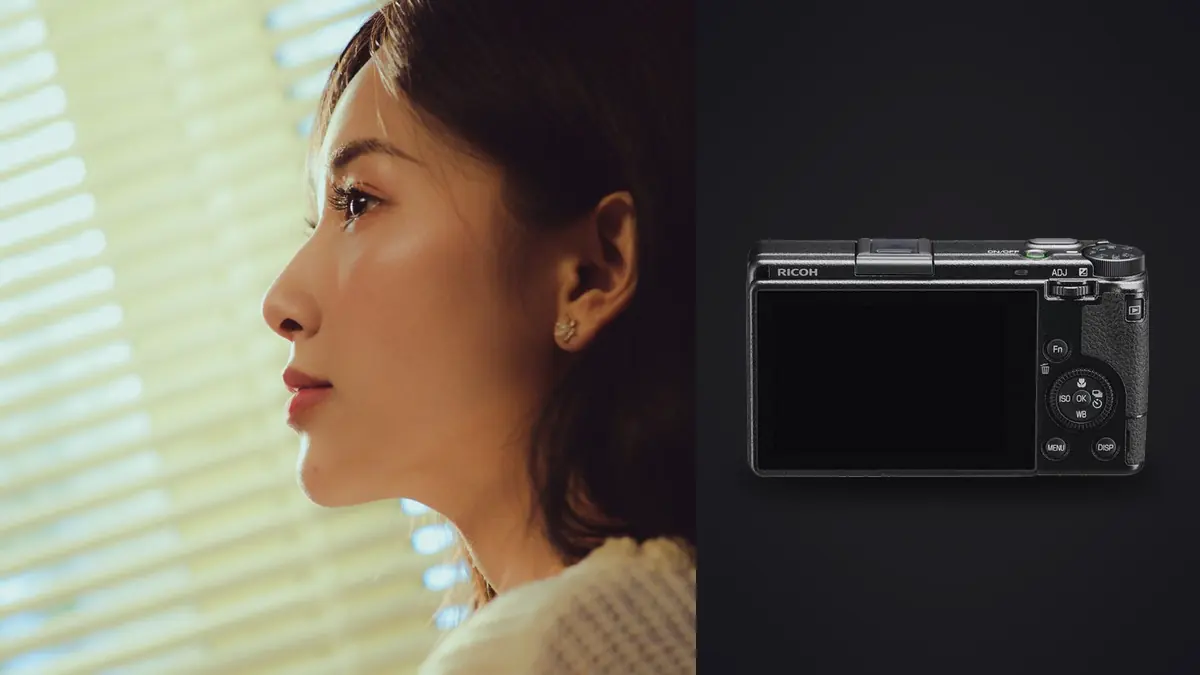
It's easy to end up switching to the Ricoh GR IIIx for boudoir work almost by accident. Say the main body is in for a sensor clean the week before a shoot, and the GR is the only other camera in the bag that isn't a phone. Three sessions later you haven't gone back to your usual setup for that kind of work, and it's still the camera to reach for first for an intimate or boudoir session in a small space. This isn't a case for replacing a full kit. It's an honest account of what a fixed 40mm-equivalent compact does well in a bedroom, a hotel suite, or a rented studio apartment, and where it runs out of road.
A 40mm view fits the room you're actually working in
The GR IIIx carries a 26.3mm lens on an APS-C sensor, which works out to roughly 40mm in full-frame terms. That's tighter than the 28mm on the standard GR III, and it matters more than the two millimetres of difference suggests. Boudoir sessions rarely happen in spacious studios. They happen in bedrooms, in hotel rooms with a queen bed taking up half the floor, in rented Airbnbs with maybe eight feet of clear wall to work with. A 35mm or 50mm prime on a full-frame body either distorts the nearest limbs when you're forced close, or it needs backing distance the room doesn't have. Forty millimetres sits in a sweet spot: close enough to fill the frame without retreating into a closet, wide enough to include a full pose without warping a hip or a knee that's nearest the lens. I still carry a longer lens for headshots and tighter beauty crops, but for the bulk of a session, the fixed 40mm does the job a 35-70mm zoom would on a bigger body, just without the zoom ring.
The shutter sound decides whether the room stays relaxed
This is the part reviews of the GR line tend to skip past, because it doesn't show up in a spec sheet. The leaf shutter in the GR IIIx is close to silent, a soft click you'd miss if there's music playing. Compare that to a DSLR mirror slap, or even the mechanical shutter clack on most mirrorless bodies, and the difference in a small, quiet room is not subtle. Every audible shutter click is a reminder to the client that they're being documented, and in boudoir work that reminder pulls people out of whatever comfortable, unguarded moment they'd settled into. It happens with a louder camera: a client relaxes into a pose, the shutter clacks twice, and their shoulders come back up half an inch. With the GR IIIx that reset doesn't happen nearly as often.
Why I don't run full electronic silent mode
The camera also has a fully silent electronic shutter option, and I expected to leave it there permanently. In practice I switch back to the leaf shutter for most of the session. Under mixed LED and lamp lighting, which is what most bedrooms and rented spaces actually have, the electronic shutter can pick up faint banding that the leaf shutter doesn't. The leaf shutter is quiet enough for the purpose and doesn't fight the room's lighting, so that's the default, with silent mode saved for moments where even that soft click would be too much.
Size changes how a client reads the camera, not just how it fits in a bag
A body that weighs 262 grams and disappears into one hand reads completely differently to a client than a full-frame body with an 85mm f/1.4 hanging off the front. That combination is heavy, it's long, and it puts real physical distance and a visible barrel of glass between you and the person you're photographing. For genres where trust has to build fast, in a session that might run ninety minutes with someone who's never done this before, the camera itself becomes part of the body language of the room. A compact that looks more like a point-and-shoot than professional gear tends to lower the temperature. Clients tend to comment on it directly, usually some version of "that's it?" halfway through, and it's said with visible relief.
Living with a fixed f/2.8, and what it costs you
The tradeoff nobody mentions enough in the buying guides: f/2.8 is not a fast portrait aperture. On the GR IIIx's APS-C sensor at 40mm, background separation is real but modest, nowhere near what an 85mm f/1.4 or even a 50mm f/1.8 on full frame gives you. I compensate three ways. First, working distance: getting physically closer to the subject does more for subject-background separation than aperture alone at this focal length, so I shoot tighter than I would with a longer lens. Second, background choice: I position against darker walls, doorways, or window light falling off into shadow, using tonal separation instead of relying purely on blur. Third, I stopped chasing creamy bokeh as the goal for this camera and leaned into its actual strength, which is a clean, slightly clinical rendering that suits a more editorial, less romanticised look. Anyone who wants the heavy soft-blur aesthetic should be told upfront that this isn't the tool for it, and the other body comes out for those shoots.
How it stacks up against the other cameras that get suggested for this work
People planning a boudoir kit usually end up comparing the same four options. Here's how they actually compare on the things that matter in a small room with a nervous first-time client.
| Camera / setup | Equivalent focal length | Widest aperture | Shutter character | Body weight | Typical price | Where it wins in a session |
|---|---|---|---|---|---|---|
| Ricoh GR IIIx | 40mm | f/2.8 | Leaf, near-silent | 262g | ~$900 used | Tight rooms, unposed in-between moments |
| Fujifilm X100VI | 35mm | f/2.0 | Leaf, silent modes available | 478g | ~$1,600 new | Slightly wider environmental frames, hybrid finder in bright rooms |
| Full-frame body + 35mm f/1.4 | 35mm | f/1.4 | Mechanical/electronic, audible | ~1,100g combined | ~$3,500+ | Maximum separation, editorial delivery, client albums for print |
| Flagship phone, main lens | ~24-28mm | f/1.8 (computational) | Silent | ~190g | Included in phone | Fastest trust-building shot, behind-the-scenes content only |
None of these wins on every row, which is the actual point. I keep the GR IIIx and a full-frame body with a fast prime in the same bag and pick between them based on what the room and the subject need that day.
What the sensor actually does once the lights get dim
Bedrooms and hotel rooms are rarely lit for photography. Many sessions run on window light early, then shift to whatever lamps and ceiling fixtures the space already has once the sun drops. On this camera I'm comfortable up to about ISO 3200 for anything going to print, and I'll push to 6400 for web-only use where the grain reads as texture rather than a flaw. Past that the shadows start losing detail in a way that's hard to recover cleanly. The GR engine's colour science handles skin tones well straight out of camera, which matters because a lot of what I shoot doesn't get heavily reprocessed. I still shoot RAW (DNG) alongside the JPEG, because even a well-tuned in-camera profile occasionally needs a white balance correction when a session moves between a window-lit room and a lamp-lit one mid-shoot.
The macro mode is not a gimmick for this genre
A boudoir session benefits from a handful of detail frames: lace texture on lingerie, a ring, the strap of a garment, sometimes just hands or collarbone in close crop. The GR IIIx's macro mode focuses down to roughly 12 centimetres from the front element, which is close enough to fill the frame with fabric texture that would otherwise need a dedicated macro lens on another body. I didn't expect to use this mode as often as I do, but it's become a standard part of the shot list, usually the last five minutes of a session while the subject is getting dressed again.
Battery, buffer, and the things that actually interrupt a shoot
The parts of this camera that cause problems aren't the ones people ask about. Battery life is rated around 200 shots per charge in real use, and a two-hour session with breaks between poses will burn through two batteries easily, sometimes three. I carry four now and charge in rotation during outfit changes. The buffer is shallow too: shoot a short burst in RAW+JPEG and the camera will slow down after five or six frames while it clears. For a genre built on posed, collaborative moments rather than fast continuous action, that's rarely a problem, but if a client does something spontaneous and you try to chase it with a burst, you'll feel the limit fast. Autofocus tracking for movement is adequate at best, and that's the honest reason I wouldn't recommend this as a sole body for anyone shooting movement-heavy boudoir work, veils, fabric thrown in the air, that kind of thing.
No viewfinder, and why that stopped bothering me
The GR IIIx has a fixed rear LCD, no viewfinder and no tilt. Outdoors in bright sun that would be a real handicap. Indoors, in the kind of low, warm light most of these sessions happen in, glare has never been an issue for me, and I've adjusted to composing at waist height or from the hip more often than I used to. The snap focus feature helps here: you can preset a focus distance and aperture combination so the camera fires instantly at a known distance without hunting, which is genuinely useful for candid getting-ready shots where a client doesn't know exactly when the frame was taken. That unposed moment often ends up as the client's favourite from the whole set.
Getting the files home without breaking the trust you just built
Client trust in this genre extends past the session itself into what happens to the files afterward. I do all of my culling for these shoots in imagic, mainly because the processing stays on my own machine and nothing gets uploaded anywhere while I'm sorting through a card of intimate images. That local-only handling matters more here than it does for a landscape or event shoot. On the practical side, the fixed 40mm at f/2.8 means missed focus is easy to overlook on a quick glance through a folder, especially on close detail shots, so I lean on imagic's local sharpness scoring to flag anything soft before it reaches a final gallery. Boudoir sessions also produce a lot of near-identical frames per pose, small shifts in expression or hand position, and the duplicate and burst clustering groups those automatically instead of leaving me to compare thirty thumbnails by eye. You can read more on how that scoring works in our piece on how AI photo culling actually works if you're curious about the mechanics behind it.
The other piece that's saved me real time is the apply_my_style preset, trained on my own past edits rather than a generic filter pack. A single session shot partly in window light and partly under a warm lamp needs a consistent skin tone across both, and having a preset built from my own previous boudoir edits gets me most of the way there before I touch a single slider by hand. If you're weighing tools for this kind of workflow, the pricing page lays out what's included at each tier.
Who I'd point toward this camera, and who I wouldn't
If your boudoir or intimate portrait work happens mostly in small rented spaces, hinges on a client feeling unwatched rather than photographed, and you're comfortable working close rather than relying on a fast lens for separation, the GR IIIx earns its place in the bag faster than its spec sheet suggests. If your style depends on heavy background blur, if you shoot a lot of movement, or if you need a single camera to cover everything from full-length poses to tight beauty crops without swapping bodies, it's a second camera at best, not a first one. Mine hasn't left the bag on a single session since that first accidental one, but it's never gone out alone either.
Frequently Asked Questions
Can the GR IIIx really replace a full-frame kit for a boudoir business, or is it a second camera?
For most working photographers it's a second camera. It excels at the quiet, close, unposed moments and at getting through tight rooms without a big lens changing how the client behaves, but the fixed f/2.8 and modest buffer mean I still bring a full-frame body with a fast prime for anything needing heavier background separation or a run of quick continuous frames.
Is a 40mm-equivalent view too tight for full-length poses in a small bedroom?
Less often than you'd think. Forty millimetres needs less backing distance than a 50mm or 85mm to get a full-length pose in frame, which is exactly the constraint most bedroom and hotel-room sessions run into. It's tighter than the standard GR III's 28mm, so if your rooms are unusually small you may still find yourself pressed into a corner for a full-body frame.
How far does the in-body shake reduction actually get you in dim rooms?
Far enough that I regularly hand-hold down to around 1/15 of a second for static, posed frames without visible blur from camera shake. It won't freeze a client's motion at that shutter speed, but for controlled poses under lamp light it lets me keep ISO lower than I otherwise could.
Do clients ever ask why the camera looks like a point-and-shoot?
Occasionally, and I take it as a good sign. Most of the time it's said with relief rather than concern, because the camera doesn't look like the kind of gear that shows up in their mental image of a photo shoot. That reaction alone has been worth more to the pacing of a session than any technical spec on the sheet.