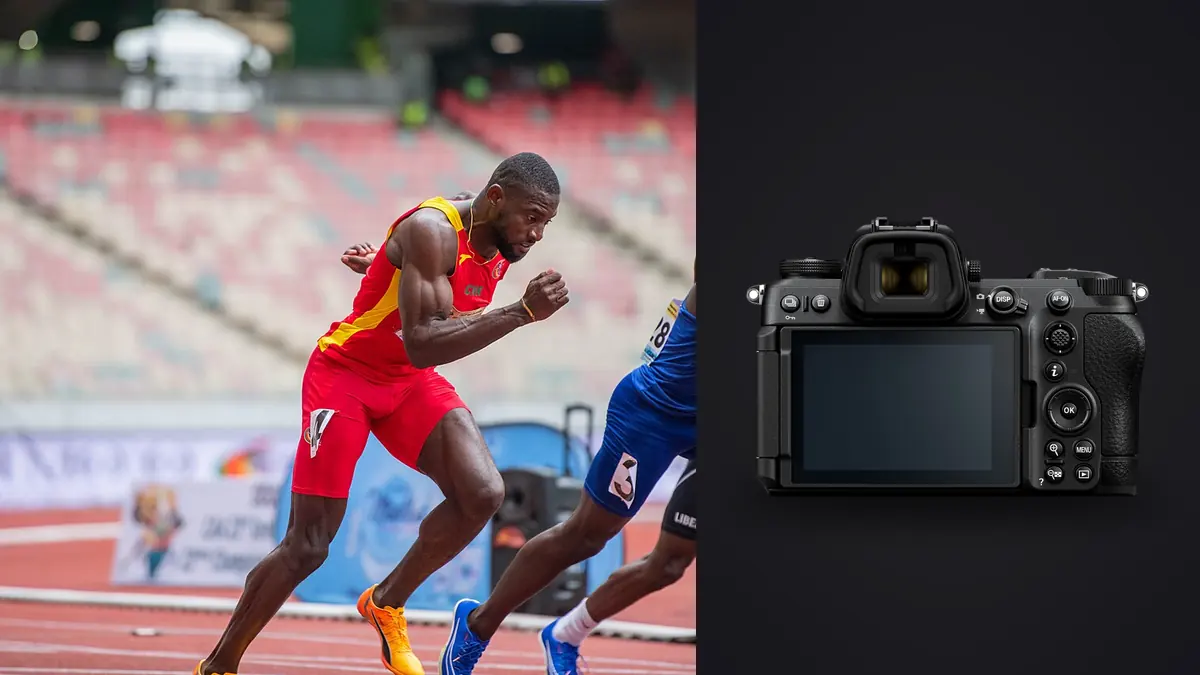
Most reviews of the Nikon Z6 III talk about it in general terms: good sensor, fast processor, nice viewfinder. None of that tells you whether it can catch a 100m final where eight athletes leave the blocks within a tenth of a second of each other, or whether it survives three hours of continuous shooting at a wet regional meet with one battery and a rain cover taped to the lens hood. This is a rundown built from actually pointing the camera at a track, not from a spec sheet.
The sensor readout is the part that matters, not the fps number on the box
Nikon markets the Z6 III on its 20fps blackout-free electronic shutter burst, and that number is real, but it's not the headline feature for track work. The headline is that the sensor is partially stacked, which means the rows of pixels get read out much faster than on the Z6 II. Practically, that shows up as reduced rolling shutter skew. Pan with a sprinter at full stride using the electronic shutter and their legs don't smear into a jello-looking diagonal the way they would on a slower-readout sensor. For a 200m curve where you're tracking a runner across the frame at speed, that difference is the reason electronic shutter is usable at all for anything beyond a static long jump landing.
The mechanical shutter is still there and still fine for slower events (shot put, discus wind-up, the walk to the blocks), but for anything moving at sprint speed I leave the camera on electronic shutter permanently during meets. The only time I switch back is very low light indoor tracks with older fluorescent banks, where flicker becomes visible as banding, and even then the camera's flicker reduction mode usually handles it without a shutter change.
Autofocus settings that actually hold up with eight lanes of runners
3D-tracking gets recommended a lot for sports because it's simple: put the box on the subject, press the shutter, the box follows. On an isolated athlete, like a long jumper alone on the runway, it works well. On a start line with eight lanes and subject detection turned on, it gets confused more often than I'd like, because the camera will happily jump to a competitor's shoulder in an adjacent lane if your framing is loose. What's worked better for me is Wide-area AF (L), sized to roughly cover one lane's width, with People detection and eye/head priority on. It gives the camera a defined zone to search rather than letting Auto-area AF hunt across the whole frame. For field events I switch to a smaller Wide-area (S) box locked onto the athlete's torso, since a pole vaulter or high jumper crossing the bar has limbs moving in directions the eye-detect algorithm doesn't always parse well at the top of the jump.
One setting worth checking before the first event: AF-C priority. I run Release priority for sprints so the shutter never stalls waiting for a focus confirmation the camera is confident about anyway, and Focus priority for slower field events where I'd rather miss a frame than get a soft one.
Burst modes, buffer depth, and what actually happens after 40 frames
The Z6 III's buffer is deeper than the Z6 II's thanks to the faster sensor readout and EXPEED 7 processing, but "deep" is relative once you're shooting a full sprint from the gun to the line. Here's what the different capture modes look like once you've actually filled a card at a meet, using a fast CFexpress Type B card in the primary slot:
| Capture mode | Resolution | Frame rate | Best use at a meet | Realistic buffer before slowdown |
|---|---|---|---|---|
| Full-frame RAW (e-shutter, 14-bit lossless) | 24.5MP | 20 fps | Sprints, hurdles, relay legs, long jump takeoff | Roughly 90-100 frames before the rate visibly sags |
| Full-frame JPEG Fine | 24.5MP | 20 fps | Same-day handoff to a coach or school newspaper | Effectively card-limited, buffer rarely an issue |
| DX crop JPEG (C60) | ~11MP | 60 fps | Bar clearance in pole vault or high jump, discus release | 2-3 seconds of true 60fps is plenty for one attempt |
| Pre-Release Capture (C30) | 24.5MP FX | 30 fps, buffered before full press | Gun starts, baton exchanges, exact foot strike on the line | Roughly 1 second of frames captured before you finish pressing the shutter |
Pre-Release Capture is the one feature I didn't expect to lean on this heavily. Half-press to arm it, and the camera keeps a rolling buffer so that when you fully press at the sound of the gun, you already have the frames from just before your reaction time caught up. For 100m starts, where human reaction lag alone can cost you the actual push-off frame, this closes that gap without needing to guess early and burn through card space on false starts.
Where the buffer genuinely bites is a 4x400m relay watched start to finish in RAW at 20fps. If you're holding the shutter down through each handoff rather than firing in short bursts, you'll feel the write speed catch up with you by the third leg. Shooting in short 1-2 second bursts around the moments that matter (start, exchanges, the final straight) gets you further than holding the shutter down for the whole race.
Lenses that actually make it to the infield
The 70-200mm f/2.8 S is the lens I bring to nearly every meet that has any kind of barrier or fence between me and the track, which is most of them. It covers the far straight adequately and lets me get tight on the finish line from the stands. For meets where I can get infield access (smaller invitationals, some high school meets), a shorter zoom like the 24-70mm f/2.8 S handles field events and warmup shots without needing to back up constantly. For stadium-scale meets with a real runway between spectators and the track, the 100-400mm f/4.5-5.6 S earns its weight, especially for far-side field events like javelin or hammer where 200mm isn't enough reach. It's not a lens I'd want handheld for three hours straight, so a monopod comes with it.
Indoor tracks are their own problem
Indoor meets bring two headaches the outdoor season doesn't: mixed, often ugly lighting, and much lower light levels overall. Older indoor facilities still running sodium-vapor or fluorescent banks will show banding on electronic shutter if you don't use flicker reduction, and even with it on, color temperature can shift meaningfully between one end of the track and the other. I shoot RAW at indoor meets specifically so white balance mistakes made trackside are fixable later rather than baked in. ISO climbs fast indoors, often into the 6400-12800 range under a typical fieldhouse lighting rig at f/2.8, and the Z6 III's full-frame sensor holds up better here than the DX crop mode does, which is one more reason I keep crop mode reserved for outdoor bar-clearance sequences where light isn't the constraint.
Battery and card logistics for a full meet
CIPA rates the EN-EL15c around 380 shots, which sounds reasonable until you remember that number assumes a mix of single shots and light burst use, not three hours of 20fps sprint coverage plus EVF use the entire time. Realistically I burn through a battery in under two hours of active meet shooting. Bring at least two spares, or run the MB-N14 grip if you're shooting a full day tournament with prelims and finals. On cards: put a CFexpress Type B card in the primary slot for the write speed RAW bursts need, and use the UHS-II SD slot in the second bay as an overflow or backup rather than relying on it for primary RAW writes during a burst. It'll bottleneck the buffer if it's set to record RAW simultaneously to both cards during fast sequences.
Sorting what the camera just handed you
A single sprint final shot in RAW at 20fps with Pre-Release Capture engaged can hand you 150 nearly identical frames of one race. Multiply that across heats, semifinals, and finals in four or five events, and a decent meet leaves you with several thousand frames to get through before anyone sees a finished photo. This is the part of track photography that has nothing to do with the camera and everything to do with what happens after. I run everything through imagic before I open an editor. It scores focus and sharpness locally on the machine, so it's not sending a folder of a few thousand RAW files anywhere, which matters when I'm culling in the parking lot right after a meet with no reliable wifi. It also groups the burst sequences from a single race into clusters instead of leaving 150 nearly-identical frames in a flat list, which is the difference between finding the one frame with the athlete's foot exactly on the line in thirty seconds versus scrolling for ten minutes. For a rundown of how that scoring actually works under the hood, this piece on AI photo culling goes into more depth than I will here.
Once I've picked the keeper from a heat and edited it the way I want (contrast on the sky, skin tones on the athlete, track surface color corrected), I use imagic's apply_my_style feature to carry that same edit across the rest of the selects from that event rather than rebuilding the look frame by frame. It's trained on your own past edits rather than a generic preset pack, so a look built from track meets keeps looking like track meets instead of drifting toward whatever a stock filter assumes sports photos should look like.
What I'd change about the kit for next season
The camera itself hasn't been the bottleneck at any meet I've shot this year. The bottleneck has consistently been reach on far-side field events and battery endurance on all-day meets. If you're deciding what to add to a Z6 III kit for track specifically, a second battery and a longer telephoto will do more for your keeper rate than any camera setting change. For general shooting speed once you're back at the computer, this workflow rundown covers habits worth building into a meet-day routine beyond just the culling step.
Frequently Asked Questions
Is 20fps actually fast enough for a 100m final?
Yes, with room to spare. At 20fps you're capturing a frame roughly every 50 milliseconds, and a 100m sprinter's stride cycle is slow enough relative to that rate that you won't miss the moments that matter (start, mid-race form, the lean at the line). The DX crop 60fps mode is more useful for fast, small, mechanical movements like a bar clearance than it is for a runner's full stride.
Do I need CFexpress cards, or will a fast SD card get me through a meet?
For RAW bursts at 20fps, CFexpress Type B is worth the cost. A fast UHS-II SD card will keep up for short bursts, but you'll notice the buffer clearing more slowly on longer sequences like a full relay leg, and that lag is exactly when you don't want the camera to hesitate.
What's the actual difference between Pre-Release Capture and just holding the shutter down early?
Pre-Release Capture buffers frames continuously once armed by a half-press, then keeps roughly a second of pre-shutter frames once you fully press. Holding the shutter down early gets you frames from whenever you actually pressed, which for a human reacting to a starter's gun is almost always later than the actual gun. The pre-capture buffer effectively removes your reaction time from the equation.
Is the Z6 III overkill for a school-level track meet, or should I look at something smaller?
It's not overkill so much as more camera than most school-level shooting strictly requires. If you're only ever shooting outdoor daylight meets with no field event coverage, a Z6 II or even a Z5 II will get usable results for less money. The Z6 III earns its keep specifically in the harder cases: indoor lighting, fast burst sequences, and events where the pre-capture buffer or the faster sensor readout actually changes what you can catch.