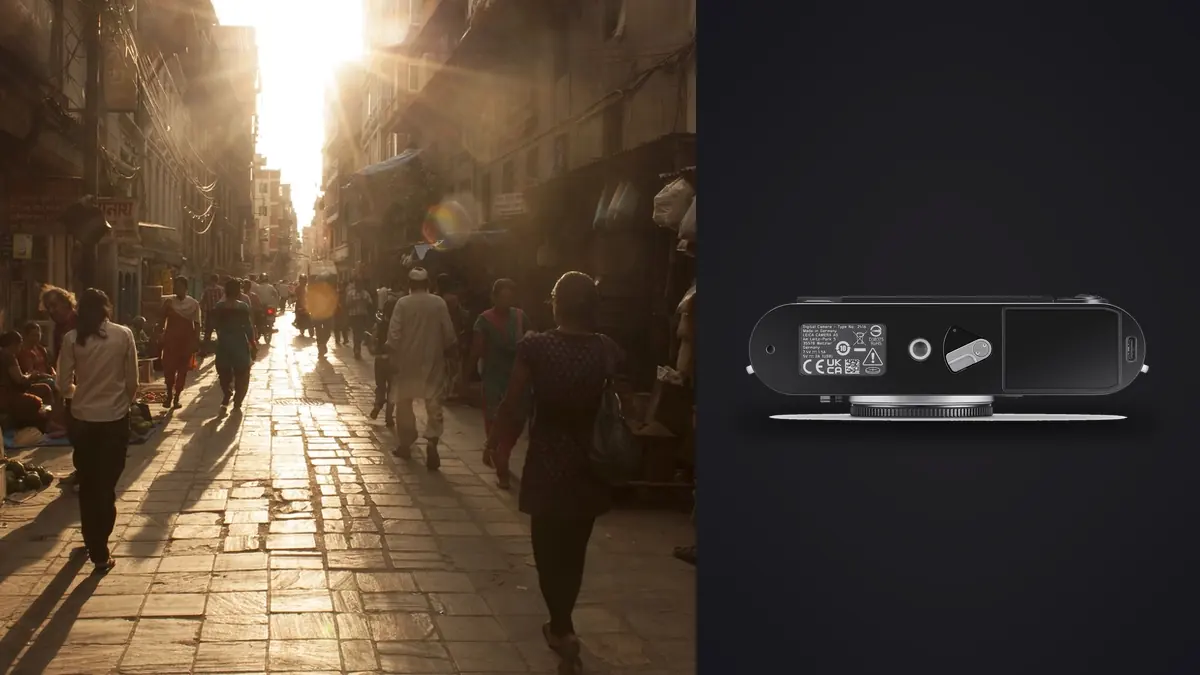
I bought my M11 used from a dealer in Berlin two years ago, mostly because I was tired of my Fujifilm X-Pro3 hunting for focus in doorway shadows while a scene disappeared in front of me. I did not buy it because I expected it to make me a better photographer. It didn't, not directly. What it changed was the rhythm of how I work a street, and for documentary projects where you're following a subject for an hour or a week, that rhythm matters more than almost any spec sheet number Leica publishes.
This isn't a spec-sheet review. There are plenty of those already, and most of them read like they were written by someone who shot the camera for a weekend in a controlled setting. I've carried the M11 through three long-form documentary projects now: a fishing community in Galicia, a closing steel plant outside Sheffield, and about four months of loose, ongoing coverage of a night market in Bangkok. What follows is what actually changed about my process, where the camera helped, and where it genuinely got in my way.
Why a rangefinder changes your instinct on the street
An optical rangefinder is not an EVF with the display turned off. You're looking through a window that shows you more than the frame lines mark, which means you see the person about to walk into your shot half a second before your composition tells you they're there. On a mirrorless body with an EVF, you're staring into a tunnel that shows exactly what the sensor sees and nothing else. That sounds like a minor difference until you're working a crowded market and you need to know, peripherally, that someone is about to step between you and your subject.
The tradeoff is focus confirmation. The M11's rangefinder patch is bright and the focus mechanism is smooth, but it is still a manual, mechanical system, and at f/1.4 with a fast-moving subject you will miss frames. I miss more focus on the M11 than I ever did with contrast-detect autofocus on the X-Pro3. I've made peace with that because the frames I do nail tend to have a different quality of composition, since I'm not waiting on an AF system to lock before I release the shutter. But if your documentary work leans toward fast action (kids, sports-adjacent scenes, anything with unpredictable subject speed) you need to know this going in. Zone focusing at f/8 to f/11 solves most of it, and I'll get into distances further down, but wide-open low light work on a moving subject is where the M11 asks the most of you.
Shutter sound and how close you can actually get
The M11's shutter is quieter than any SLR-derived mirrorless camera I've used, and quieter than the leaf shutter on a Fuji X100V, which surprised me the first time I heard them side by side in a quiet room. It's not silent. There's a soft mechanical click, closer to a pen clicking than a camera firing. For documentary work where you need to stay close (arm's length, sometimes closer) without breaking a moment, that matters more than almost any other spec. I've photographed a family argument from four feet away and had nobody turn toward the sound. That would not have happened with my old Nikon DSLR.
Files, resolution modes, and what you actually need
The 60-megapixel sensor produces DNG files that run 80 to 110 MB depending on scene complexity, and Leica gives you three capture resolutions baked into the sensor itself rather than as a crop-and-hope-for-the-best option: 60MP (BSI triple-resolution full), 36MP, and 18MP. This isn't marketing fluff, it's genuinely useful for documentary shooters who need to manage card space and later editing load across a long assignment. I shoot 36MP for almost everything now. It's a meaningful jump down in file size from full resolution without giving up the print or crop flexibility documentary editors ask for.
| Resolution mode | Approx. DNG size | Best use on assignment | Buffer depth (UHS-II card) |
|---|---|---|---|
| 60MP (full) | 90-110 MB | Gallery prints, tight crops from a single decisive frame, static or posed portraits | ~15 frames before slowdown |
| 36MP | 55-65 MB | General documentary coverage, editorial delivery, most of a working day's shooting | ~30 frames before slowdown |
| 18MP | 28-34 MB | Long burst sequences, multi-week projects where card and drive space is tight, quick web turnaround | Effectively unlimited in practice |
The buffer numbers above are from my own cards, a mix of SanDisk Extreme Pro UHS-II SD cards, not Leica's published figures, and your mileage will vary with card speed and firmware version. The practical takeaway: if you're shooting a long documentary day, at 60MP you will hit the buffer wall during any real burst sequence, and on a rangefinder without continuous AF, bursts are already less useful than on a mirrorless body. I mostly shoot single frames or short two-to-three-frame bursts anyway, so the buffer rarely becomes the bottleneck it would be on an event shooter's card.
Lens choices that actually earn their keep on assignment
I carry two lenses for documentary work and almost never a third. The 35mm Summicron-M f/2 ASPH lives on the body most days. It's small enough that the whole kit disappears into a jacket pocket, and 35mm on a full-frame sensor gives you enough context in the frame to tell a story without forcing you into a wide-angle distortion that flattens faces at close range. The second lens is a 28mm Elmarit f/2.8, which I pull out specifically for interiors and cramped market stalls where 35mm doesn't get me enough of the room.
I tried working with a 50mm Summilux for a few weeks on the Sheffield steel plant project and gave up on it for documentary purposes specifically. It's a beautiful lens for portraits, but 50mm on the street asks you to stand further back from your subject than most documentary moments allow, and by the time you've repositioned, the moment is gone. That's a personal workflow observation, not a knock on the lens itself.
Zone focusing distances I actually use
With the 35mm Summicron at f/8, focused to 3 meters, you get acceptable sharpness from roughly 1.8 meters to infinity. That's my default walking-around setting for most daylight documentary work; I set it once in the morning and rarely touch the focus ring again until light drops. At f/5.6 the same 3-meter setting narrows to roughly 2.2 meters to about 12 meters, which is still generous for most street distances. Once you drop to f/2 for low light, you're back to critical rangefinder focusing on every frame, no shortcuts.
Battery, weight, and the parts nobody photographs for the review
The M11 uses USB-C charging directly in the body, which sounds like a small thing until you're on week three of a project in a place with unreliable power and you can top up from a power bank in a cafe rather than hunting for a proprietary dock. Battery life is rated around 700 shots per charge by Leica's own testing, but in practice, with the screen mostly off (I chimp far less than I did on my Fuji, since I trust the rangefinder more than I trusted the EVF), I've gotten closer to 900-1000 frames on a single charge during a documentary day. The body itself is lighter than the M10 generation thanks to the aluminum top plate rather than brass on some finishes, which matters after eight hours of carrying it on a strap.
There's no weather sealing rating Leica publishes for the M11 the way, say, an OM-1 or a Nikon Z9 gets rated. I've shot it in light rain in Galicia without incident, but I wouldn't take it into a downpour on purpose the way I would a properly sealed body. For documentary work that regularly puts you in unpredictable outdoor conditions, that's worth knowing before you commit a project's budget to the system.
What happens after the shoot: sorting a manual-focus body's frames
This is the part most reviews skip entirely, and it's where a manual-focus rangefinder actually creates a different problem than an autofocus body does. Because focus misses on the M11 happen at the moment of capture and not because a system failed, you end up with a specific pattern in your take: clusters of near-identical frames where you fired two or three times on the same gesture because you weren't fully sure the first one was sharp. On the Bangkok market project I came home with just over 4,000 frames across four months, and a meaningful chunk of those were duplicate attempts at the same handful of moments.
Sorting that by eye, frame by frame, at 100% zoom to check focus, is exactly the kind of task that eats an entire evening. I run everything through imagic before I open Lightroom now. It scores actual sharpness per frame locally on my laptop, so the near-misses where I thought I nailed focus but actually caught the rangefinder patch a hair off get flagged before I waste time editing them, and it clusters the near-duplicate bursts so I'm choosing between three similar frames instead of scrolling past all of them individually.
The offline part matters more for this kind of work than it might for a wedding photographer's take. Documentary photography, especially the kind that involves people in vulnerable situations (workers losing their jobs, families in a dispute, market vendors who didn't necessarily sign a formal release) comes with a real obligation not to have those images sitting in someone else's cloud storage before you've even decided what to do with them. imagic processes everything on the machine in front of me, nothing uploads anywhere during the cull, which is one less thing to explain to a subject who asks where their photo is going.
Building a consistent look across a long project
Documentary work that stretches across weeks or months needs visual consistency, or the final edit reads like three different photographers shot it. I settled on a fairly desaturated, slightly cool black-and-white treatment for the Sheffield project after about two weeks of manually adjusting each import in Lightroom, and it was slow going. Once I had a set of edits I was happy with, I trained imagic's apply_my_style feature on roughly 150 of those finished frames, and it now applies a version of that same tonal treatment to new imports automatically, based on my own editing choices rather than a generic film-emulation preset. I still go in and adjust individual frames, particularly anything shot in mixed tungsten and daylight, but starting from something close to my own style rather than a flat default cuts real time out of a long project's post-production.
If you're coming from a workflow built around automated culling tools on a high-volume mirrorless body, expect the M11's take to behave a little differently: fewer total frames per outing than a fast-burst mirrorless shooter would generate, but a higher proportion of focus misses to sort through, since there's no AF system catching mistakes before the shutter fires.
Where the M11 loses to cheaper options
I want to be honest about this because most Leica writing avoids it. A Ricoh GR III costs a small fraction of the M11 and lens combination, fits in a coat pocket entirely, and its autofocus and snap-focus mode will out-perform manual rangefinder focusing in fast, chaotic street scenes almost every time. A Fujifilm X100V gets you close to the rangefinder-adjacent shooting experience, with a hybrid viewfinder that can switch to EVF when you need focus confirmation, at under a fifth of the M11's price for body and equivalent lens.
| Camera | Viewfinder | Focus method | Approx. body weight | Best fit for documentary work |
|---|---|---|---|---|
| Leica M11 | Optical rangefinder | Fully manual | 530g | Slow, deliberate long-form projects; low-light discretion; subjects where shutter sound matters |
| Fujifilm X100V | Hybrid optical/EVF | Hybrid AF with manual override | 478g | Faster-moving scenes, travel documentary, shooters wanting AF as a safety net |
| Ricoh GR III | None (rear screen only) | AF with snap-focus zones | 257g | Fully covert, pocketable, fast-paced urban scenes, minimal setup between shots |
| Leica M-A (film) | Optical rangefinder | Fully manual | 580g | Grant-funded archival projects where a specific film aesthetic is the point, not speed |
None of that is a knock on the M11. It's a different tool built for a different tempo of work. If your documentary style is grab-and-go, chase-the-action, the GR III or the X100V will serve you better and leave more money for travel and printing. If your style is closer to what I'd call embedded observation, where you're in a place long enough that people stop noticing you and the camera becomes almost incidental to the relationship, the M11's slowness is a feature, not a bug. It forces a kind of attentiveness that faster gear lets you skip.
Frequently Asked Questions
Is the Leica M11 too slow for documentary work involving movement, like protests or events?
It can be, depending on how you shoot. Zone focusing at f/8 or narrower gets you most of the way to usable speed for walking-pace subjects, but for genuinely fast, unpredictable action (a scuffle breaking out, a sudden sprint) you will miss frames that an autofocus body would catch. I've covered a couple of protest situations with the M11 and came away with fewer usable frames than I would have on a Sony body, but the ones I got had a different, more considered quality to them.
Do I need the full 60MP resolution for documentary and street work?
Almost never, in my experience. I shoot 36MP for the large majority of assignments and only switch to full 60MP when I know a specific frame is heading toward a large gallery print. The smaller files at 36MP or 18MP mean faster imports, less storage burden across a long project, and a meaningfully deeper buffer if you do end up in a burst situation.
How do I manage the volume of near-duplicate frames from manual focus misses?
This was the biggest post-production headache I had in my first year with the camera, worse than I expected going in. Running the day's take through a local culling tool that scores actual sharpness and groups similar frames, rather than relying on Lightroom's flat filmstrip view, cuts the review time down substantially. I use imagic for this specifically because the analysis happens on my laptop rather than a cloud service, which matters given how often documentary subjects haven't formally agreed to their images going anywhere before I've made an editorial decision about them.
Is the M11 durable enough for extended field documentary projects?
Mechanically, yes. I haven't had a single hardware issue across two years and three long projects, including humidity in Bangkok that would worry me with some electronics. But there's no official weather-sealing rating, so if your project regularly puts you in real rain or dust, budget for careful handling rather than assuming the body will shrug it off the way a rated adventure camera would.