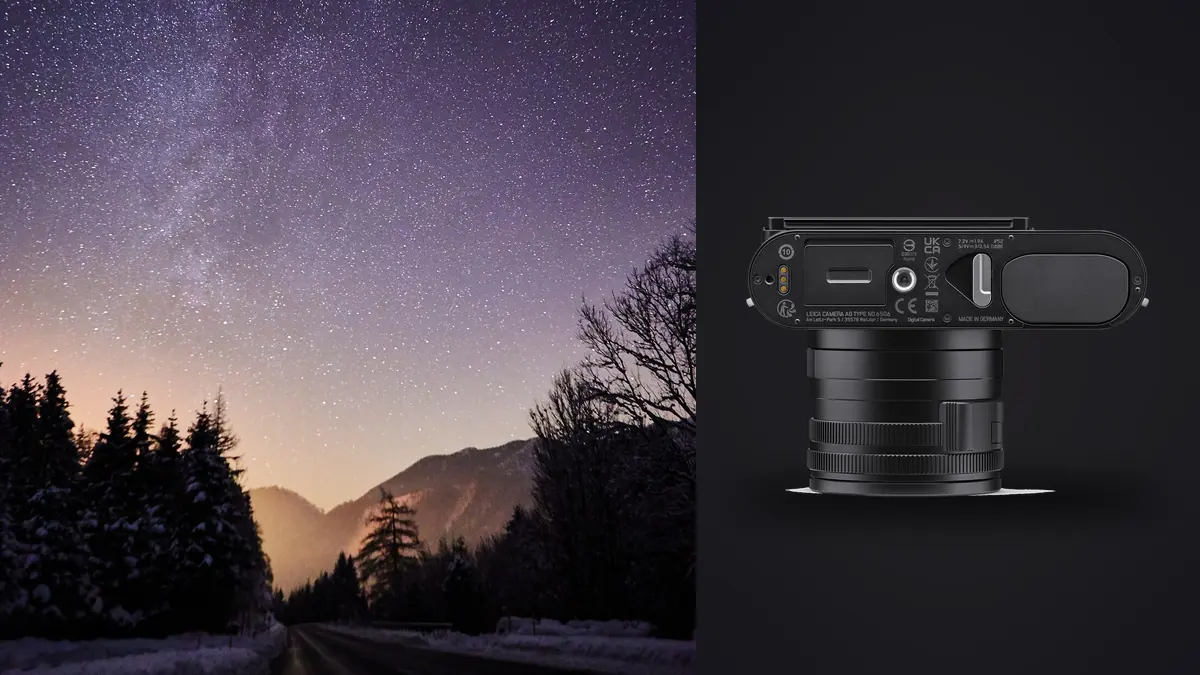
The Leica Q3 can make detailed wide-field night photographs with a compact kit. Its 60-megapixel full-frame sensor, fixed 28mm f/1.7 lens, tilting screen, and DNG capture are a useful combination for stars over landscapes. The same fixed lens is the central limitation: the buyer cannot switch to an ultra-wide foreground view, a coma-optimized third-party lens, or a telephoto star-field composition.
The right question is not whether the Q3 can photograph the night sky. It can. The buying question is whether a premium fixed 28mm camera matches the photographer's preferred sky scale and broader work. This assessment separates genuine advantages from constraints that resolution and cropping cannot remove.
Buy it for a 28mm way of seeing
A 28mm full-frame view includes a broad section of sky while giving the foreground more presence than an extreme ultra-wide lens. It suits the Milky Way over a ridge, stars above architecture, and travel scenes where landscape remains important. It is less suited to filling the frame with a small constellation or compressing a distant moon.
Use existing 28mm photographs to judge fit. If the strongest night compositions repeatedly come from that angle, the Q3's fixed lens can simplify decisions. If the work alternates between 14mm interiors of the sky and 85mm star fields, a fixed camera will create frustration regardless of sensor quality.
Digital crop modes do not change optical perspective or light gathering. They trim the captured image and reduce remaining pixels. They can aid framing, but they do not replace a longer lens. For astro purchase decisions, evaluate the full 28mm file and crop only as a delivery option.
Test the lens on stars, not daytime detail
Stars reveal optical behavior that buildings and portraits can hide. Coma, astigmatism, field curvature, color fringing, and decentered elements become visible as point lights move toward the corners. The Q3 lens is fast, but maximum aperture should be tested rather than assumed to be the best astro setting.
Make or obtain full-resolution DNG samples at several apertures, focused carefully at infinity. Compare center, middle, and all four corners. A small amount of stopping down may improve star shape enough to outweigh the lost light. The exact compromise depends on output size and whether corner stars are important to the composition.
Check the individual camera if possible. A fixed-lens body cannot solve a sample alignment issue by changing lenses. A night rental or retailer trial with return terms provides stronger evidence than a small web image. Focus at the actual temperature because lens behavior can shift as equipment cools.
Value compactness as a real field advantage
The Q3 removes lens choice and reduces the kit to camera, support, power, cards, dew control, and safety equipment. For hiking and travel, that simplicity can be meaningful. A camera that is carried to a dark viewpoint has more practical value than a larger system left behind.
Compact does not mean support-free. A stable tripod and head remain necessary for repeatable star frames and later stacking. The camera should be balanced securely, and the tilting screen can reduce awkward crouching at low angles. A remote release, interval method, or self-timer prevents contact during exposure.
Weather resistance does not eliminate dew or condensation. Use a hood and heater when humidity demands it, protect connections, and warm cold equipment gradually in a closed bag. The fixed lens means moisture or damage at the front affects the entire camera, which strengthens the case for careful protection.
Understand what 60 megapixels contribute
High resolution records fine foreground detail and leaves crop room when focus, lens performance, and stability support it. It also reveals small tracking trails, vibration, and corner weakness. Pixel count is not a substitute for accurate focus or a suitable exposure length.
Large DNG files increase card use, copy time, processing, and archive needs. A night sequence intended for stacking multiplies that cost. Test the workstation with a complete set, not one sample. If previews and alignment become a bottleneck, storage and compute belong in the purchase calculation.
Final output may reduce much of the file. That is not wasted if the detail supports print or correction, but it should be intentional. A photographer delivering only small online images may value compactness and lens rendering more than the full resolution.
Plan focus without interchangeable-lens shortcuts
Use magnified live view on a bright star and turn manual focus until it becomes the smallest, cleanest point. Do not trust the infinity end stop blindly. Make a test exposure and inspect both center and corners. Lock or mark the ring only in a way that cannot damage the lens or obstruct controls.
Recheck after temperature changes, after moving the camera, and before a long sequence. A tilting screen helps with low tripod positions, but screen brightness should remain low enough to protect night vision. Use the histogram rather than perceived preview brightness to assess exposure.
Autofocus may acquire a bright distant light, but manual confirmation remains the reliable standard for stars. If foreground focus will be separate, record it deliberately and avoid touching the tripod. Any blend or stack is completed later in appropriate software.
Assess untracked exposure and stacking needs
At 28mm, practical untracked exposure depends on declination, output resolution, aperture, and tolerance for star elongation. Simple rules based only on focal length can be too generous for a 60-megapixel sensor. Make progressively longer tests and inspect at the intended output.
Stacking several shorter sky exposures can reduce random noise while preserving tighter stars, but it adds alignment, edge loss, and workflow time. Keep exposure, aperture, and white balance consistent within the sequence. Leave framing space for alignment and record clear separators between compositions.
The Q3 captures source frames; dedicated software performs star alignment and combination. imagic can help review local files for sharpness and exposure and group similar frames, but it does not merge stacks. This distinction should be part of the buyer's workflow expectation.
Compare the Q3 with an interchangeable system
An interchangeable-lens body offers optical choice. The photographer can select a lens for cleaner corners, a wider foreground, more reach, or different manual-focus behavior. It also adds lens weight, decision time, sensor exposure during changes, and a larger travel kit.
The Q3 offers integration and simplicity. The fixed lens and body are always matched, the camera remains compact, and 28mm becomes a consistent visual language. That is valuable when astrophotography is one part of travel or documentary work rather than the sole purpose of the purchase.
If night sky is the primary discipline, compare the Q3 price and weight with a body plus one tested astro lens, tripod, tracker if needed, and dew equipment. Do not compare body specifications alone. The complete field kit and desired focal lengths determine fit.
Know the situations it cannot solve well
The fixed lens cannot provide true ultra-wide coverage for very large sky arcs or tight spaces. It cannot switch to a longer focal length for nebula-scale compositions. Cropping cannot recreate the perspective, aperture, or subject size of another lens.
The camera is also not a substitute for a tracking mount when long exposures at greater sky detail are required. A star tracker introduces alignment, power, and foreground complications but addresses Earth's apparent sky motion in a way a camera body cannot.
Finally, high resolution does not overcome poor access, cloud, moon position, light pollution, or unsafe terrain. Site planning will often improve a night image more than changing cameras. Check legal access, weather, moon, horizon, and return route before committing to the location.
Use a complete buying trial
- Photograph stars at several apertures and inspect all four corners.
- Make a short untracked sequence and process it in the intended stacking software.
- Carry the full tripod, dew, power, and safety kit to a real viewpoint.
- Focus at night with the tilting screen and normal gloves or eyewear.
- Process the DNG files and export at the largest expected size.
- Compare the same composition with an interchangeable-lens alternative.
Buy when the 28mm view, compact body, and broader photographic use all align. Look elsewhere when focal-length choice or a dedicated astro lens is central. More system comparisons are available in the camera hardware guides.
Plan travel power and data for large DNG sequences
A compact camera does not guarantee a compact data problem. Several 60-megapixel DNG sequences can fill cards and portable storage quickly. Estimate one complete night, include test and foreground files, then carry enough verified capacity without planning to delete under a dark sky.
Use a card case with clear ready and exposed positions. At accommodation or a safe work area, copy the whole card, verify samples and counts, and create the required independent backup before reuse. Avoid opening the camera or card case in blowing sand, rain, or heavy condensation merely to start an early ingest.
Cold affects battery endurance. Carry charged spares in an inside pocket, reduce unnecessary review, and know whether any external power method is suitable for the camera and tripod position. A hanging cable can transmit wind movement, so secure it with enough slack and keep connections away from wet ground.
When traveling across time zones, set the camera clock deliberately and record the change. Star sequences, foreground exposures, and scouting images may be sorted by time later. Correct metadata makes it easier to match them with notes about moon position, weather, and location.
Keep one card unused as reserve rather than distributing every byte to planned sequences. Weather delays, an unexpected clear window, or a corrupted card can change the night. Data margin is the storage equivalent of a spare battery.
Before departure, test one complete copy from card to travel storage and open a DNG on the device that will verify it. A cable that charges but does not transfer, an unsupported card reader, or a nearly full destination can defeat an otherwise careful plan.
Separate the night folders by composition and sequence before any stacking begins. Keep tests, foregrounds, sky sources, and rejected bumped frames labeled. This prevents a visually similar file from entering the wrong alignment set after several travel days.
Keep the original card order in metadata or a manifest. It provides a reliable path back when two compositions share exposure settings and nearly identical star patterns.
Frequently asked questions
Is the Leica Q3 a dedicated astrophotography camera?
No. It is a premium fixed-lens general camera that can make strong wide-field night images. Its fit depends on whether 28mm matches the photographer's preferred compositions.
Can crop modes replace a longer astro lens?
No. They trim the 28mm capture and reduce remaining resolution. They do not change perspective, optical magnification, or light gathering.
Does the Q3 stack stars inside this workflow?
The camera records the DNG source frames. Alignment and stacking are completed later in dedicated software, with a method suited to the sky and foreground.