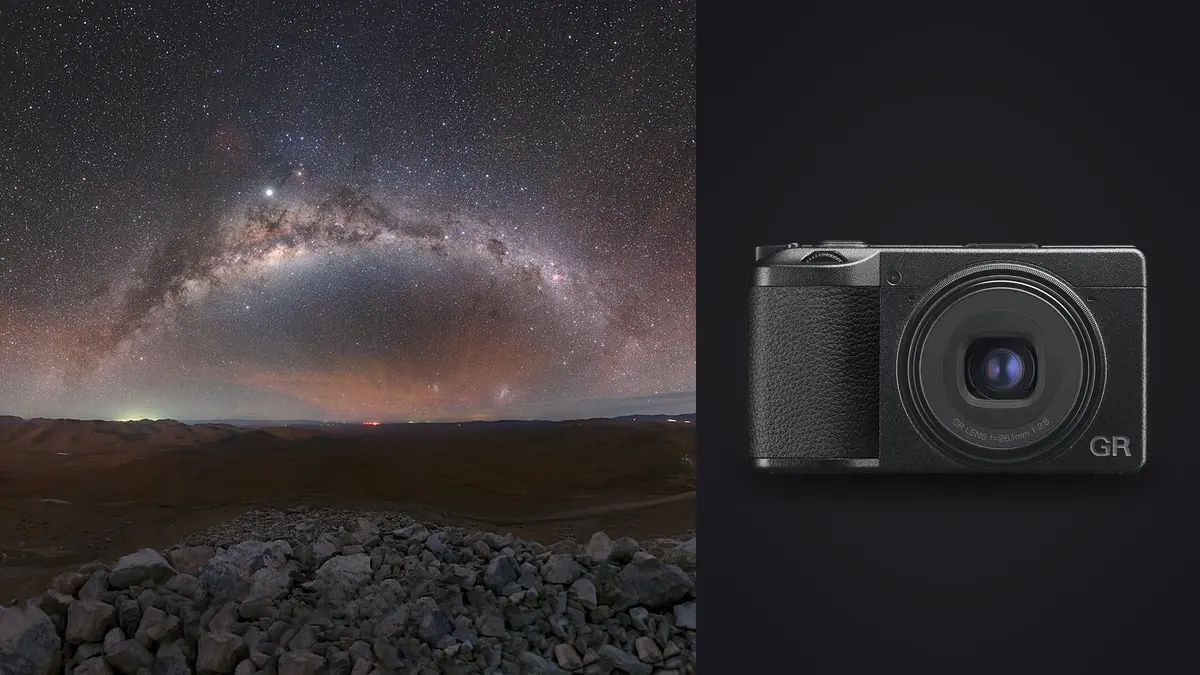
I didn't buy a Ricoh GR IIIx to shoot stars. I bought it because it fits in a jacket pocket and the 40mm equivalent field of view matches how I actually frame a scene when I'm walking around at night. It took a week at a friend's place in rural Portugal, a genuinely dark sky with almost no light pollution, and an evening where the GR IIIx was the only camera in the bag, before I pointed that little compact straight up and tried to make something useful out of a few thousand stars instead of streetlights.
The short answer is that it works, but not the way a dedicated astro rig works, and the workarounds matter more than the spec sheet does. What follows is what I learned running the GR IIIx through real star stacking sessions over about a dozen nights across two trips, not a lab test with a single frame grabbed for a review.
Why this camera is the wrong tool on paper
Start with the honest case against it. The GR IIIx has a fixed 26.1mm lens (40mm full-frame equivalent) at a maximum aperture of f/2.8. That's a perfectly good aperture for a walkaround compact and a mediocre one for astro, where a lot of people are shooting f/1.4 to f/2 to pull in as much light as possible in a 15 to 20 second window before stars start to trail. There's no way to swap in something faster. Whatever light f/2.8 lets in is the ceiling for every session.
The field of view is the bigger practical limit, honestly, more than the aperture. 40mm is a portrait-and-street focal length. It's too tight to get a sweeping Milky Way arch with foreground in a single frame the way a 14mm or 20mm lens would. You either accept a tighter, more intimate composition (a section of the arch behind a specific tree or ridge line) or you shoot a panorama of several overlapping frames and stitch them, which adds a whole extra step most compact-camera owners never planned on doing.
Then there's the body itself. No cable release port, no hot shoe, no weather sealing on the standard GR IIIx, and a battery (the DB-110) that's rated for something like 200 shots under CIPA testing, which sounds fine until you realize a real star stacking sequence can easily run 60 to 200 exposures in one sitting. None of this is a surprise on a pocket camera built primarily for street photography. It just means the astro use case is one Ricoh clearly didn't design around, even though, as it turns out, they quietly built the tools to make it possible anyway.
What actually makes it work: the modes buried in the menu
The GR IIIx (like the standard GR III) has two shooting modes that exist specifically for long-exposure night work, and neither gets much attention in the marketing copy. The first is Interval Composite. Instead of one long bulb exposure, the camera fires a sequence of shorter frames at a set interval and additively combines them in-camera into a single output image. The second is a dedicated star trail recording mode that does something similar but is tuned for trail effects rather than pinpoint stars.
Why bother compositing short frames instead of just doing one long exposure? Because the GR IIIx doesn't have an actively cooled sensor, and a small APS-C sensor pushed to a five or ten minute single exposure builds up heat and hot pixels fast. Stacking, say, forty 15-second frames gets you the same total light-gathering time as a 10-minute exposure without the thermal noise penalty of doing it in one shot. It's the same logic dedicated astro cameras use, just implemented with firmware instead of a cooling fan.
Interval Composite versus a single long exposure
I tested both back to back on the same clear night, same tripod position, roughly matched total exposure time. The single long exposure (the closest the GR IIIx gets to bulb, using the Time setting on the mode dial, capped well under what a real bulb mode would allow) had visibly more speckled noise and a handful of stuck-bright pixels in the shadows once I pushed the file in post. The composited stack from the same total light was noticeably cleaner. That gap is the whole reason to bother with the interval mode instead of just cranking the shutter speed as long as the menu allows.
Since there's no cable release port, the other trick worth knowing is Ricoh's smartphone app, which can trigger the shutter over Bluetooth or Wi-Fi. Touching the camera body directly to start a long sequence, even gently, is enough to introduce a wobble on a lightweight travel tripod. Triggering from a phone two feet away removes that variable entirely.
Getting focus to actually land on infinity
This is the part that trips people up more than exposure math. The GR IIIx has no physical focus ring and no distance scale you can just twist to the infinity mark. Autofocus in near-total darkness mostly gives up, so you're doing manual focus through the touchscreen and the rear dial, using the digital focus assist that magnifies a section of the live view.
My routine now: focus on a distant point light (a streetlight, a far-off window, the moon if it's up) while there's still enough of it visible to lock onto, magnify the live view to confirm the point looks like a tight dot rather than a soft blob, then physically leave the focus setting alone for the rest of the session. No peaking overlay on this camera the way some mirrorless bodies have, so it's a manual visual check every time, not a glance at a colored highlight. If I bump the ADJ lever by accident mid-sequence, I lose focus and don't always notice until I'm looking at frames on a bigger screen later, which is exactly the kind of mistake that turns a 60-frame session into 40 usable frames and 20 soft ones.
Settings from three actual nights
These aren't theoretical numbers pulled from a manual. They're what I dialed in for three different outcomes I was actually trying to get, on nights with Bortle 3 to 4 skies.
| Goal | Camera mode | Aperture | ISO | Frames × shutter | Output |
|---|---|---|---|---|---|
| Confirm composition and focus before committing | Manual (M) | f/2.8 | 3200 | 1 × 20s | Single DNG |
| Fast in-camera preview, no laptop needed | Interval Composite | f/2.8 | 1600 | 40 × 15s (~10 min) | One composited JPEG |
| Maximum detail for later stacking | Interval shooting, raw | f/2.8 | 1600 | 60 × 13s (~13 min) | 60 separate DNGs |
| Star trails over a foreground silhouette | Interval Composite (trail) | f/4 | 400 | 200 × 15s (~50 min) | One composited JPEG |
The 13-second shutter for the raw sequence isn't arbitrary. It's roughly where the 500-rule math lands for a 40mm equivalent lens before individual stars start to show visible elongation at full-size review. I stopped down slightly to f/4 for the trail sequence because at f/2.8 the trails bloomed a bit more than I liked against a bright foreground light, and depth of field wasn't the concern there.
The battery and dew problem nobody puts in the spec sheet
A 200-shot battery rating turns into an actual number once you're running a 60-frame raw sequence plus test shots plus chimping the screen between attempts. On a cold night I've drained a full battery in under two sessions. I now carry two spares and treat a battery swap as a scheduled break rather than an emergency, because the alternative is losing a sequence halfway through and having to start over.
Dew is the other thing nobody warns you about with this specific body. There's no lens hood included, so the front element is exposed, and in anything above moderate humidity it fogs faster than I expected for a lens this recessed. My fix is unglamorous: a rubber band wrapped around a chemical hand warmer packet, snugged against the barrel, refreshed every hour or so. It's not elegant, but it's kept three sessions from ending early with a foggy front element.
Turning sixty near-identical frames into one usable stack
Shooting raw for an external stack means the actual camera work is the easy half. The harder half starts once you're looking at 60 to 80 DNGs on a laptop, most of which look nearly identical at a glance and a handful of which have a plane trail through them, a gust-induced wobble, or the focus drift I mentioned earlier. Free stacking tools like Sequator or Starry Landscape Stacker will align and blend the stars for you, but they still expect you to hand them a clean set, and garbage frames pull the average down.
This is where I stopped doing the review by eye. I run the sequence through imagic first, using its local sharpness scoring to flag which frames in the burst are actually crisp versus which ones softened from a tripod nudge or a focus slip, and the duplicate and burst clustering to group the near-identical exposures instead of scrolling through them one at a time. Since it processes everything on-device, I can do this culling pass at the cottage with no signal at all, rather than waiting to get somewhere with a connection before touching sixty gigabytes of RAW files. If that kind of frame-by-frame review is new to you, how AI photo culling actually works covers the mechanics in more detail than I have room for here.
Once I've got the clean subset, I stack them, then apply imagic's apply_my_style preset, trained on my own past edits, so the final look matches the rest of my night photography instead of looking like a one-off experiment. It's a small thing, but consistency across a portfolio matters more than any single frame does, and doing that step by hand across every stacked image would eat an evening I'd rather spend shooting the next one. For anyone doing this regularly, tightening the review pass is worth more than any single camera setting; these workflow habits apply just as much to a folder of star frames as they do to a wedding take.
When I leave the GR IIIx at home
I want to be straight about the limits, because I've seen people talk themselves into buying this camera specifically for astro and then feel let down. If the goal is a genuine deep sky target, a nebula, a galaxy at real magnification, this isn't that camera and no amount of technique fixes a fixed 40mm f/2.8 lens. If I want a wide Milky Way arch with a mountain range underneath it in one clean frame, I bring something with a 14 to 20mm lens at f/1.8 or faster, ideally on a star tracker.
Where the GR IIIx earns its spot in the bag is the opposite situation: a spontaneous clear night where a full kit isn't coming with me, a moonrise composition where the tighter field of view actually compresses the scene nicely, or a foreground-heavy trail shot where portability mattered more than raw light-gathering. It's the camera that's actually with me on the nights the "real" astro setup stayed in a drawer at home.
Frequently Asked Questions
Does the GR IIIx have a true bulb mode for long star exposures?
Not in the traditional sense. There's no cable release port and no unlimited bulb setting tied to a physical shutter button hold. The Time setting on the mode dial gets you longer single exposures than standard shooting, but for anything past roughly 30 seconds of effective light gathering, the Interval Composite mode is the more reliable path, since it stacks shorter frames instead of relying on one long sensor exposure.
Is the 40mm equivalent lens too tight for Milky Way photography?
For a full arch shot with wide foreground, yes, it's tighter than what most dedicated astro lenses offer. It works well for a section of sky framed against a specific subject, and it's workable for panoramas if you're willing to shoot and stitch several overlapping frames. I wouldn't buy this camera specifically to shoot wide starscapes, but I wouldn't leave it home either if it's what's already in my pocket.
How many frames does a stack actually need to look clean?
On this sensor, I've found the noticeable improvement plateaus somewhere around 40 to 60 frames at ISO 1600. Below 20 frames the stack still looks visibly noisy next to a longer sequence. Past roughly 80 frames the gains get small enough that I'd rather stop and try a second composition than keep shooting the same one.
Should I shoot raw or JPEG for star stacking on this camera?
Raw (DNG) for anything you plan to stack externally in something like Sequator, since you want full control over noise reduction and white balance across the set. The in-camera Interval Composite output is JPEG only, which is fine for a quick preview or a trail shot you don't intend to push hard in post, but it throws away the latitude you'd want for a pinpoint-star stack you're serious about.