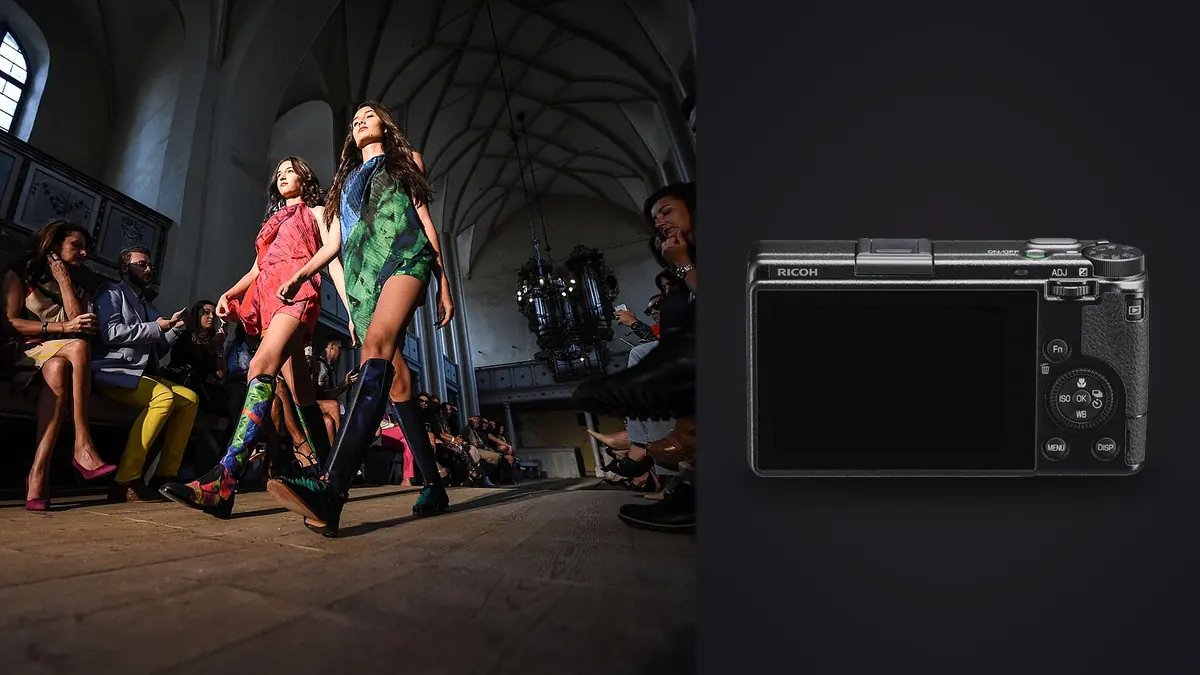
Nobody puts a Ricoh GR IIIx on a call sheet as the hero camera. It doesn't have a viewfinder most people bother using, it can't change lenses, and its buffer runs out of room after about ten raw frames if you lean on the shutter. And yet on a growing number of lookbook shoots, there's a GR IIIx in someone's jacket pocket the whole day, and by the end of the shoot it's often produced the images the client actually reposts. This is about why that happens, what the camera is genuinely good at in a commercial fashion context, and where it will let you down if you try to make it the only camera in the room.
Why a fixed 40mm compact earns a spot on a fashion set
The GR IIIx is the longer-lens sibling in Ricoh's GR line. Where the standard GR III carries a 28mm-equivalent lens, the IIIx swaps in a 26.3mm optic on the same 24.2MP APS-C sensor, which works out to roughly a 40mm field of view once you account for the crop factor. That focal length sits in an odd spot for street photography purists, some of whom find it too tight for the wide, in-your-face GR aesthetic. On a lookbook set, though, 40mm is close to how a person actually sees a room, and that turns out to be exactly what you want for walk shots, in-between moments, and anything you're trying to make look unstaged. A 28mm lens flatters nothing at close range on a full-body subject; get near enough for a waist-up crop and you start bending the edges of the frame. A GR IIIx at 40mm lets you stand close enough to work fast in a hallway or a cramped studio corner without the model's proportions warping, while still being wide enough that you're not backing into a wall trying to fit two people in frame during a duo look.
The in-camera crop modes, and when they're actually worth using
Ricoh gives the IIIx two digital crop options beyond its native 40mm: a 50mm-equivalent crop and a 71mm-equivalent crop, both taken from the center of the sensor and both costing you resolution. It's tempting to treat these like a built-in zoom, but they're closer to a cropped-in-post shortcut that happens to update your composition on the rear screen before you press the shutter. Here's roughly how the tradeoffs break down on a shoot day.
| Mode | Approx. output resolution | Best lookbook use | Where it falls apart |
|---|---|---|---|
| Native 40mm | ~24MP | Full-body walk shots, environmental portraits, most of the day's work | Too tight for wide group setups in small rooms |
| 50mm crop | ~12MP | Tighter torso-up shots without moving closer and spooking a nervous model | Print crops beyond A3 start showing softness |
| 71mm crop | ~7MP | Grabbing a candid expression from across the room during a lighting reset | Basically unusable for anything a client wants to print large |
In practice, shoot native 40mm for the vast majority of a lookbook day and only reach for the 50mm crop when you want a tighter frame without physically closing distance, usually because closing distance would put you in someone else's shot or break a model's concentration mid-walk. The 71mm crop is a novelty worth using maybe twice a shoot, almost always for a behind-the-scenes frame rather than anything destined for the actual lookbook.
Snap focus turns a fixed lens into a fast one
Autofocus hunting is the enemy of any candid documentary shot, and the GR IIIx's contrast-detect AF, while perfectly fine for static setups, is not what you want chasing a model mid-stride under mixed studio and window light. Snap focus solves this by letting you preset a focus distance (1m, 1.5m, 2m, 2.5m, 5m, or infinity) and fire the shutter instantly at that distance the moment you half-press, no hunting at all. Set the snap distance to roughly where your subject will be when they hit their mark in a walk-through, hold the shutter down halfway as they approach, and fire the instant they cross that plane. This is basically zone focusing with a digital assist, and it's the single biggest reason the GR IIIx keeps up on a set where models are moving and light is changing between every look. I keep it dialed to 2m for most in-studio walk shots and bump it to 5m for anything shot from across a larger space, like a warehouse or a loft location.
Image control profiles are a starting point, not a delivered look
The GR series ships with in-camera color profiles like Positive Film and a couple of black and white variants, and they're genuinely fun to shoot with, especially if you're chasing that slightly gritty digicam look that a lot of younger fashion brands have been asking for on their lookbook and social crossposts. But a client-facing lookbook needs a consistent grade across every camera and every photographer who touched the shoot, and an in-camera JPEG profile isn't going to match what came off a tethered mirrorless body five feet away. What I actually do is shoot DNG raw on the GR IIIx, ignore the in-camera profile entirely, and once the frames are pulled onto a laptop, run them through imagic's apply_my_style preset, which is trained on the brand's own previously graded edits rather than a generic filter. That keeps the compact-camera frames feeling like they belong in the same lookbook as the primary camera's output instead of reading as an obviously different device. Because imagic processes everything locally, unreleased campaign images never get pushed to a cloud service mid-shoot, which matters more than it sounds like on jobs covered by an NDA.
Where the GR IIIx belongs in a lookbook production, and where it doesn't
I want to be clear that this camera is not replacing a medium format body or a tethered mirrorless setup for the hero product shots. Anything that needs precise, repeatable color for a catalog page, anything the client wants to review frame by frame on a calibrated monitor as it's shot, and anything requiring a longer lens for a compressed beauty crop is still going to a proper studio camera. The GR IIIx's job is the coverage around that: the walk from the dressing area to set, the moment between poses when a model's expression relaxes, the texture detail on a fabric that a longer macro lens on the main body would take too long to set up for. Fixed lens compacts have become a fairly common secondary tool on fashion sets for exactly this reason, so it's worth comparing where the GR IIIx sits against the other cameras that show up in the same role.
| Camera | Effective focal length | Weight (body) | Discretion on set | Typical role |
|---|---|---|---|---|
| Ricoh GR IIIx | 40mm fixed | ~257g | Very high, pocketable, near-silent leaf shutter | Candid/BTS, walk shots, texture detail |
| Ricoh GR III | 28mm fixed | ~257g | Very high | Wide environmental frames, tighter spaces |
| Fujifilm X100VI | 35mm fixed | ~521g | High, but noticeably larger in hand | Hybrid stills/video BTS with more control |
| Phone in a case | Varies, usually 24-28mm | ~200g | Highest, but instantly recognized as "not the real camera" | Client social content, quick reference shots |
The GR IIIx wins the discretion category by a wide margin against anything with a viewfinder hump or an obvious camera silhouette. Models and stylists stop noticing it after the first ten minutes in a way they never fully do with a Fuji or a full mirrorless body pointed at them between poses.
Burst shooting a walk cycle creates a culling problem fast
The catch with using the GR IIIx for walk shots is that getting the one frame with the right stride, the right arm position, and a clean expression usually means firing several bursts as the model comes down the line. At around 4fps with a buffer that starts protesting after roughly ten raw frames, you're not shooting like a sports photographer, but across a full day of walk-throughs, look changes, and re-shoots, the near-duplicate frames pile up fast, and they look almost identical on a laptop screen at a glance. This is the point in the day where I stop trying to eyeball which frame is sharpest and let software do it. I run the card through imagic and let its local sharpness scoring flag the technically sharpest frame in each burst, then use the duplicate and burst clustering to group the walk-cycle sequences together instead of scrolling through forty visually similar thumbnails one at a time. If you haven't looked at how that kind of automated scoring actually works under the hood, this breakdown of how AI photo culling works covers the sharpness and clustering logic in more detail than I'll get into here. The short version for a lookbook day: it turns a twenty-minute squint-at-thumbnails task into something closer to five.
Storage and card discipline on a shoot day
DNG files off the GR IIIx run somewhere in the 25 to 30MB range depending on scene complexity, which sounds modest until you've shot four or five hundred frames chasing walk cycles and candid moments across a ten-hour day. Carry at least two 128GB cards and swap rather than delete on set, because deleting in-camera to make room is how you lose the one frame you actually needed. At the end of the day both cards get offloaded and backed up before anything gets touched for editing. Because the GR IIIx has no weather sealing rated for anything beyond light dust and the occasional splash (Ricoh calls it a dust and moisture resistant structure, not a waterproof one), Keep it in a jacket pocket rather than a bag pouch on any outdoor lookbook shoot where the weather is uncertain. It can get through a light drizzle on a rooftop shoot without complaint, but don't test it in anything heavier.
Battery life is the one spec that will actually catch you out
CIPA rates the GR IIIx at roughly 200 shots per charge, which is low even by compact camera standards, and real-world use with the screen on constantly for framing checks lands somewhere in that neighborhood or a little under it. USB-C charging means you can top up from the same battery bank powering a strobe or a laptop between setups, but if you're planning to shoot several hundred frames across a long lookbook day, bring at least one spare battery. I learned this the hard way on a shoot where the only backup was a phone charger with the wrong cable.
What limits the GR IIIx as a primary lookbook camera
Beyond battery life, the fixed 40mm lens is the real ceiling. There's no changing to something wider for a tight interior location, and no reaching for something longer for a genuinely compressed beauty crop, only the two soft digital crops discussed above. Macro mode brings the minimum focus distance down to around 12cm, which is enough for fabric texture and small accessory detail but not a substitute for a dedicated macro lens on a product shot that needs to fill frame with a button or a stitch. There's also no electronic or optical viewfinder built in (Ricoh sells an optional optical finder that clips into the hot shoe, but it's an extra piece of gear to keep track of), so composing in direct sun means shading the rear screen with your hand more often than you'd like. None of this rules the camera out of commercial work. It just means it earns its place as a second camera, not a first one, and the shoots where it works best are the ones where a photographer already knows to hand off the raws to a fast culling pass rather than trying to review every burst by eye between setups.
Frequently Asked Questions
Is the GR IIIx actually sharp enough for print lookbooks?
At base ISO and native 40mm, yes, comfortably. The lens is genuinely one of the sharper fixed optics in this class stopped down to f/4 or f/5.6, and the files hold up fine for a printed lookbook spread. Where it gets shakier is high ISO in dim studio corners or diffraction past about f/8, and honestly the bigger risk on a shoot day isn't the lens, it's picking a slightly soft frame out of a burst by accident. Running the day's take through imagic's sharpness scoring before sending anything to a retoucher catches that before it becomes a print problem.
Should I shoot the crop modes or just crop wider shots later in post?
For anything going to print, shoot native 40mm and crop later if you need to, since you'll keep the full 24MP of data to work with instead of committing to a 12MP or 7MP file in-camera. The crop modes are worth using live only when you need to confirm a tighter composition in the moment, usually for a quick behind-the-scenes frame rather than a hero image.
How does a GR IIIx lookbook frame compare to shooting the same moment on a phone?
The physical controls are the real difference. Snap focus and a dedicated aperture ring let you preset a shot and fire it instantly without touching a screen, which matters when a model hits a mark for half a second. Raw files also give a colorist far more room to match a grade across cameras than a phone's processed output does, which is the whole reason to bother carrying a second camera instead of just using whatever's already in your pocket.
Can one photographer realistically run the GR IIIx alongside a main studio camera on the same job?
Yes, and it's fairly common, but it only works if the culling step is fast. Trying to manually sort a few hundred near-duplicate walk-cycle frames from a compact camera on top of the main camera's take is where days run long. Treating the GR IIIx card as its own quick culling pass, rather than mixing it into the main edit from the start, keeps the workflow from bottlenecking at the end of the day. If speed on exactly this kind of high-volume day is the goal, these workflow tips are worth a look, and pairing a fast local culling tool with a one-time purchase rather than another subscription (imagic's pricing is laid out on the pricing page) keeps the cost of adding a second camera to your kit from creeping up over a season of shoots.