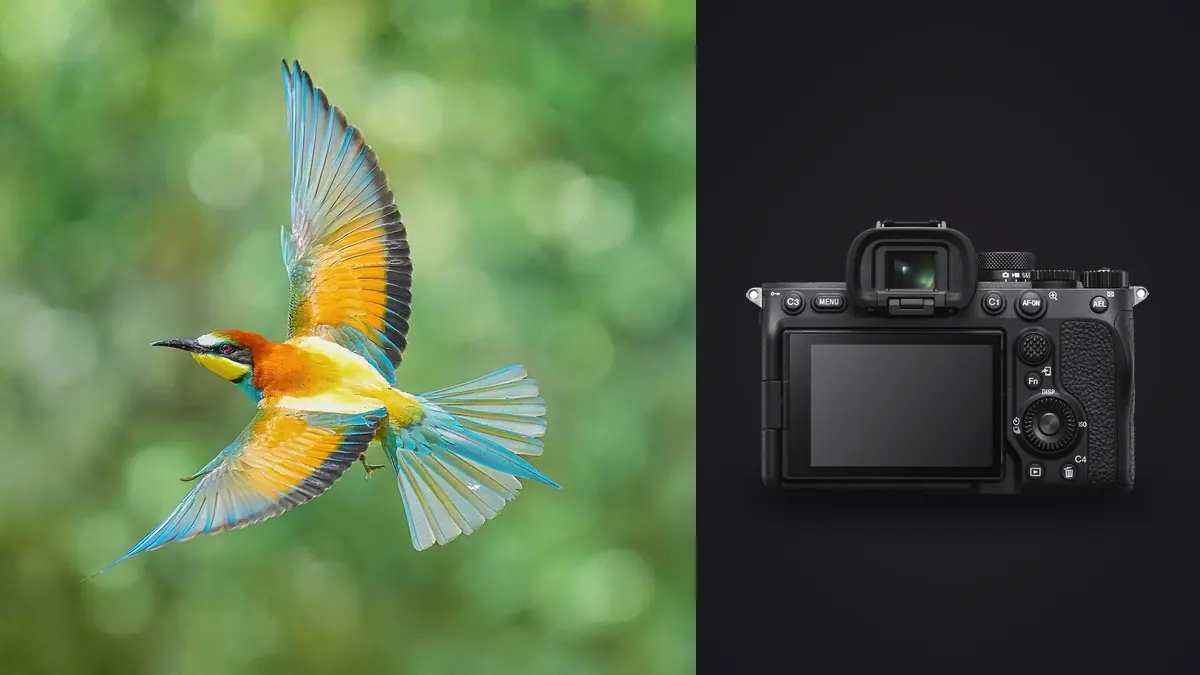
I bought my A7 IV expecting it to slot in as a general-purpose body that could handle wildlife on the side. Two seasons of shorebirds, ospreys diving on a tidal flat, and one genuinely miserable week trying to track swifts against a bright sky taught me something more specific: it is a good camera for birds in flight, not a camera built around birds in flight the way Sony's own A9 line is. That distinction gets lost in spec-sheet comparisons, but it changes how you shoot, what lenses make sense, and how many frames you throw away afterward.
The Honest Autofocus Picture
The A7 IV has 759 phase-detection points spread across roughly 94% of the frame, and subject recognition for birds arrived through a firmware update rather than shipping day one. Once it's on, bird eye detection is genuinely useful for anything perched, anything gliding, and anything flying a predictable line toward or across you. It struggles more with the stuff every bird photographer actually wants: a tern folding into a dive, a swift juking through a swarm of midges, a raptor banking hard against a cluttered treeline. In those situations the tracking box will occasionally jump to a wingtip or lock onto a background branch for half a second, and that half second is usually the frame you wanted.
None of this means the autofocus is bad. It means it's tuned for a broader customer than a dedicated bird shooter, and the algorithm prioritizes stability over aggression. If you're coming from an older body like an A7 III or an A6400, the jump is real and welcome. If you're comparing it against an A9 II or A1, you'll notice the difference in erratic-flight scenarios within the first outing.
Ten Frames a Second Is the Real Ceiling
Burst rate is where the A7 IV shows its hand as a hybrid stills/video body rather than a sports camera. Hi+ mode tops out at 10fps with full AF/AE tracking on either the mechanical or electronic shutter. That's fine for a heron flapping past at a measured pace. It is not fine for anything with a fast wingbeat cycle, because at 10fps you're sampling roughly one frame per wingbeat on a small fast-flying bird, which means you get either the wings up or the wings down and almost never the clean mid-stroke position that makes a flight shot read as sharp and intentional. Photographers who've shot a 20fps body get spoiled fast, and going back to 10fps for something like plovers or swallows takes real adjustment: more panning practice, more patience, more tolerance for missed strokes.
The workaround I've settled on is accepting a lower hit rate and shooting longer sequences rather than shorter, precise ones. Where I used to fire 8-10 frame bursts on my old body, I now hold the shutter through 20-30 frame passes on the A7 IV specifically to raise the odds that one frame lands the wing position I want. That produces a lot of near-duplicate material to sort through afterward, which is its own problem I'll get to.
| Lens | Focal Range | Weight | Teleconverter Support | Field Notes |
|---|---|---|---|---|
| Sony FE 200-600mm f/5.6-6.3 G | 200-600mm | 2,115g | Not supported | Best value reach for the A7 IV; AF slows noticeably past 500mm in low light |
| Sony FE 100-400mm f/4.5-5.6 GM | 100-400mm | 1,395g | SEL14TC / SEL20TC compatible | Faster, lighter, sharper wide open; with the 1.4x it nearly matches the 200-600's reach with quicker AF |
| Tamron 150-500mm f/5-6.7 Di III VC VXD | 150-500mm | 1,725g | Not supported | Cheapest entry point; AF is noticeably slower to commit on erratic flight than either Sony option |
| Sigma 150-600mm Contemporary DG DN | 150-600mm | 2,100g | Not supported | Good compromise on price and reach; tracking hunts more than the Sony 200-600 in backlit conditions |
The teleconverter column matters more than it looks. The 200-600 G is the lens most A7 IV owners reach for first because of the price-to-reach ratio, but Sony doesn't support its own teleconverters on it, so there's no clean path past 600mm without cropping. The 100-400 GM does support them, and a 100-400 GM plus 1.4x lands you around 560mm at f/8 with autofocus that's still faster to commit than the 200-600 shooting native. If reach past 600mm matters for the birds you shoot, that's worth factoring in before you buy glass, because switching lens systems later is expensive.
Shutter Choice Matters More Than People Expect
The A7 IV's electronic shutter reads the sensor slowly enough that fast subjects show visible skew, the classic bent-wing or jello effect you get on rolling shutter sensors under quick motion. On a soaring hawk it's invisible. On a duck taking off in a hurry, or anything with quick lateral motion across the frame, you can see the leading edge and trailing edge of the wing land in slightly different positions in the same frame. I shoot mechanical shutter for essentially all flight work now, silent/electronic only for perched birds where I don't want to spook them with shutter noise. The mechanical shutter still caps out at 10fps in Hi+, so you're not giving anything up in burst rate by choosing it, and you avoid an artifact that's genuinely hard to fix after the fact.
Flicker under early morning light near artificial sources (feeders under floodlights, birds near a boardwalk with sodium lamps still on) is where the anti-flicker shooting mode earns its keep. It's a small setting buried in the menu that's easy to forget until you get home and find a banding pattern across half your frames.
Settings I Actually Dial In Before a Session
This is the checklist I run through before I leave the car, in the order I touch the dials:
- Drive mode: Hi+ (10fps), mechanical shutter for flight, electronic for stationary birds.
- Focus area: Tracking: Zone as a default, switching to Tracking: Expand Flexible Spot when a single bird is isolated against open sky and I want the camera locked onto exactly one subject rather than whatever crosses the zone.
- Subject recognition: set to Birds, not Animal/Bird generic, whenever it's available for the scene, since the narrower category noticeably improves eye lock speed on smaller birds.
- AF tracking sensitivity: pushed toward the responsive end (around 4-5) for erratic small-bird flight; pulled back toward the middle for large soaring birds where I don't want the focus jumping every time a wingtip crosses in front of a branch.
- Shutter speed: 1/2000-1/3200 for swifts, swallows, small shorebirds; 1/1600 is usually enough for herons, gulls, and larger raptors with slower wingbeats.
- Auto ISO with a shutter floor rather than manual ISO, because light on a moving bird against changing sky background swings faster than I can chase with a thumb dial.
None of that is exotic. What matters is having it set before the bird appears, because the A7 IV's menu system is not fast to navigate mid-encounter, and ospreys do not wait for you to find the subject recognition submenu.
The Card and Buffer Reality
The A7 IV has one combo slot that accepts CFexpress Type A or SD, and one SD-only slot. If you're shooting long bursts at 10fps and you've only got UHS-II SD in the fast slot, you will feel the buffer. JPEG capacity is generous, comfortably into the hundreds of frames, but switch to compressed RAW and that number drops hard, and uncompressed RAW empties the buffer in a few seconds of continuous fire. Since most serious bird work benefits from RAW's extra headroom for pulling back blown highlights on white plumage, I run CFexpress Type A in the primary slot and treat the SD slot as backup only. It's a real cost difference at purchase time (CFexpress Type A cards are considerably more expensive per gigabyte than SD), but it's the difference between a 20-frame pass completing cleanly and the buffer choking three seconds into a good sequence.
What Happens After You Land the Card
The unglamorous part of BIF photography with this camera is what a session actually produces: several thousand frames from a few dozen bursts, most of them variations on the same wing position a hundredth of a second apart. Sorting that by eye at full resolution is the part of the hobby nobody warns you about, and it's where I stopped trying to do everything manually. I run cards through imagic before I open a single frame in an editor, mainly for two things: it clusters burst sequences together instead of showing me 4,000 individual thumbnails, and it scores sharpness locally per frame so the two or three genuinely crisp wing positions in a 30-frame pass surface to the top instead of getting buried between soft ones. Given how the A7 IV's 10fps rate practically demands longer bursts to land a clean wingbeat, that clustering step alone probably saves me an hour a session.
The other thing that matters for a field workflow is that it runs entirely on the laptop with no upload step, which is not a minor convenience when you've been shooting a saltmarsh with no signal for six hours and want to cull that evening at the truck instead of waiting for a hotel connection. Once I've picked keepers, I lean on the apply_my_style preset to carry my usual wildlife edit (slightly cooler shadows, restrained saturation on greens) across the whole select without re-building the look frame by frame. It's not a replacement for individual attention on a hero image, but for the fifteen solid-but-not-portfolio frames from a session, it gets them to a consistent, publishable state fast. If you're weighing how AI-assisted culling actually behaves on burst-heavy wildlife work rather than portrait sessions, it's worth reading through how AI photo culling works before assuming it behaves the same on 30-frame flight sequences as it does on a wedding reception.
Frequently Asked Questions
Is 10fps actually a limitation for birds in flight, or is that overstated?
It's real but subject-dependent. For anything with a slow, sustained wingbeat (herons, eagles, gulls, most raptors) 10fps captures usable wing positions without much trouble. For fast, erratic small birds (swifts, swallows, terns diving) you're sampling coarsely enough that you'll frequently miss the clean mid-stroke frame and land on wings-up or wings-down instead. Shooting longer bursts partially compensates but doesn't fully close the gap against a 20fps body.
Does the APS-C crop mode help with reach on a super-telephoto?
It gives you roughly 1.5x additional reach at around 14 megapixels, which is enough resolution for web use and modest prints but noticeably softer for large output compared to cropping the same amount from a full 33MP frame in post. I use it occasionally when a bird is distant and I need the extra pixels-on-subject for tracking to lock reliably, but I don't treat it as a default shooting mode.
Should I shoot mechanical or electronic shutter for flight sequences?
Mechanical, in almost every case. The electronic shutter's sensor readout is slow enough to produce visible skew on fast wing motion, and since mechanical shutter on the A7 IV still reaches the same 10fps in Hi+ mode, there's no burst-rate penalty for choosing it. Save electronic/silent shutter for perched or slow-moving subjects where shutter noise is the concern.
Is the A7 IV worth buying now, or should I wait and get a used A9 II instead?
If flight photography is the majority of what you shoot, a used A9 II is the better tool for pure hit rate: faster burst, better buffer depth, and a sensor architecture built around exactly this kind of subject. If birds are a serious hobby but not the only thing you photograph (landscapes, events, general travel), the A7 IV's versatility and newer sensor make it the more sensible single body, and the autofocus gap is smaller than the marketing for either camera suggests. I'd rather own an A7 IV and accept a lower keeper rate on the hardest subjects than own a specialist body that sits unused the rest of the month.