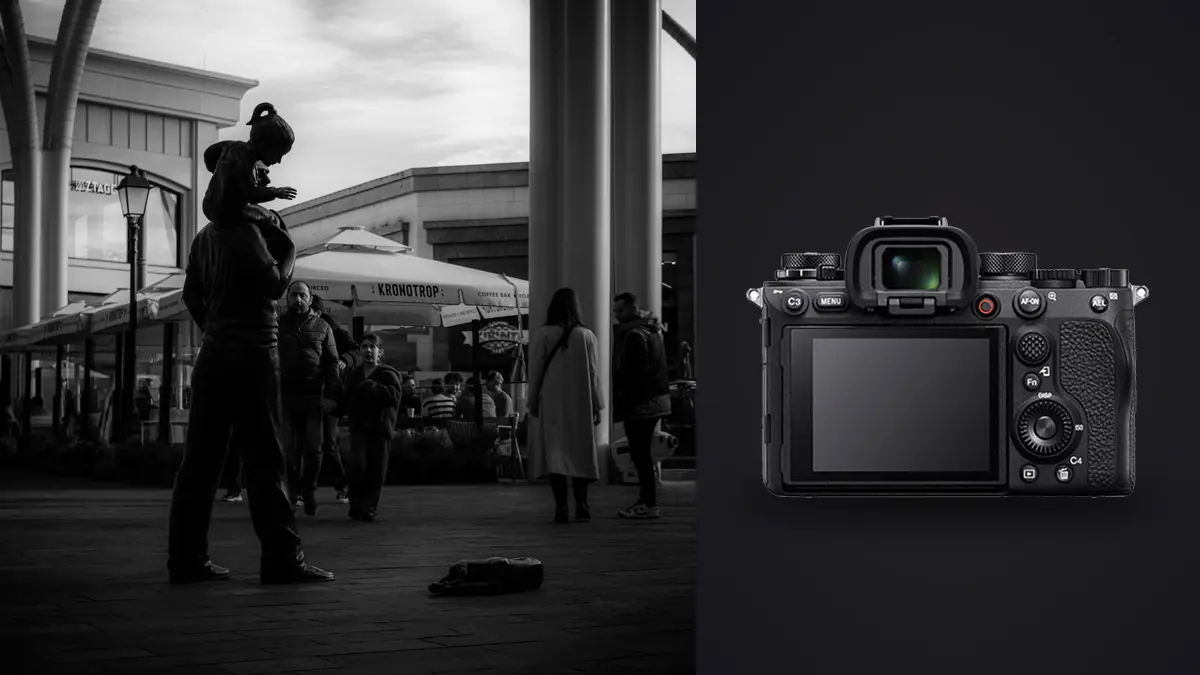
I spent a week shadowing a friend who documents union meetings and neighborhood organizing for a small nonprofit press outlet, and she was carrying a Sony A1 the entire time. Not because someone handed it to her for a review. She bought it with her own money, which is the detail that made me pay attention. A $6,500 body that most people associate with wildlife shooters chasing birds in flight and studio photographers who need every one of its 50 megapixels for billboard crops, and she was pointing it at folding chairs and exhausted organizers at 11pm.
So this isn't a spec sheet regurgitation. It's what I actually watched happen when a stacked-sensor flagship gets used for the genre it was arguably not designed for, plus my own two months running it on evening markets and a couple of protests where I needed to work fast and not be noticed.
The case people make for it, and why half of it is wrong
The usual pitch for the A1 in street or documentary work goes: 30fps blackout-free burst means you never miss the peak of a gesture, and the autofocus tracks eyes so reliably you can shoot from the hip and still nail focus. Both true. Neither is the reason it's good for this work.
30fps sounds incredible until you realize what it does to your evening. Shoot a five-second burst of a street vendor's hands and you've generated 150 frames of essentially the same three moments, differing by a few milliseconds each. Multiply that across a night of documentary coverage and you can walk home with 4,000 to 6,000 exposures from four or five hours of shooting. Most cameras in this class don't have a buffer deep enough to sustain that rate for more than a second or two anyway, so the marketing number is misleading on its own. The A1's actual advantage isn't the frame rate, it's that the buffer doesn't choke: with a fast CFexpress Type A card you can hold 30fps for roughly 3 to 4 seconds of RAW+JPEG before it slows, versus under a second on a lot of competing bodies. That matters exactly once or twice a night, in the actual chaotic moment when something breaks loose in a crowd. The rest of the time you're better off in the 10fps mechanical mode or even single-shot, because the alternative is drowning in near-duplicates.
Where the size actually costs you
Nobody selling you this camera for street work wants to talk about the size, because it undercuts the pitch. The A1 body alone is 737g. Pair it with the 35mm f/1.4 GM, which is the lens most documentary shooters reach for on this system, and you're carrying close to 1.2kg around your neck for a full session. That's not heavy in absolute terms, professionals carry more on weddings, but it's the opposite of discreet. People notice a camera that size. Subjects change their behavior. Store owners ask questions. A Fuji X100V or a Ricoh GR III disappears into a bag or a jacket pocket and reads as a tourist's point-and-shoot even when it isn't. The A1 reads as "photojournalist," which is sometimes exactly what you want (it can open doors at organized events where credibility matters) and sometimes exactly what you don't (it closes doors on the loose, unplanned moments that make documentary work worth doing).
The electronic shutter helps claw some of that back. Fully silent, no mechanical slap, and because it's a stacked sensor the rolling shutter distortion that plagues cheaper electronic shutters on panning subjects is genuinely minor. You can shoot inside a quiet room, three feet from someone, and they won't hear it. That's the single feature that made my friend's decision make sense to me. Silence bought back some of what the bulk cost her.
Autofocus in conditions that aren't a soccer pitch
The A1's subject recognition is tuned and marketed around sports and wildlife, but the human and eye detection modes are what matter here, and they hold up in genuinely bad light. I tested it at a night market lit mostly by string lights and a couple of phone flashlights, and it kept locking onto faces that I could barely make out myself through the viewfinder. That's real, not hype. Where it gets less impressive is with partially obscured subjects, someone turned three-quarters away, hands and faces overlapping in a crowd, which is most of documentary photography. In those situations it behaves like any other modern tracking system: good, occasionally confident and wrong, and worth double-checking rather than trusting blind.
Battery and dual cards, the boring stuff that actually matters on assignment
If you're shooting something you can't reshoot, a strike, a funeral, a one-time community event, the dual CFexpress/SD slots with simultaneous backup recording matter more than almost any spec on the sheet. I know two photographers who've had a card fail mid-shoot over the years, and both times the second card saved the assignment. The A1 rates around 430 shots per charge under CIPA testing, which is optimistic in real use, especially with the EVF running and 30fps bursts draining things fast. Carry two spares if you're out past four hours.
How it actually stacks up against what people really carry for this work
I put the A1 next to three cameras I've either owned or borrowed for extended street and documentary stretches. This isn't a lab test, it's what I noticed carrying each one for real sessions.
| Camera | Body weight | Discretion on the street | Max useful burst | Silent shutter | Approx. body price (USD) | Best fit |
|---|---|---|---|---|---|---|
| Sony A1 | 737g | Low, reads as pro gear | 30fps, deep buffer | Yes, minimal rolling shutter | $6,499 | Fast-breaking events, credentialed access |
| Fuji X100V | 478g | High, looks casual | 11fps, shallow buffer | Yes, leaf shutter | $1,399 (when in stock) | Loose, wandering street work |
| Leica Q2 | 734g | Medium, but quiet reputation | 10fps, shallow buffer | Yes, near silent | $5,795 | Deliberate, single-frame documentary |
| Sony A7C II | 514g | Medium-high, compact body | 10fps, moderate buffer | Yes | $2,199 | Travel and long days on foot |
What jumps out looking at it laid out like that: the A1 is the heaviest and most expensive option here by a wide margin, and it earns that gap almost entirely through buffer depth and autofocus confidence in bad light. If your documentary work is mostly planned events with access (press credentials, organizer relationships, situations where being seen with a big camera isn't a liability) that trade makes sense. If you're doing the classic loose street practice, walking neighborhoods, working corners, staying invisible, the X100V or a Q2 will serve you better and cost you far less.
The part nobody mentions: what 50 megapixels at 30fps does to your evening
This is the actual operational problem with the A1 for this genre, and it's not about the camera, it's about what happens after you put the camera down. A compressed RAW file off the A1 runs 25 to 60MB depending on scene detail. A single burst of two seconds at full speed is 60 frames. Do that eight or ten times over a night and you're looking at 400+ gigabytes of new material and several thousand frames to review, most of which are redundant by design, because burst shooting means capturing the same three seconds of a moment dozens of times to guarantee you got the one where the expression landed.
I used to sit at a laptop for two, sometimes three hours after a shoot just scrolling through nearly identical frames trying to spot the one with the sharpest eyes and the best hand position. That's the actual bottleneck the A1 creates, and it's the reason I started running everything through imagic before I touch Lightroom. It scores sharpness and focus locally on the machine, so it flags which frame in a 40-shot burst is actually the sharpest one rather than me eyeballing them at 100% zoom one by one, and it clusters the near-duplicate bursts together automatically so I'm reviewing maybe 15 clustered groups instead of 400 loose frames. Given how much of the A1's burst mode is genuinely useless past the first handful of frames, having something cluster and rank that pile for me turned what used to be a wasted evening into about twenty minutes.
It also matters that this runs entirely on the machine. Documentary work sometimes involves images you don't want touching a cloud service before you've reviewed them, whether that's a source's face at a sensitive event or just a client agreement about where files go, and not having to think about that is one less thing on a long night.
Getting a consistent look across a body of work
The other thing that changes with a camera this capable is how much footage you're generating across a whole project, sometimes weeks of coverage. Keeping a consistent tone across hundreds of final images, especially in mixed lighting from event to event, used to mean redoing my presets constantly. I ended up training imagic's apply_my_style feature on a set of edits I was happy with from an earlier project and now new imports lean toward that same grading automatically before I do the finer adjustments by hand. It's not magic, it still needs a human pass, but it cuts the starting-from-zero feeling on every new folder.
Dynamic range and low light, where the sensor actually earns its price
Documentary and street work rarely happens in flattering light. You're in doorways, under awnings, inside kitchens, at dusk. The A1's sensor handles shadow recovery impressively for a 50MP chip, noise stays controlled up to around ISO 6400 in my experience, usable with some grain up to 12800 if you're not printing large. That headroom matters more for this kind of work than resolution does. Nobody's cropping a street photograph to 400%. What they need is the ability to underexpose slightly to protect highlights in a harsh doorway and pull the shadow detail back later without the image falling apart, and the A1 does that as well as anything on the market right now.
So who should actually buy one for this
Honestly, fewer people than the review cycle around this camera suggests. If you're doing credentialed documentary work where you need buffer depth for unpredictable action, reliable dual-card backup because the moment won't happen twice, and autofocus you can trust in genuinely bad light, the A1 is a real tool, not a vanity purchase. If your work is closer to classic wandering street photography, quiet observation, small interactions, staying unseen, you're paying a huge premium for capabilities you'll rarely use, and you'll be lugging weight that works against the whole point of the genre. A used A7 IV or a Fuji body will get you 90% of the results for a third of the cost and half the bulk.
The honest answer for most people asking whether they need this camera is no. But for the narrow slice of documentary work where things happen fast, once, and in bad light, it's earned its price tag more convincingly than I expected going in.
Frequently Asked Questions
Is the Sony A1's 30fps burst actually useful for street photography, or just a marketing number?
It's useful in short, specific windows, mainly when something unpredictable breaks loose in a crowd and you genuinely don't know which fraction of a second will matter. Outside those moments it mostly produces redundant frames that you'll need to sort through later, so most experienced shooters default to 10fps mechanical or single-shot for the bulk of a session and save the full 30fps for the two or three unpredictable seconds a night that actually call for it.
How loud is the Sony A1 in silent shooting mode compared to a leaf-shutter camera like the Leica Q2?
Both are effectively silent to a subject standing a few feet away. The A1's electronic shutter produces zero mechanical sound, while the Q2's leaf shutter has an extremely faint click that's audible only in dead-quiet rooms. In practical street and documentary conditions, with ambient noise from a crowd or street traffic, neither will give you away.
Does the file size and burst volume from the A1 make culling unmanageable for documentary work?
It can, if you're reviewing everything manually. A night of coverage easily produces several thousand frames, most of them near-duplicates from burst sequences. Software that clusters bursts and scores sharpness automatically, which is what imagic does locally without uploading anything, turns that pile into a much smaller set of real decisions rather than thousands of individual frames to eyeball.
Is the Sony A1 too heavy or conspicuous for candid street work?
Compared to compact options like the Fuji X100V or Ricoh GR III, yes, noticeably. At 737g for the body alone, plus a lens, it reads as professional gear to bystanders, which changes how people react to being photographed. For loose, unplanned street shooting where staying unseen matters, a smaller camera will usually serve you better despite the A1's technical advantages elsewhere.