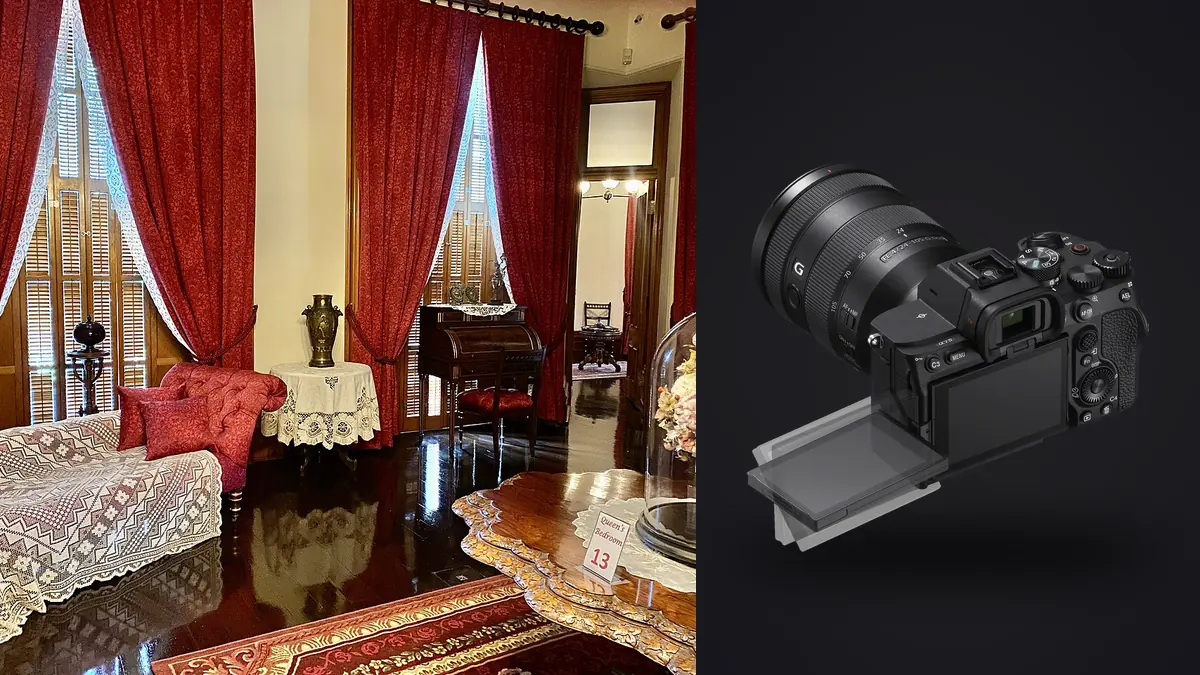
I picked up a Sony A7 IV about two years ago to replace an aging A7 III, and it's stayed in service longer than almost any other piece of gear I own. Boudoir is a strange genre to shoot technically. You're usually in a small room, the light is whatever the client's bedroom or a rented suite gives you, the subject is moving in small unpredictable ways the entire time, and the client is acutely aware of every sound the camera makes. None of that shows up on a spec sheet, but all of it changes which camera actually earns its keep in this genre.
Why This Body Fits a Genre That Punishes Loud, Clumsy Gear
Boudoir sessions run on trust more than almost any other type of portrait work. A client who tenses up because the shutter sounds like a machine gun going off two feet from her face is not going to give you a relaxed pose, no matter how good your posing direction is. The A7 IV's electronic shutter option is genuinely silent, and I use it for probably 80% of a session once we're past the first few warm-up frames. The mechanical shutter is there when you want it (some subjects actually find total silence unsettling and prefer knowing when a frame was taken), but having the choice matters more than either option on its own.
The body is also small enough that it doesn't dominate the room the way a gripped sports body does. I shoot handheld for nearly the entire session, working close, repositioning constantly, and a body that's comfortable to hold for two straight hours without a grip attached is not a small consideration. In-body stabilization rated around 5.5 stops means I can drop shutter speed lower than I'd trust on an unstabilized body when the room is lit by a single window or a couple of continuous LED panels, which describes most boudoir setups.
Sensor and Color: What 33 Megapixels Actually Does Here
The 33-megapixel sensor is not the headline spec for this genre and I don't pretend it is. What it buys me is room to crop and reframe in post without the file falling apart, which matters a lot in boudoir because composition often shifts after the fact. A pose that felt too tight in camera sometimes gets pulled back into a three-quarter crop for the final album spread, and a pose shot a little loose sometimes gets tightened to a close detail crop for a standalone print. Having 7008 by 4672 pixels of native resolution gives me that flexibility without visible softness creeping in at normal print sizes.
Skin tone rendering out of camera, using the Standard or Deep creative look profiles, needs very little correction before I even open Lightroom. That matters practically because boudoir clients are far more sensitive to how their skin looks in a preview on the back of the camera than clients in almost any other genre. If the JPEG preview looks orange or waxy straight off the sensor, you spend the first ten minutes of the session reassuring someone instead of shooting.
Dynamic Range Against a Window
Most of my boudoir work happens near a window, often with sheer curtains as the only diffusion available on location. That's a high-contrast scenario, bright window and comparatively dim room, and the sensor's dynamic range gives me enough latitude to expose for skin and still pull back highlight detail in the window itself if I need the frame to include it. I don't push this too far. Recovering four stops of blown window in post always looks worse than metering properly in the first place, but having the margin for error on a genre where you can't always ask the subject to hold a pose while you re-meter is worth a lot.
Lens Choices That Actually Change the Mood
The lens matters more than the body for how a boudoir image actually feels, and I get asked about this more than any other gear question. Here's how the four lenses I rotate through on the A7 IV actually behave in this specific context, not in a generic studio test.
| Lens | Typical Working Distance | Character in a Bedroom-Sized Room | Best For |
|---|---|---|---|
| Sony FE 35mm f/1.4 GM | 3 to 5 feet | Wide enough to include environment and bedding without distortion becoming a problem; forces intimacy because you're physically close | Environmental frames that show the whole scene, tight rooms with no space to back up |
| Sony FE 50mm f/1.2 GM | 4 to 7 feet | Closest to how the room actually looks to the eye; falloff at f/1.2 is dramatic but manageable, focus plane is unforgiving on moving subjects | General coverage lens for most of a session, half-body to full-body |
| Sony FE 85mm f/1.4 GM | 7 to 10 feet | Compresses the room, flatters facial proportions, needs real distance most small rooms don't have | Close-up portrait frames when there's a hallway or adjoining room to back into |
| Sony FE 90mm f/2.8 Macro G OSS | 1 to 3 feet | Sharp enough for detail work on jewelry, lace, or hands; not a portrait lens for full poses in a small room | Detail shots for album spreads, ring or garment close-ups |
My honest opinion after two years: the 50mm f/1.2 GM does more of the actual session than any other lens I own, but I would not want to shoot an entire session without the 35mm in the bag, because plenty of bedrooms simply don't give you seven feet of clearance for the 85mm. If I had to keep exactly one lens for this genre it would be the 50mm, not because it's the most flattering focal length in isolation but because it's the one that works in the most rooms.
Autofocus in a Session Full of Small, Constant Movement
Boudoir posing is rarely static. Clients shift weight, adjust hair, change hand position, and the best frames often come between the poses you actually called out, not during them. Real-time Eye AF on the A7 IV tracks through hair falling across the face, through a hand partially covering an eye, and through fabric moving in frame, which is the exact set of obstructions this genre throws at a focus system constantly. I shoot wide open a lot (f/1.2 to f/2 depending on lens), and at those apertures the margin for a missed focus plane is basically zero. I don't think I could shoot this genre confidently on a body without reliable eye tracking, because manually re-acquiring focus every time the subject adjusts her pose would slow the session to a crawl and kill the natural flow that gets you the best expressions.
One caveat worth being honest about: tracking through fast fabric movement, like a robe being pulled off in one motion, still occasionally hunts for a frame or two. I've learned to shoot that specific motion as a short burst rather than a single frame, which solves it in practice even if it's not a perfect system.
Settings I Actually Use
- Aperture: f/1.8 to f/2.8 for most posed frames, f/1.2 to f/1.4 reserved for single-subject detail shots where I want the background to disappear completely
- Shutter speed: rarely below 1/125 even with IBIS, because subject movement (not camera shake) is the real risk of blur in this genre
- ISO ceiling: I stop pushing past 3200 handheld unless the room genuinely has no other light source, and even then I'd rather add a warm-gelled LED panel than shoot at 6400
- Metering: spot metering on skin for backlit window setups, center-weighted for anything more evenly lit
What Happens After the Card Comes Out
A single boudoir session, once you count wardrobe changes and pose variations shot in bursts, regularly leaves 800 to 1,200 frames. The client sees maybe 40 to 60 of those in the final gallery. That gap is where a lot of photographers lose hours they didn't budget for, sitting in Lightroom flipping through nearly identical frames trying to spot which one has the sharpest eyes and the best expression.
This is the part of my workflow imagic actually changed. I run the card through it before I ever open Lightroom, and its local sharpness and focus scoring flags which frame in each burst actually nailed eye focus, which matters enormously at f/1.2 to f/1.8 where the difference between a keeper and a reject is sometimes a few millimeters of focus shift between the eyes and the eyelashes. It also clusters the burst and near-duplicate sequences from a single pose together, so instead of scrolling through fifteen nearly identical frames one at a time I'm comparing a pre-grouped set and picking the standout. Because everything runs locally with no cloud upload, intimate client images never have to leave your own machine, which for this specific genre is not a minor detail. Once the initial cull is done, the apply_my_style preset trained on my own past edits gets the selects to roughly 80% of my final look before I do any manual adjustment, which can be the difference between a two-day turnaround and a two-week one on a genre where clients are often waiting to see themselves in a specific light. If you haven't looked at how AI-assisted culling actually works under the hood, this breakdown covers the mechanics in more depth than I have room for here.
Session Logistics That Have Nothing to Do With Specs
A few things I've learned the hard way that don't show up in a review. Battery life matters more than people think, because boudoir sessions run long with a lot of chimping between setups as clients want to see how a pose looks. I carry three batteries and rarely finish a session on the first one. The flip-out screen is genuinely useful for showing a client a frame without handing over the whole camera, which keeps the physical camera in your hands and out of a nervous client's. And the dual card slots mean you can shoot RAW to one card and a JPEG backup to the second for the entire session, because this is one genre where losing a card is not just an inconvenience, it's a client relationship problem. If your broader capture-to-delivery process could use tightening beyond just this genre, this workflow rundown is a decent starting point.
Frequently Asked Questions
Is the A7 IV's silent shutter actually reliable, or does it introduce rolling shutter issues in a moving session?
For boudoir specifically, where subjects aren't sprinting across frame, I haven't run into rolling shutter distortion in practice. It shows up more on fast horizontal motion (spinning fans, vehicles) than on the kind of slow repositioning typical of a posed session. I use it as my default and only switch to the mechanical shutter if I'm shooting near a strobe that needs the flash sync the electronic shutter can't provide.
Do I actually need the 50mm f/1.2 GM, or does the kit 50mm f/1.8 do the job?
The f/1.8 is a perfectly usable lens and I used one for over a year before upgrading. The difference is in how the background falls apart at f/1.2 versus f/1.8, and in focus accuracy at the widest aperture, where the GM's focus motor is noticeably more confident tracking a moving eye. If budget is the constraint, the f/1.8 will not embarrass you. If you're shooting this genre professionally and pricing sessions accordingly, the GM earns the upgrade over about a year of use.
What's a realistic ISO ceiling for a window-lit bedroom shoot with no additional lighting?
I hold the line at ISO 3200 as my personal ceiling for anything going into a final gallery, and I'd rather bring a single warm LED panel than shoot at 6400 to compensate for a dim room. The A7 IV is clean at 3200 with modest noise reduction, but past that the grain starts fighting with skin texture in a way that reads as noise rather than intentional grain, especially in shadow-heavy compositions this genre leans on.
How many frames should I expect to shoot per session, and does that change how I should plan the cull?
Between 800 and 1,200 frames for a typical two-hour session with two to three wardrobe changes is normal in my experience. Planning the cull matters as much as planning the shoot itself. I've found it's faster to cull in short passes right after each wardrobe change rather than one long session at the end, because the poses and lighting are still fresh in memory and mistakes in framing are easier to catch while you can still reshoot them.