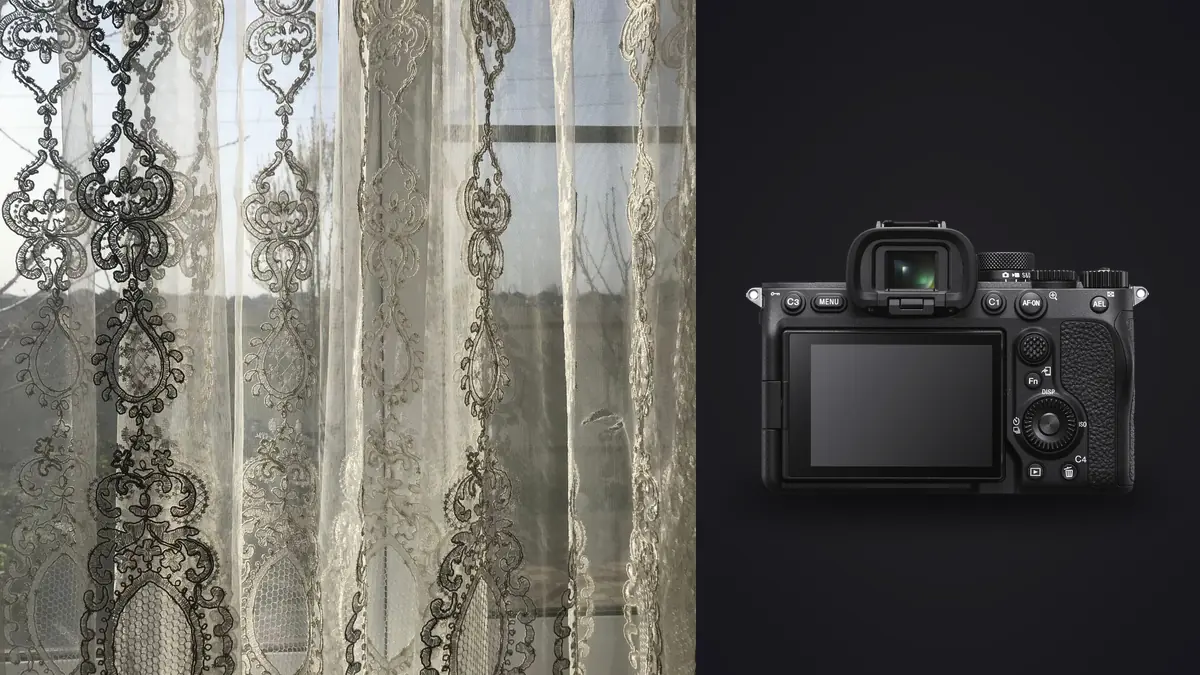
Every boudoir session starts the same way. The client is nervous, the light in the room is never quite what was scouted, and there are maybe ninety minutes to get her comfortable enough in front of a lens that the pictures don't look like she's bracing for them. The camera body has almost nothing to do with that part. But once a session is actually rolling, the Sony A7 IV earns its keep in ways that are specific to this kind of work, not just "good camera" in the abstract. I moved from an A7 III to the A7 IV about eighteen months ago, and there are a handful of things about the newer body that genuinely changed how a session runs, plus a few that get overstated online.
Why this body specifically for this genre
The 33-megapixel sensor gets talked about mostly for landscape and product work, but for boudoir it solves a real problem: clients almost always want a mix of full-body environmental shots and tight detail crops (a hand on a collarbone, the curve of a shoulder against a window) pulled from the same frame rather than reshot. Thirty-three megapixels gives you enough room to crop a full-length frame down to a waist-up composition and still print it at 16x20 without the file falling apart. On my old A7 III, at 24 megapixels, that same crop started showing softness the moment anyone wanted a larger print of a detail shot.
The in-body stabilization matters more here than it does in most genres people associate with Sony bodies. Rated around 5.5 stops, it lets me shoot handheld at 1/30 or even 1/15 in a dim hotel room without a flash, which keeps the mood of the available light intact instead of flattening it with strobe. Boudoir clients respond to soft, warm, low ambient light. The moment you introduce a flash into a small bedroom, the whole emotional register of the session shifts toward "photo shoot" instead of "quiet moment," and a lot of the ease you spent the first twenty minutes building evaporates.
Eye AF is the other piece that actually changes outcomes rather than just specs. Boudoir subjects move slowly and deliberately, but they also move into partial cover constantly (hair falling across the face, a sheet pulled up, an arm across the eyeline), and the A7 IV's real-time tracking holds onto the near eye through most of that without me having to recompose or manually shift the focus point mid-sequence. It isn't flawless. Fine lace patterns close to the face occasionally pull focus toward the fabric texture instead of the eye behind it, and I'll flag that again further down.
Picking a lens for a bedroom, not a studio
Most boudoir work doesn't happen in an open studio with room to back up. It happens in a client's actual bedroom, a rented suite, or a small home studio corner, and that changes which lenses are actually usable, not just which ones render nicely on paper.
The 85mm f/1.4 GM is the lens everyone recommends for portraits, and it's stunning glass, but in a lot of the rooms I shoot in there simply isn't three meters of working distance to use it for anything beyond a tight headshot. I own it, I bring it, but it stays in the bag for maybe fifteen minutes of a typical session.
The 50mm f/1.2 GM has become the lens I'd keep if I could only bring one. At 1.5 to 2 meters, which is a realistic distance in most bedrooms, it still gives enough separation from the background to isolate a subject against rumpled linen or a window, and it's forgiving enough on framing that I'm not fighting distortion on full-length compositions the way I would with something wider.
For environmental frames, where the room itself (the light through a curtain, the shape of the bed, the wallpaper) is part of the story, I'll switch to a 35mm f/1.4 GM. The catch is that anything closer than about 1.2 meters starts stretching a subject at the edges of the frame in a way that isn't flattering, so it's a lens for wider compositions only, never for a close three-quarter portrait. And for pure detail work, hands, a necklace, the texture of skin against fabric, the 90mm f/2.8 Macro G comes out. It's slow to focus compared to the GM primes and I wouldn't use it for anything requiring quick reaction to a subject's expression, but for static detail shots it's sharper than either of the other two at close range.
Settings that hold up when the light is warm and dim
Boudoir light is rarely bright. Clients want warmth, not brightness, which means most of a session happens well under what a lot of portrait settings guides assume. Here's roughly where I land depending on the light source, based on the last several dozen sessions logged in my shooting notes rather than a spec sheet.
| Light source | Aperture | Shutter speed | ISO range | Notes |
|---|---|---|---|---|
| North-facing window, overcast day | f/1.8 to f/2.2 | 1/125 | 400-800 | Cleanest light of the list, rarely need to go past ISO 800 |
| Sheer curtain, direct sun behind it | f/2 | 1/250 | 200-400 | Watch for blown highlights on skin near the curtain edge |
| Bedside lamp only, no window | f/1.4 to f/1.6 | 1/30 to 1/60 | 1600-3200 | IBIS is doing real work here, brace elbows against something solid |
| Single softbox, 45 degrees, low power | f/2.8 | 1/125 | 200 | Most controllable option but also the most "shoot" feeling, use sparingly |
| Golden hour, outdoor balcony or deck | f/2 | 1/500 | 100 | Backlight tends to flatter skin, watch flare with the GM primes wide open |
The ISO 1600-3200 range is where I get the most questions from other photographers who assume that's too noisy for skin. On the A7 IV it isn't, at least not at the file sizes clients actually order. Noise reduction in post handles it fine at web and even most print sizes, and honestly a touch of grain in low, warm light reads as intentional rather than as a technical shortfall.
The shutter sound is not a small detail
This is the one thing I didn't expect to matter as much as it does. The A7 IV's electronic shutter is genuinely silent, and in a genre where the whole point is getting someone to relax enough to stop performing for the camera, the mechanical clack of a shutter firing every two seconds works against you. You often don't fully register this until a subject, about forty minutes into a session, says she's stopped noticing the camera entirely. That doesn't happen with an audible shutter. It just doesn't.
The usual objection to electronic shutter is rolling shutter distortion on fast motion, and it's a legitimate concern for sports or dance work. For boudoir it's close to a non-issue. Subjects move slowly and deliberately by the nature of the genre, so I run silent shutter for probably ninety percent of a session and only switch to mechanical if I need flash sync above the electronic shutter's limits, which is rare given how much of this work happens in ambient or continuous light rather than strobe.
What a two-hour session actually produces
Here's the part that doesn't show up in gear reviews. A single boudoir session, shot the way I shoot it, produces somewhere between 500 and 900 raw frames. That number surprises people who haven't shot the genre. You're not taking one photo per pose. You're shooting short bursts through each pose because the difference between a flat expression and the one the client will actually love is a half-second of eye movement or a slightly different hand position, and you can't predict which frame in the burst is the one until you look.
Sorting that volume by eye, frame by frame, is where a session used to eat an entire evening for me. This is honestly the reason I started using imagic in the edit workflow rather than for anything flashy. Its duplicate and burst clustering groups those near-identical sequences together automatically, and the local sharpness scoring flags which frame in each burst is actually the sharpest at the eye rather than making me zoom into forty thumbnails one at a time. If you haven't looked into how that kind of automated culling actually works under the hood, this breakdown of AI photo culling covers the mechanics better than I can in a paragraph here.
There's a privacy angle to this too that matters more in boudoir than in almost any other genre. These are images clients are trusting you with under the assumption they won't end up anywhere you didn't explicitly agree to. imagic processes everything locally on the machine, nothing gets uploaded to a cloud service to get culled or scored, which means a client's most private images don't go through a third-party server just to sort a shoot. That's not a minor feature for this kind of work, it's close to a requirement.
A repeatable retouch look without re-uploading anything
Boudoir retouching has its own conventions: warm shadows, slightly lifted blacks, skin that reads soft without looking plastic, contrast pulled back just enough that the image feels like it was shot on film even though it wasn't. Once you've built that look and a client base that expects it, consistency across sessions matters as much as any single edit.
I built that look over about two years of trial and error in Lightroom, and once I was happy with it, I trained imagic's apply_my_style feature on a batch of my own finished edits rather than a generic preset pack. It picks up the specific way I'm treating warmth and contrast on skin and applies that as a starting point across a new set, so a fresh batch of 600 culled frames gets roughly 80 percent of the way to my final look before I touch a single slider by hand. Same as the culling step, that all runs locally, so a new client's images never leave the machine just to get a first pass of color applied. For anyone building out their own consistent color approach from scratch, this guide to color grading workflow is a decent starting point before you get to the point of training something on your own edits.
A few things I'd tell someone starting on this body
APS-C crop mode gets recommended a lot as a free reach extender, and for boudoir I'd avoid leaning on it. Cropping the A7 IV's sensor down to APS-C drops you to roughly 14 megapixels, and combined with the low ambient light this genre usually involves, the noise becomes noticeably more visible in a way that undercuts the whole point of shooting a full-frame body in the first place. I use it maybe twice a year, for a genuine reach problem I can't solve by moving my feet.
Dual card slots matter more here than in almost any other kind of shoot, because a boudoir session is not something you can casually ask a client to redo. If a card fails and there's no backup, you haven't just lost files, you've lost a client's trust and possibly the entire emotional arc of the session that got her comfortable in the first place. Anyone starting out in this genre should run simultaneous write to both slots on every single session, no exceptions, and treat that setting as non-negotiable rather than optional.
And on the eye tracking issue I mentioned earlier: lace, sheer fabric, and patterned sheets held close to the face will occasionally pull focus away from the eye and onto the texture instead. It doesn't happen often, but it happens often enough that I've learned to check focus confirmation on the back screen during any pose where fabric is near the face, rather than trusting the green box blindly the way I would in a cleaner portrait setup.
Frequently Asked Questions
Is the A7 IV's autofocus reliable when a subject is partially covered by sheets or lace?
Mostly, yes. Real-time Eye AF holds through hair and soft fabric better than older Sony bodies did, but fine lace patterns positioned directly over or near the face can occasionally distract the tracking onto the fabric texture instead of the eye. I've learned to double-check the focus confirmation on those specific poses rather than assume it's locked correctly every time.
Do I actually need f/1.2 or f/1.4 glass for boudoir, or would a slower lens work?
A slower lens, something like an f/2.8 zoom, will absolutely produce usable images, but you'll be working harder for the same look. The fast primes buy you two things this genre depends on: enough separation to isolate a subject in a cluttered bedroom, and enough light gathering to shoot handheld in ambient light without introducing flash. If budget only stretches to one fast prime, the 50mm f/1.2 or f/1.4 range covers the most ground.
How many final images should a client expect from a boudoir session, and how do you get there from 700 raw frames?
A two-hour session might yield 30 to 50 finished images out of somewhere around 600 to 900 raw frames. Getting there starts with culling out the bursts down to the single sharpest, best-expression frame per pose (this is where imagic's clustering saves the most time), then a second pass where the client and photographer narrow that culled set down together before final retouching.
Is APS-C crop mode on the A7 IV worth using for detail shots in boudoir work?
Rarely, in my experience. It drops resolution to around 14 megapixels and amplifies noise in exactly the low, warm light conditions boudoir sessions tend to happen in. For genuine detail shots I'd rather physically move closer or switch to the 90mm macro at native resolution than crop the sensor.