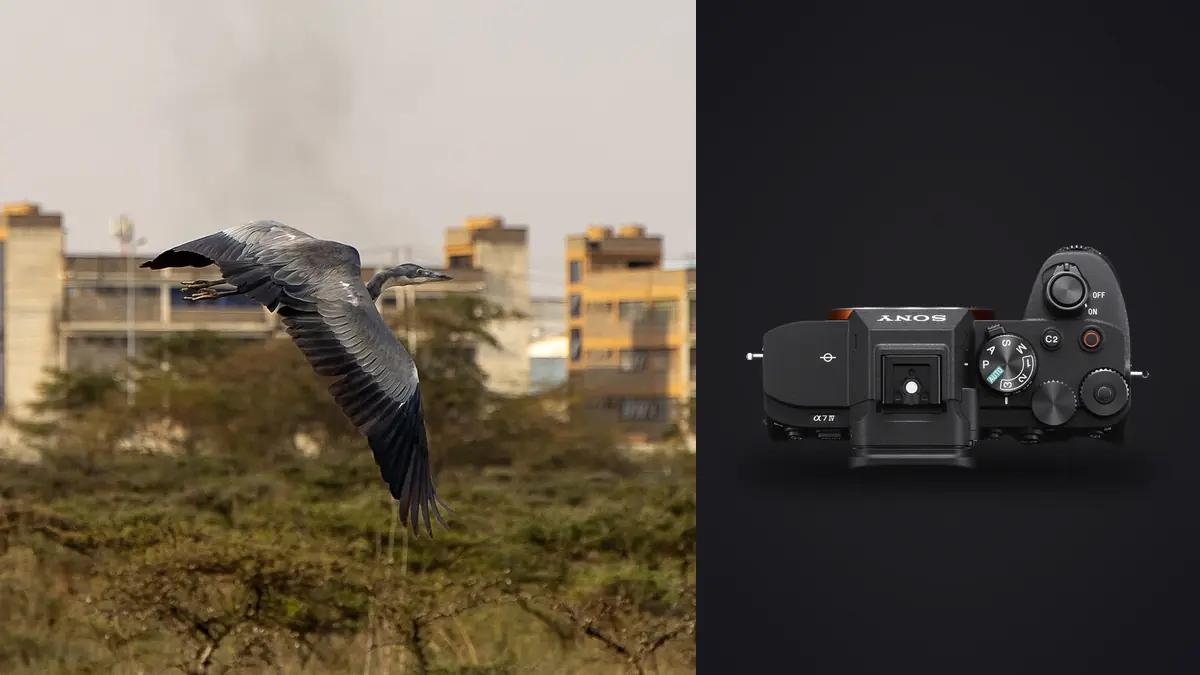
I spent most of last spring parked on a folding stool next to a kestrel nest box, waiting for the female to make hunting passes over a hedgerow. The A7 IV was the body I had on hand, paired with a 200-600mm, and it took about four sessions before I stopped fighting the camera and started working with what it's actually good at. That distinction matters with this body more than most, because the A7 IV was never built as a sports and wildlife flagship. It's a 33-megapixel hybrid stills and video camera that Sony happened to give a genuinely capable autofocus system, and birders have been bending it toward birds in flight ever since, with mixed but often good results.
This isn't a spec sheet reprint. It's what changed in my settings, my lens choice, and my culling process once I accepted the A7 IV for what it is rather than what I wished it were (an A1 at a third of the price).
Where the A7 IV actually helps with birds in flight
The sensor is the quiet strength here. 33 megapixels on a full-frame body gives real room to crop a bird that's smaller in the frame than you'd like, which happens constantly with anything that isn't a stationary raptor on a perch. A hawk crossing at 40 meters fills maybe a sixth of the frame at 600mm, and being able to crop that down to a tight portrait without the file falling apart in an 8x10 print is genuinely useful. I've pulled keepers out of frames where the bird occupied less than 10% of the total pixel area, something I couldn't do reliably on the 24-megapixel A7 III I used before this one.
The autofocus system, 759 phase-detection points across 94% of the frame, tracks a bird against open sky about as well as anything short of Sony's top-tier bodies. Real-time Tracking holds onto a subject through wing beats and minor occlusion far better than the contrast-assisted hybrid AF on older Sony bodies ever did. Bird and animal Eye AF arrived later than it should have, Sony shipped the A7 IV without it and added it in a firmware update roughly three months after launch, but once it's there it locks onto an eye at surprising distances, assuming the bird's head is turned enough for the sensor to actually see it.
Where it fights you
The A7 IV does not have a stacked sensor. That single fact explains most of its limitations for this genre. Read-out speed on the electronic shutter is slow enough that fast wingbeats against a bright sky produce visible skew, the classic "jello" rolling shutter effect where a wing tip that should be straight comes out curved. It's most obvious on smaller, fast-flapping birds like swallows or terns; it's far less of an issue on something like a heron or an osprey with a slower wingbeat cadence.
The other limitation is buffer depth, and it caught me off guard the first time I filled it mid-pass on a peregrine stoop. Ten frames per second sounds fine on paper. What the spec sheet doesn't advertise loudly is how quickly that ten fps evaporates once the buffer fills, and how much the card in slot one changes that number.
Buffer depth by card and file format
I ran this test with the same lens (200-600 G), the same 10fps Hi+ continuous mode, and the same three-second bursts, swapping only the card and file format between runs. Sony's own published numbers are close to what I measured in the field, with slightly more optimistic figures for the CFexpress runs than I actually got outdoors in warm weather.
| File format | Card type | Approx. frames before slowdown | Rough buffer clear time |
|---|---|---|---|
| JPEG Fine | CFexpress Type A | 750-800 | Under 5 sec |
| Compressed RAW | CFexpress Type A | ~130-140 | 6-8 sec |
| Compressed RAW | SD UHS-II (V90) | ~40-50 | 18-25 sec |
| Uncompressed RAW | CFexpress Type A | ~80-90 | 10-14 sec |
| Uncompressed RAW | SD UHS-II (V90) | ~15-20 | 30+ sec |
That gap between CFexpress Type A and SD is the practical takeaway. If you're shooting birds in flight on the A7 IV with SD cards in slot one and compressed RAW, you get roughly four to five seconds of usable burst before the frame rate collapses to a crawl, and then you're staring at a "processing" icon while an osprey folds its wings and drops. I switched to CFexpress Type A in slot one specifically for this reason and left SD in slot two as backup, not primary capture.
Autofocus settings I actually changed
AF transition speed and subject shift sensitivity
Two custom AF parameters buried in the menu made a bigger difference than anything else: AF Transition Speed and AF Subject Shift Sensitivity, both on a 0-7 scale under the AF area settings. For a bird moving against a clean background, I run Transition Speed at 7 (fastest reaction to a new subject) and Shift Sensitivity low, around 1-2, so the camera doesn't jump off the bird onto a branch or a distant tree line the moment something crosses the frame edge. When I'm shooting a bird weaving through foliage, like a woodpecker moving through a canopy, I flip Shift Sensitivity higher so the camera is willing to release focus and re-acquire rather than sticking stubbornly to a twig.
Focus area and Real-time Tracking
Tracking: Expand Flexible Spot is my default starting point, placed over where I expect the bird to enter frame, then handed off to Real-time Tracking once it locks. Wide-area tracking sounds appealing for erratic flight but in practice it grabs background clutter far too often when there's any vegetation in the frame. Against open sky, wide tracking works fine. Against a treeline, it doesn't, and I've lost sharp sequences to the camera confidently tracking a branch instead of the bird that just flew past it.
Lenses that make sense on this body
The A7 IV's AF system is good enough that lens choice matters more than body choice past a certain point. Here's what I've actually used and what changes with each.
| Lens | Max reach (full frame) | Reach in APS-C crop | Practical note |
|---|---|---|---|
| Sony FE 200-600mm G OSS | 600mm | ~900mm equivalent | Best value; AF holds up well with the 1.4x TC, noticeably slower with the 2x |
| Sony FE 100-400mm GM | 400mm | ~600mm equivalent | Faster AF and better wide-open sharpness, less reach for small distant birds |
| Sony FE 600mm f/4 GM | 600mm | ~900mm equivalent | Fastest AF of the three by a real margin, weight and cost put it out of reach for most |
The APS-C crop mode deserves a mention because it's genuinely useful on the A7 IV in a way it isn't on lower-resolution bodies. Cropping in-camera to Super 35 drops you to roughly 14 megapixels but gives you that extra 1.5x reach without buying more glass, and the AF system still uses the full sensor's phase-detect coverage within that crop. I use it when a bird is distant enough that I'd be cropping heavily in post anyway; better to let the camera do it and keep the buffer writing smaller files.
Shutter speed and exposure for wings in motion
1/2000s is my floor for anything faster than a gull, and I'll push to 1/3200s or 1/4000s for small fast fliers like swifts or swallows where wingtip blur ruins an otherwise sharp frame. That's expensive in light, which pushes ISO up fast on overcast days, but the A7 IV's sensor holds detail cleanly enough through ISO 6400 that I don't hesitate to let it climb rather than drop shutter speed. Underexposing slightly and recovering in post beats motion blur on a wingtip every time, since blur can't be fixed and a stop of shadow noise mostly can.
I shoot Aperture Priority with Auto ISO capped around 12800, minimum shutter speed set manually rather than left on Auto (the camera's auto-selected minimum shutter speed logic tends to be too conservative for erratic flight paths). Manual exposure with Auto ISO is the other option and works just as well if you're used to it; the point is not leaving shutter speed to the camera's judgment when a wing needs freezing.
What happens after the flight pass: the culling problem
A single good hunting pass from a kestrel, shot at 10fps for four or five seconds, is 40-50 frames. Multiply that across a two-hour session with several passes and you're looking at several hundred nearly identical frames of the same bird in slightly different wing positions, most of them soft because the eye drifted off focus for a fraction of a second during a wingbeat. Sorting that by eye, frame by frame, at 100% zoom, is the part of bird photography nobody romanticizes.
This is where I lean on AI photo culling rather than clicking through every frame manually. I run bursts through imagic after a session, which does local sharpness and focus scoring on every frame and groups near-identical shots from the same burst together, so instead of scrolling through fifty variations of one pass I'm looking at the two or three sharpest frames it already flagged, usually with the eye and the leading wing edge in focus. Everything runs on the laptop with no upload step, which matters when you've got a card full of RAW files and spotty rural wifi at a hide.
The duplicate and burst clustering specifically saves time on kestrel and osprey sessions, since a hover or a hunting stoop produces exactly the kind of tightly-spaced, visually similar sequence that's tedious to sort by hand but straightforward for software to group.
Building a consistent look across a season of bird shots
The other thing that changed my workflow was training a custom preset on my own edited files rather than reaching for a generic wildlife preset pack. I run imagic's apply_my_style feature on a folder of raptor images I'd already graded the way I like them, slightly warm, contrast pulled up in the midtones, shadows opened just enough to keep detail in dark plumage, and it applies that same treatment to new sessions automatically. It's not a substitute for judgment on a tricky backlit frame, but for the bulk of a season's worth of similar-light hunting shots it gets me most of the way there before I touch anything by hand, which matters a lot more once you've got three months of kestrel sessions to process instead of one.
A session that shows the whole workflow
One evening in late April, the kestrel pair I'd been watching started making hunting passes over the hedge line right as the light went gold, maybe forty minutes of usable light total. Settings were 1/2500s, f/6.3 (wide open on the 200-600 at that focal length), Auto ISO capped at 12800, Tracking: Expand Flexible Spot handed to Real-time Tracking, AF Transition Speed at 7, Shift Sensitivity at 2. CFexpress Type A in slot one, compressed RAW.
I got six real hunting passes in that window, each one 3-5 seconds of 10fps bursts, somewhere around 220 frames total. Back home that evening, the culling pass in imagic took maybe ten minutes and left me with fourteen frames worth a second look, three of which ended up as keepers: one with the eye locked on the moment of the stoop, one mid-hover with wings fully spread, one on the pullout with talons extended. That ratio, fourteen worth reviewing out of 220 shot, is fairly typical for BIF work on this body and is exactly why I don't cull by hand anymore.
For context beyond the mastering sony a7 iv for wildlife birding in flight guide focus in entry 1, continue with photo automation guide. These resources connect the subject to a practical local review process.
Frequently Asked Questions
Is the Sony A7 IV fast enough for birds in flight, or should I look at an A9 III or A1 instead?
It's fast enough for most birding, meaning raptors, waterfowl, waders, and anything that isn't a small, erratic songbird. The 10fps ceiling and rolling shutter on the electronic shutter are real limits against an A9 III's global shutter or an A1's stacked sensor, but those bodies cost two to three times as much. If your subjects are mostly herons, ospreys, hawks, and gulls rather than swifts and swallows, the A7 IV holds up well enough that the upgrade isn't obviously worth it.
Does the bird eye autofocus actually work reliably on the A7 IV?
Yes, once you're on a firmware version that includes it (Sony added bird and animal Eye AF after launch, so check you're updated). It performs best when the bird's head is turned enough for the sensor to see the eye, which in practice means it works great on a perched bird or a bird flying roughly toward or across you, and less reliably on a bird flying directly away or with its head tucked low in a fast dive.
What card should I actually buy for shooting birds in flight on this camera?
A CFexpress Type A card in slot one, not SD. The buffer difference is large enough to change what you can shoot; a five-second stoop that clears in under ten seconds on CFexpress can leave you staring at a "processing" screen for twenty-plus seconds on SD, and that's exactly when the next pass happens.
Is the 200-600mm G lens actually good enough, or do I need a prime?
For most birders it's genuinely good enough, and it's the lens I use for the large majority of my sessions. A 600mm f/4 prime autofocuses faster and holds up better with teleconverters, but it costs several times more and weighs enough that handholding it through a long session changes how you shoot. The 200-600 is the lens that gets used because it's light enough to carry on a long walk-in.