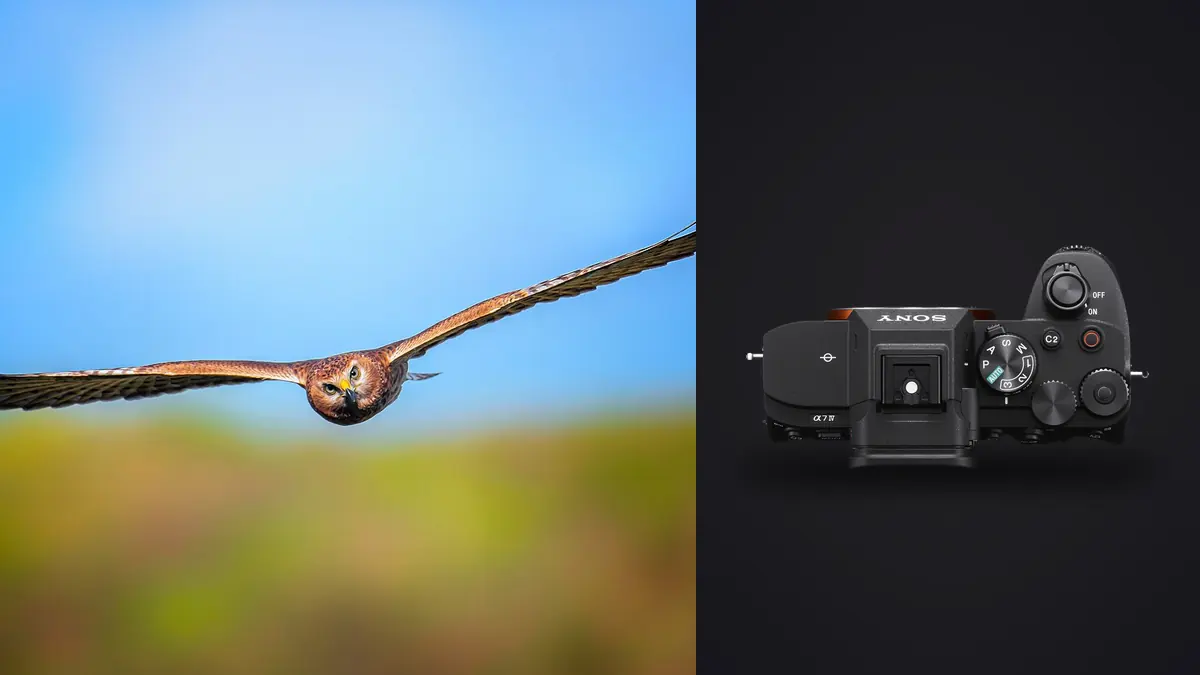
A friend who spends his weekends photographing osprey along the Chesapeake asked me last spring whether the Sony A7 IV was "good enough" for birds in flight. The honest answer took longer than he wanted to hear. Yes, with real caveats, and only once you understand where Sony compromised to build a hybrid stills-and-video body instead of a dedicated action camera. The A7 IV was never pitched as a successor to the A9 line. It shares a sensor generation with cameras built for weddings and documentary video, then gets asked to keep up with a peregrine falcon stooping at 200 miles an hour. It mostly manages. Not always gracefully.
The autofocus system is genuinely better than the spec sheet suggests
The A7 IV runs 759 phase-detection points covering about 94% of the frame, paired with Sony's Real-time Tracking algorithm. On paper that sounds like every other Sony from the last five years. In practice, what matters for birding is that Sony pushed a firmware update within the camera's first year that split subject recognition into distinct categories, including a dedicated Bird option separate from generic Animal detection. Before that update, the camera would happily lock onto a bird's whole body or occasionally its beak. After it, eye detection on birds in flight became reliable enough to trust at 400mm and beyond, even against a cluttered treeline.
Turn on Bird recognition under the subject recognition menu, set focus area to Tracking: Zone or Tracking: Wide depending on how much of the frame the bird fills, and leave the camera in AF-C. I run back-button focus for this specifically because birds move unpredictably between flight and perch, and I want the option to release the AF-ON button and hold focus without the shutter half-press fighting me. It is a small setting, but it is the single change that made the A7 IV click for me on this subject.
Where the buffer actually bites
Sony rates the A7 IV at 10fps, and it will hit that number, but only under specific conditions people gloss over in spec comparisons. Ten frames per second requires the mechanical shutter and either compressed RAW or JPEG. Shoot uncompressed RAW, which a lot of wildlife photographers default to out of habit, and the buffer empties out after roughly a dozen frames before the camera throttles down while it clears to the card. Compressed RAW with a CFexpress Type A card gets you north of 800 frames before you see any slowdown, which is a completely different shooting experience. If you're relying on a UHS-II SD card in that same slot, expect the ceiling to drop noticeably, especially in uncompressed RAW where you can burn through the buffer in under two seconds of continuous shooting. For anyone chasing a swallow through a barn door, that difference is the gap between getting the frame and reviewing a memory card full of the moment right before it.
Drive modes, shutter type, and what each one costs you
The A7 IV's drive dial hides four distinct continuous modes, and I've watched people leave the camera on Hi rather than Hi+ without realizing it, then wonder why their keeper rate on fast fliers was low. Here's how they actually behave in the field, based on shooting terns, raptors, and backyard feeder traffic over the past two seasons.
| Drive Mode | Approx. Speed | Viewfinder Blackout | Best Use for BIF |
|---|---|---|---|
| Hi+ | 10 fps | Noticeable blackout between frames, no live view during burst | Fast, erratic fliers (swifts, swallows) where you're firing on instinct anyway |
| Hi | 8 fps | Reduced blackout, closer to live tracking | Raptors and larger birds with more predictable wingbeats, easier to follow visually |
| Mid | 6 fps | Minimal, feels close to real-time | Takeoff and landing sequences where framing matters more than frame count |
| Lo | 3 fps | None | Perched or slow-moving subjects, conserving buffer and card space |
I default to Hi+ for anything airborne and moving fast, and accept that I'm shooting semi-blind between frames. It feels wrong the first few outings, like you're spraying and praying, but the hit rate with Bird eye tracking active is high enough that the approach works. What I don't do on this camera is switch to electronic (silent) shutter for flight work. The A7 IV isn't a stacked sensor, so its readout speed is slow enough that fast panning against a bright sky produces visible skew, especially on wingtips. The mechanical shutter costs you a little in maximum theoretical speed and adds wear over tens of thousands of actuations, but it keeps wing shapes honest.
Lens pairings that actually make sense
The camera is only half the equation, and for anyone landing on this article from a search for A7 IV wildlife setups, the lens choice matters more than any menu setting. The FE 200-600mm F5.6-6.3 G OSS is the lens I see on the most tripods at local hides, and for good reason: it's the rare superzoom that holds up wide open at 600mm, it balances reasonably on the A7 IV's smaller body, and it takes a 1.4x teleconverter without falling apart, though autofocus does slow down noticeably at f/9 effective aperture in anything but good light. For photographers who already own the FE 100-400mm GM for other work, adding a 1.4x or 2x teleconverter gets you into similar reach with a lighter carry, at the cost of some corner sharpness with the 2x attached. On the budget end, the Tamron 150-500mm and Sigma 100-400mm both autofocus well enough with the A7 IV's tracking to be worth considering if the G Master glass is out of reach financially.
In-body stabilization rated around 5.5 stops helps less than you'd expect for flight work, since you're usually shooting at 1/2000s or faster anyway where blur from body movement isn't the limiting factor. Where IBIS earns its keep is steadying the viewfinder image while you track a bird circling a thermal at 600mm, which matters more for your composition than for sharpness.
When APS-C crop mode is worth the resolution hit
Switching to APS-C crop drops you from 33 megapixels to roughly 14.6, but it also turns a 400mm lens into an effective 600mm and buys real working distance advantage on skittish or small subjects. I use it for warblers and shorebirds where filling the frame matters more than pixel count, and skip it for anything already large in the viewfiname at native reach, like herons or eagles, where the resolution loss isn't worth it. Autofocus point density stays proportionally similar in crop mode, so tracking performance doesn't suffer, only your final file size and cropping headroom in post.
The part nobody mentions until you're staring at the memory card
Ten frames a second sounds manageable until you do the math on an actual outing. A single six-second burst following a heron's takeoff is 60 frames. A morning at a decent hide easily produces two or three thousand images, the overwhelming majority of them near-duplicate wingbeat positions with maybe one in twenty actually sharp on the eye. This is the unglamorous side of bird-in-flight photography that gear reviews skip, and it's where the shooting stops being the bottleneck and the editing desk becomes one.
This is honestly the part of my workflow that changed the most once I started running captures through imagic before touching Lightroom. It does local sharpness and focus scoring on the whole take, so instead of scrubbing through 700 near-identical frames of a kestrel hovering, I get the handful the software actually flagged as in-focus on the eye. It also clusters bursts and duplicates together, which matters a lot here specifically, since a ten-frame-per-second sequence of the same bird banking through a turn is exactly the kind of near-identical run that eats review time without adding value. Everything runs locally on the machine, no cloud upload, which is worth mentioning if you shoot from a hide or a lodge with no signal, which describes most good birding spots I've been to. If you want more detail on how automated sharpness scoring actually works under the hood, we've covered the mechanics in a separate piece on how AI photo culling works.
Once the burst is trimmed down, I lean on imagic's apply_my_style preset, trained on my own past edits, to push a consistent color and contrast treatment across the surviving frames rather than grading each flight sequence individually. For raptor feather detail specifically, having a preset that's learned my usual contrast and warmth choices from prior edits saves a genuinely large amount of desk time compared to starting from a generic wildlife preset pack. If your card-to-final-edit process is still fully manual, it's worth reading through our broader notes on trimming down a photo workflow, since burst-heavy genres like BIF are exactly where the time savings compound.
Where the A7 IV genuinely falls short
I don't want to oversell this camera for a genre it wasn't built around. It has no pre-capture buffer, the feature on newer bodies like the A9 III and A1 II that starts saving frames before you fully press the shutter, which means timing a raptor's exact wingbeat position is still entirely on you. Viewfinder blackout at Hi+ is real, not the near-blackout-free experience you get on a stacked-sensor body, and it takes some habituation to keep tracking a bird through the gaps. The single CFexpress Type A slot (only slot 1 supports it, slot 2 is SD-only) means you need to actually buy those cards, which remain pricier and less common than the CFexpress Type B or straight SD cards other systems use, to get the buffer depth the camera is capable of. None of these are dealbreakers for a hobbyist or a semi-serious birder, but if you're doing this professionally and the keeper rate on fast, erratic species is your income, it's worth test-renting an A9 II or III before committing.
Frequently Asked Questions
Is the Sony A7 IV actually fast enough for birds in flight, or should I just save for an A9 body?
For the large majority of birding subjects, raptors, herons, gulls, geese, it's fast enough, and the eye-tracking accuracy is arguably more useful day to day than another few frames per second would be. Where it genuinely struggles is very small, very fast, erratic fliers like swifts and hummingbirds, and in low light where AF hunting increases. If that's your specific target species, the buffer and readout advantages of a stacked-sensor body start to matter more.
What's a realistic budget lens to pair with the A7 IV for birding?
The FE 200-600mm G is the lens most people land on, and it's worth the stretch if you can manage it. If the budget genuinely won't allow it, the Tamron 150-500mm autofocuses well enough on this body to be a legitimate starting point, and you can always upgrade the glass once you know how often you're actually getting out to shoot.
Should I use mechanical or electronic shutter for bird-in-flight work?
Mechanical, almost always. The A7 IV's sensor readout is slow enough that electronic shutter introduces visible rolling shutter skew on fast wing movement and quick pans, particularly against bright backgrounds like open sky. Save the silent electronic shutter for perched or stationary subjects where noise discretion actually matters.
How do I stop hundreds of nearly identical flight frames from taking over my editing time?
Cull before you edit, not during. Running a burst through local sharpness scoring and duplicate clustering before you ever open Lightroom means you're only making creative decisions on the frames worth the time, rather than manually scrubbing a folder of a thousand wingbeat variations to find the two or three that are actually sharp on the eye.