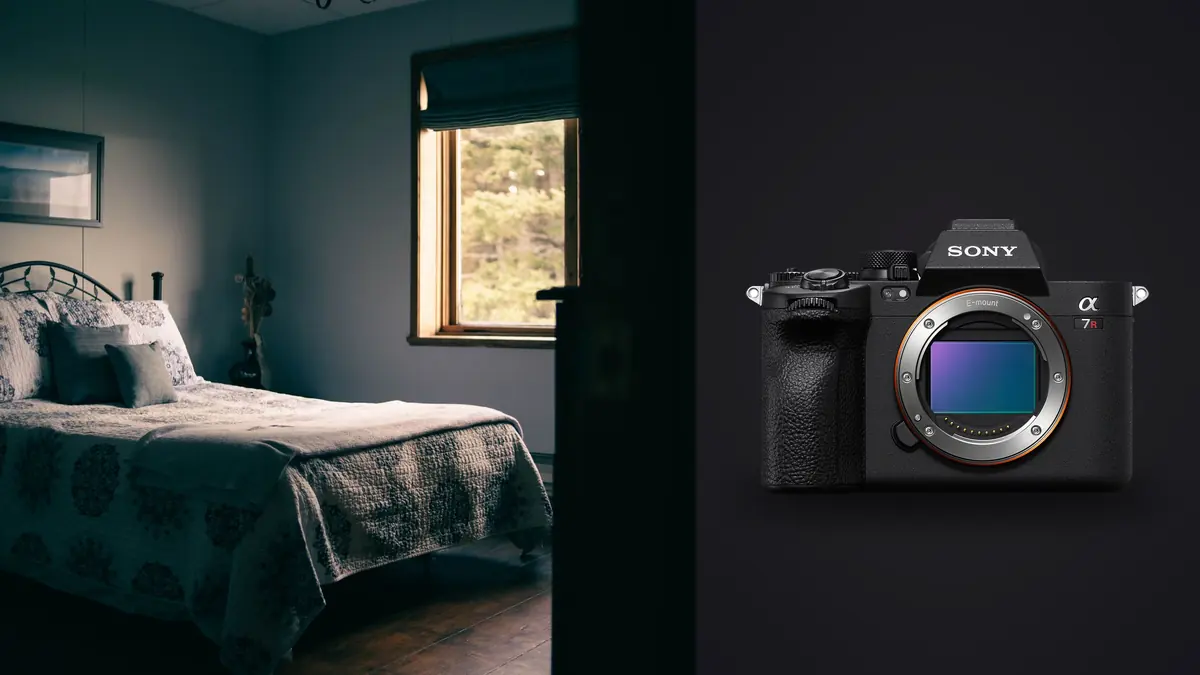
Boudoir sits in an odd corner of the portrait world. You're working close, usually with one client, often in a bedroom or a small suite, and the lighting changes by the minute as curtains get adjusted and a lamp gets nudged six inches to the left. When I switched to the Sony A7R V for this kind of work, I expected the resolution bump and not much else. What actually changed my sessions was the autofocus system, and less obviously, how the camera behaves once the room goes quiet. This isn't a spec sheet rundown. It's what mattered once I started shooting real sessions with it, session after session, in rooms that were never built for photography.
Resolution That Helps You, Then Doesn't
Sixty-one megapixels means you can crop hard into a detail shot, a collarbone, a hand resting on a hip, the line where a strap meets skin, without carrying a macro lens into every session. That's a genuine advantage in boudoir work, where the client wants variety in the final gallery but you don't want to be swapping glass every five minutes in a room with barely enough floor space to back up.
The flip side is that skin at 61 megapixels is unforgiving. Every crease in a bedsheet pressed against someone's hip, every bit of texture a lower-resolution sensor would soften just enough on its own, shows up clearly. I've had to be more deliberate about diffusion on my key light and more careful about how far I push retouching, because the files simply show you what's there. There's less room for the sensor to flatter anyone.
File size compounds the problem fast. A two-hour session shot at a relaxed pace produces somewhere between 800 and 1,200 raw frames, each one 60 to 120MB depending on compression. Boudoir shoots generate long runs of nearly identical frames more than most genres do, because you're often following a slow, continuous movement rather than shooting distinct, separated poses. That's a workflow problem more than a camera problem, and it shows up later.
The Autofocus System Is the Real Upgrade
The A7R IV, which I shot for three years before this, would occasionally hunt when a subject's hair fell across her face or a hand came up near the eyes. The A7R V's dedicated AI processing unit, running human pose detection separately from the main image processor, holds onto an eye through that kind of obstruction in a way the previous generation simply didn't manage. At f/1.4 on an 85mm lens, missing focus by even a couple of centimeters turns a good frame into a discard, so this matters more here than it would at f/5.6 on a landscape shoot.
What surprised me was how well it tracks through motion that isn't a deliberate pose change, someone shifting weight, turning toward a window, exhaling and letting their shoulders drop. Those in-between moments are often the strongest images from a boudoir session, and they're exactly the moments where older autofocus systems tended to lose the thread.
Setting Up Human Recognition for a Session
I set the subject recognition target to Human rather than the general default, with eye priority over face or head, and I leave right eye/left eye selection on auto rather than committing to one. Subject recognition sensitivity gets bumped up a notch from the middle setting, which helps the camera reacquire faster when a client turns away and back. I run everything on back-button focus, continuous AF engaged with the thumb, so a half-press of the shutter never disengages tracking mid-sequence. Wide tracking zone stays selected for movement, and I'll narrow to a smaller zone only for static detail compositions.
Working Quietly in a Small Room
Discretion matters more here than in almost any other kind of portrait work. The fully electronic, silent shutter mode means the room doesn't fill with mechanical clatter every time you fire off a sequence, which noticeably changes how relaxed a nervous client stays through a session. The four-axis tilting screen (it swings out to the side and tilts, not just the usual up-and-down hinge) lets me shoot from a low angle or crouched beside the bed without disappearing behind a viewfinder. Keeping my face visible and maintaining actual eye contact between frames does more for a subject's comfort than any piece of gear I own.
The in-body stabilization, rated around 8 stops, lets me shoot handheld at shutter speeds down to 1/15 or 1/20 with a 50mm lens, which means I can lean on window light or a couple of warm lamps instead of setting up a flash and a stand in a room that barely fits a bed and a chair.
What the Sensor Actually Holds in Low Light
This isn't a low-light specialist body the way the A7S III is, and I don't pretend otherwise. For stills, though, it holds up comfortably to around ISO 3200 to 6400 with acceptable noise, especially once you apply a bit of luminance noise reduction in post. Golden hour sessions lit through a west-facing window rarely push me past ISO 800. Evening sessions relying on string lights and a couple of table lamps regularly sit at ISO 4000 to 6400, and the files still hold enough shadow detail to pull without banding or blotchy color shifts, which matters when half the frame is often deep shadow by design.
Dynamic range is the quieter win here. I can expose for the highlight side of a subject's skin near a window and recover two to three stops of shadow detail on the far side of the body without adding a bounce card or a second light source, which keeps the room feeling like a bedroom instead of a set.
Lens Pairings That Actually Work for This Genre
| Lens | Max Aperture | Best For | The Trade-off |
|---|---|---|---|
| Sony FE 50mm F1.2 GM | f/1.2 | Environmental full-length poses in window light | Focus-and-recompose gets risky with a moving subject; lean fully on eye AF |
| Sony FE 85mm F1.4 GM | f/1.4 | Classic half-body portraits, compression, background separation | Needs real working distance, tight in smaller bedrooms or hotel rooms |
| Sony FE 35mm F1.4 GM | f/1.4 | Wider environmental context, editorial storytelling frames | Noticeable distortion if the subject gets close to the frame edge |
| Sigma 105mm F2.8 Macro Art | f/2.8 | Detail shots: jewelry, lace, hands, texture | Slow and deliberate, not a lens for the whole session |
| Sony FE 24-70mm F2.8 GM II | f/2.8 (constant) | Location and outfit changes without swapping glass | Gives up low-light reach and subject separation compared to the primes |
The File Problem Nobody Mentions in Camera Reviews
Here's what none of the camera review sites tell you: the hardest part of a boudoir session with a 61-megapixel body isn't the shoot itself, it's what happens after. Sorting through 900-plus raw files, many of them nearly identical, each with subtly different eye closure, hand position, or expression, eats hours if you're doing it by scrubbing through a folder one frame at a time. And there's a privacy dimension unique to this genre that I don't take lightly: subjects are trusting the photographer with images they would never want sitting on someone else's server.
This is the part of my workflow where imagic actually earns its place. Its local sharpness and focus scoring flags the genuinely sharp frame out of a burst where six shots look nearly identical at a glance, and its burst and duplicate clustering groups those slow-movement sequences together so I'm choosing one from a set instead of comparing every frame against every other frame manually. Because it processes everything on the machine with no cloud upload, none of those files ever leave my drive to get scored, which is exactly the guarantee a boudoir client deserves to hear when they ask where their photos are going. If you want the mechanics of how that scoring actually works, this breakdown of AI photo culling covers it in more depth than I have room for here.
The other piece I've leaned on is imagic's apply_my_style feature, a preset that learns from edits I've already made rather than shipping a fixed filter. Boudoir clients expect a consistent, recognizable warmth across a gallery, skin tones that read the same in frame twelve as they do in frame ninety. Once I've graded the first pass of a session by hand, I can carry that same treatment into the next import without manually rebuilding sliders from scratch every time. For a deeper look at how skin tone grading choices affect the final feel of a gallery, this color grading guide is worth reading alongside whatever preset workflow you land on.
A Realistic Settings Starting Point
- Aperture priority, f/1.8 to f/2.8 for most of the session, f/1.4 reserved for a handful of closing shots where maximum separation is the point
- Auto ISO capped around 6400, minimum shutter speed tied to focal length rather than left on auto
- Subject recognition on Human, eye priority, left/right eye set to auto
- Back-button focus, continuous AF for anything with movement, switched to single-shot AF for static detail compositions
- Electronic shutter engaged for the full session, silent mode on
- Custom white balance pulled from a gray card at the start, adjusted properly in post rather than chased live under mixed lamp and window light
Frequently Asked Questions
Is 61 megapixels overkill for boudoir photography?
Not overkill exactly, but it changes what the job requires of you. You get room to crop hard into detail shots without extra lenses, but you also need more careful skin prep, more deliberate light diffusion, and an actual culling workflow, because file counts and sizes balloon fast. If you're not planning to print large or crop aggressively, a 24 to 33 megapixel body will feel every bit as capable for this genre, and your storage bill will thank you. Either way, a culling pass through something like imagic before you touch Lightroom saves real hours once the frame count climbs past a few hundred.
Does the A7R V handle low light well enough for moody, window-lit sessions?
For stills, yes, comfortably up to around ISO 6400 with acceptable noise, and the roughly 8-stop stabilization lets you hold shutter speeds low enough to lean on ambient light rather than a flash. It isn't built for video-grade low-light performance the way the A7S III is, but for portrait work lit by a window or a couple of warm lamps, it holds up through an entire session without a hiccup.
Which focus mode should I use for boudoir portraits with the A7R V?
Continuous AF with human subject recognition and eye priority for anything involving movement, a robe coming off, hair shifting, a slow change of pose. Switch to single-shot AF for static detail compositions where you want focus locked on one specific point, like a hand or a piece of jewelry. Running both off back-button focus keeps the two modes from fighting each other mid-session.
Is the A7R V too bulky for an intimate, relaxed shooting environment?
It's not a small camera, the body alone weighs around 723 grams before a lens goes on, but in practice the bulk hasn't been the issue for building rapport. The tilting screen lets me shoot from lower angles without vanishing behind a viewfinder, which does far more for keeping a nervous subject comfortable than the size of the body ever has.