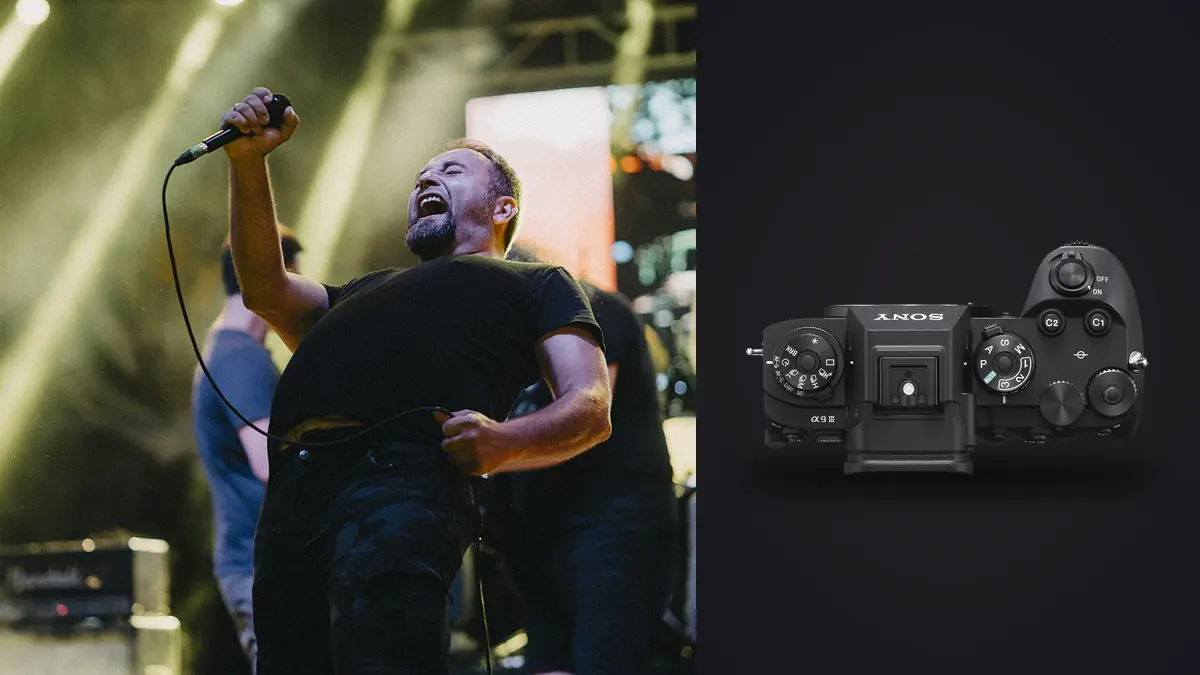
Three songs, no flash, house lights doing whatever the lighting designer feels like that night. That's the brief for most photo pit work, and it hasn't changed in a decade. What has changed is the camera a lot of touring photographers are now bringing into that pit: the Sony A9 III, the first full-frame camera with a global shutter. I've shot with one for the better part of a club and small-arena season, alongside an A7S III and a rented A1 for comparison, and the honest answer is that it solves one problem concert shooters have quietly hated for years and creates a smaller one in exchange.
The banding problem nobody outside live photography talks about
If you've never shot under a modern LED lighting rig, this will sound abstract. If you have, you already know the problem by feel: moving-head fixtures and LED PAR walls don't emit continuous light, they pulse, often at refresh rates that don't line up cleanly with a rolling shutter sensor's readout speed. Shoot silent (electronic) shutter on a rolling-shutter camera under that kind of rig and you get horizontal bands of color shift running across the frame, sometimes on every third or fourth shot, sometimes on all of them depending on the fixture's PWM frequency that night. It's the single most annoying failure mode in club and arena photography, and it's why a lot of photographers were stuck choosing between mechanical shutter (loud, slower burst, shutter shock at high shutter speeds) and electronic shutter (silent, fast, but a banding lottery). The A9 III's global shutter reads every pixel at the exact same instant instead of scanning top to bottom. There's no rolling readout, so there's nothing for the lighting pulse to smear across. I shot an EDM-adjacent bill with strobing PAR cans flashing at a rate that would have wrecked half my frames on a rolling-shutter body, and I didn't get a single banded image across roughly 1,400 frames. That's not a marginal improvement, it's a different category of camera for anyone shooting under hostile stage lighting on a regular basis.
120fps sounds like a gimmick until you're shooting a drummer
The headline spec is 120 frames per second with full AF/AE tracking and a blackout-free viewfinder, and I'll admit I was skeptical going in. Most concert moments aren't fast in the sports-photography sense. A singer isn't running a 40-yard dash. But live music has its own version of "fast": the exact frame where a guitarist's pick hits the string on a downward strum, the top of a drummer's stick before it comes down, the split second a singer's hair is fully airborne mid head-bang. Those windows are often two or three frames wide at 10fps and functionally invisible. At 120fps they become editable choices instead of luck. I don't shoot a whole set at 120fps, that's an unreasonable amount of data and it burns through a CFexpress Type A card fast. What I actually do is drop into the high-speed burst for specific, anticipated moments (jump shots, the guitarist's signature move, a drop in the song I already know is coming) and shoot more conservatively at 10-15fps for the rest. The blackout-free EVF matters more than the frame rate here, honestly, because you can track a moving performer through the viewfinder without the strobing black-frame effect you get on cameras that blank the finder during each shot. You keep visual contact with the subject, which is the difference between nailing focus on a spinning mic stand toss and guessing.
The ISO trade-off is real, and it's worth being honest about it
Here's the part enthusiast forums argue about and working photographers just deal with: the global shutter's stacked sensor design has a narrower native ISO range and a noisier high-ISO floor than the A9 II or the A1. Native sits at ISO 250-25600, and past around ISO 6400 you can see it's working harder than Sony's non-global-shutter bodies at the same setting. In a dim club with only stage wash for light, where I'm regularly at ISO 8000-12800 to hold a workable shutter speed, that difference is visible in the shadows on a large screen. My take after a season with it: I'll take the ISO trade every time for club and festival work specifically because banding is a total loss (the frame is unusable, full stop) while noise is a manageable one (you can grade around it, and modern noise reduction handles chroma noise from stacked sensors reasonably well). If you shoot mostly outdoor daytime festivals or well-lit theater productions where banding was never your problem to begin with, the calculus flips and a camera with a cleaner high-ISO ceiling might serve you better. This isn't a camera that's simply "better" than its stablemates, it's a camera that made a specific trade for a specific kind of shooting, and concert work under harsh moving-light rigs is close to the ideal use case for that trade.
Where the noise actually shows up
In practice it's not the highlights or midtones, it's shadow detail on skin under blue or purple stage wash, the color casts that are hardest to fix without also crushing detail. I've started exposing slightly hotter than instinct tells me at these shows, then pulling back a third to a half stop in post, which keeps more usable signal in the areas where the noise would otherwise show.
How it stacks up against the other pit cameras
These are the three bodies I actually see most often in photo pits right now, compared on the things that matter for this specific job rather than a generic spec sheet.
| Camera | Max burst (full AF/AE) | Banding risk (silent shutter) | Native ISO ceiling | Body weight | Street price (body) |
|---|---|---|---|---|---|
| Sony A9 III | 120fps | None (global shutter) | 25600 | 703g | ~$5,999 |
| Sony A1 II | 30fps | Moderate under PWM lighting | 32000 | 743g | ~$6,499 |
| Nikon Z9 | 20fps (RAW), 30fps (JPEG crop) | Low, but present under fast strobes | 25600 | 1340g | ~$5,499 |
| Canon R3 | 30fps | Low to moderate | 102400 | 1015g | ~$5,999 |
The Z9 and R3 both use partial mechanical-style stacked sensors that read fast enough to largely avoid banding under most rigs, and both hold a real ISO advantage over the A9 III, the R3 especially. What they don't have is a true zero-banding guarantee, and I've still caught the occasional band on the Z9 under aggressive strobe cues at electronic shows. If banding has personally cost you a usable frame from a paying gig before, that's the deciding factor, not frame rate.
Lens choices that actually make sense in a three-song pit
I run three lenses for most club and arena work and rotate depending on venue size: 24-70mm f/2.8 GM II is on the body for maybe 60% of the set, wide enough for full-stage shots and the crowd-facing moments, tight enough for a two-person frame at mid-stage distance. 70-200mm f/2.8 GM II comes out for headliners on bigger stages or when I'm stuck at the back rail of a barricade and need reach for a tight face shot. 35mm f/1.4 GM is my low-light backup when the venue is genuinely dark and I need every stop of aperture I can get, since even at ISO 8000 on the A9 III you want f/1.4 doing some of the work rather than ISO alone. I don't bring a 24mm or wider unless I know I'll be shooting from the crowd rather than the photo pit. Pit distances at most venues put you close enough that a true wide angle distorts faces unflatteringly on anyone near the frame edge.
Sorting the take when you shoot this fast
The honest downside of a 120fps-capable body is what it does to your card and your evening after the show. A three-song set shot the way I described above, mixing bursts for peak moments with steadier bursts for the rest, routinely leaves me with 2,000 to 3,500 frames by the time load-out starts. Most nights I'm filing to a publication or a band's team before I sleep, so wading through that manually isn't realistic. This is where I lean on imagic to do the first pass. It runs entirely on my laptop with no cloud upload, which matters when a band's team has an embargo on unreleased setlist or outfit reveals and I don't want frames leaving my machine before they're cleared. The sharpness and focus scoring catches the difference between the in-focus frame and the two neighbors in a burst where the singer's head moved half an inch, and the burst clustering groups those 120fps sequences automatically instead of me clicking through a hundred nearly-identical thumbnails of the same guitar swing. What used to take me ninety minutes of squinting at a laptop screen backstage now takes closer to twenty, which is the difference between filing same-night and filing the next morning. If you want the mechanics behind how that kind of scoring works, how AI photo culling works goes through it in more detail.
Building a look across a whole tour
If you shoot the same act across multiple dates, consistency across venues with wildly different lighting rigs is its own headache. I trained imagic's apply_my_style feature on a set of edits from a run of shows I was happy with, and it now gets my color starting point close on the first pass even when one venue is bathed in magenta wash and the next is cooler white LED. It's not a substitute for grading each image, especially with the color shifts stage lighting throws at you, but it cuts the baseline work down a lot. For the actual grading decisions once you're past the starting point, this color grading guide covers the parts that are genre-agnostic.
Who this camera is actually for
If you shoot pit work regularly under moving-head or LED-heavy rigs and you've been burned by banding before, the A9 III earns its price in avoided reshoots and unusable frames alone. If you mostly shoot outdoor festivals in daylight, acoustic sets under warm tungsten stage lighting, or theater work where the lighting design is slower and less strobe-heavy, you're paying a premium for a problem you don't have as often, and a camera with a cleaner high-ISO file might genuinely serve you better for less money. It's a specialist's tool that happens to be extremely good at general photography too, not the other way around.
Frequently Asked Questions
Does the A9 III actually eliminate banding under every type of stage lighting?
In my experience, yes for the fast-strobing PWM-driven LED fixtures that cause it in the first place, since the global shutter has no rolling readout for the pulse to interact with. I haven't hit an exception across a season of shows, though it is worth testing at a specific venue before betting a paid gig on any camera sight unseen if the rig is unusual.
Is the resolution enough for magazine covers or large prints?
24.6 megapixels is on the lower end for full-frame in 2026, but it's been enough for every editorial and print use case I've been asked for, including double-page magazine spreads. If your primary business is large-format gallery prints rather than editorial or social delivery, it's worth weighing against higher-resolution bodies, but for live music work specifically it's not the limiting factor.
Do I need flash sync capability for concert photography?
Rarely, since most venues and artist riders prohibit flash in the photo pit entirely. The A9 III's extremely high flash sync speed is a genuine advantage for smaller club shows or promotional shoots where flash is allowed, but don't buy this camera for that spec if pit work under a no-flash policy is your main use case.
Is the high-ISO noise a dealbreaker for dark venues?
Not in my experience, but it does change how you shoot. I expose a bit hotter than habit suggests, lean on fast primes rather than pushing ISO alone, and expect to do more shadow noise work in post than I did on my previous body. If you shoot almost exclusively in extremely dark small venues with minimal stage lighting, budget the extra editing time or consider whether a body with a cleaner ISO ceiling fits your workflow better.