
Newborn photography inverts most of the speed advice that applies elsewhere in this niche. Weddings and events reward fast culling and batch consistency; newborn sessions reward slowing down at exactly the points where other genres speed up. The frame count is small, the stakes per image are high, and parents will look at these photos for years.
Why Newborn Skin Needs Its Own Correction Approach
Newborn skin is frequently red, blotchy, or uneven in the first days and weeks, a normal and temporary condition that most parents still do not want emphasized in a portrait they will frame or share. Correcting this is not the same task as general skin retouching: it is closer to careful color correction, evening out redness and blotchiness through targeted white balance and tone adjustment rather than trying to smooth or reshape anything. imagic's batch editing and color tools support applying a consistent, gentle correction across a session's frames, keeping the baby's true skin tone rather than pushing toward an artificial, uniform look. Getting this wrong in either direction, leaving obvious blotchiness or over-correcting into flat, waxy skin, is one of the most common complaints in newborn photography.
Why Culling Should Be Careful, Not Fast
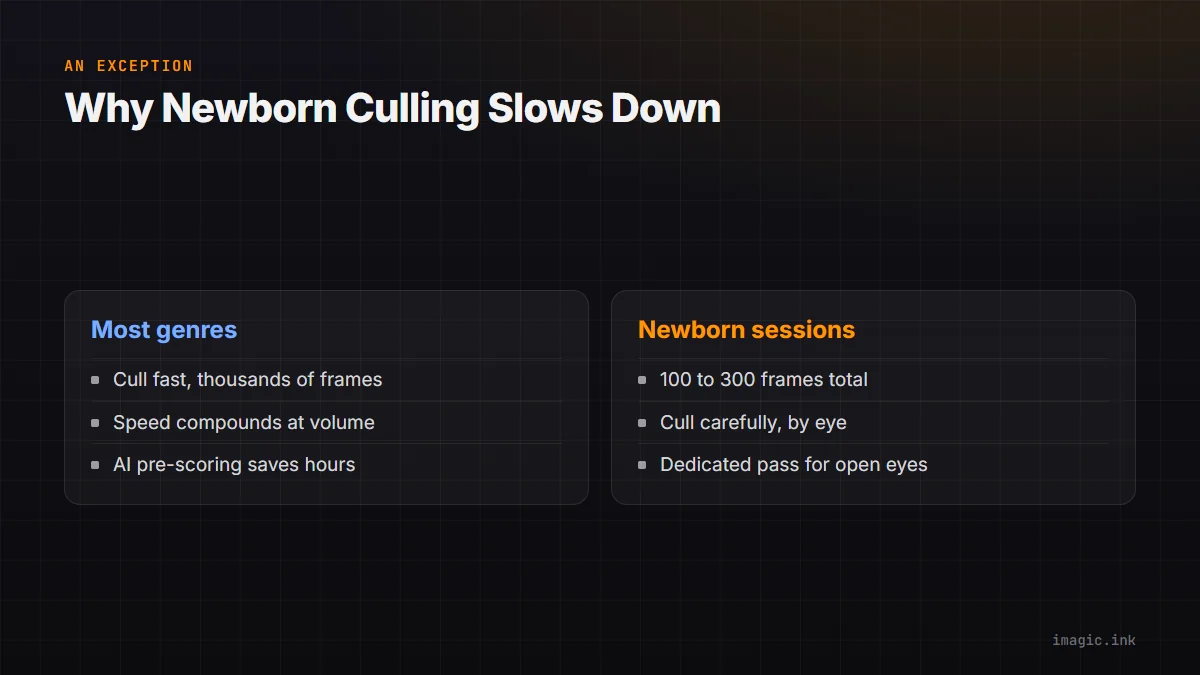
Most of this site's workflow advice pushes toward faster culling, because most genres involve thousands of frames where speed compounds. Newborn sessions are the exception: a typical session runs 100 to 300 frames total, small enough that speed is not the constraint, and the risk of a fast cull is real, since sleeping newborn poses can look nearly identical while differing in small but important ways (a hand position, a slightly open eye, a prop shifted). Treat newborn culling as a careful, full review rather than an AI-assisted speed pass; use quality scoring to flag technical issues like softness or exposure, but make the actual keep decision by eye, on every frame, without rushing.
Parent-Proofing the Final Gallery
The single most damaging mistake in a newborn gallery is a mid-blink or half-open-eye shot slipping through, since newborns are asleep for most of the session and any awake frames draw extra scrutiny from parents checking every image closely. Before finalizing a gallery, do a dedicated pass specifically checking for this, not folded into general quality review, but as its own deliberate step. It takes a few extra minutes and prevents the single most common source of a parent asking for a fix after delivery.
Softness as a Deliberate Choice, Not a Flaw
Newborn photography commonly uses a soft, slightly diffused rendering rather than the crisp sharpness expected in most other genres, since it suits the mood of the images and forgives the skin texture common in the first weeks. This is worth distinguishing clearly from actual focus misses: a deliberately soft edit applied to a genuinely sharp capture reads very differently from a frame that was never in focus to begin with, and mixing the two in one gallery undermines the intentional look. See the newborn photography editing workflow for a fuller walkthrough, and HSV and HSL color correction for the technical detail behind targeted skin tone adjustment. imagic supports this careful editing approach for newborn and family photography, and more genre-specific guides live in the tips and workflow archive.
Frequently asked questions
Should I use AI culling for newborn sessions at all?
Use it to flag technical issues like softness or exposure problems, but make the final keep decision by eye, on every frame, since the small frame count makes speed a lower priority than accuracy here.
How do I correct blotchy newborn skin without making it look fake?
Work in small, targeted adjustments to redness and tone rather than heavy smoothing, and check the result against the original regularly so the correction stays believable rather than artificial.
Is soft focus in newborn photography a mistake?
Not when it is a deliberate stylistic choice applied consistently, but it should be distinguished clearly from genuine focus misses, which still need to be culled out.