
Ask a slow editor to describe their process and you often hear the same pattern: open a photo, decide if it is a keeper, adjust exposure, decide again whether it is good enough now, tweak crop, move on, and repeat for every single frame in the shoot. That constant switching between judging and adjusting is not a personality quirk, it is a measurable tax on speed. Separating culling from editing into two distinct passes is one of the simplest changes that reliably cuts total post-production time.
The Real Cost of Mode-Switching
Culling is a judgment task: keep or discard, based on focus, expression, and composition. Editing is an adjustment task: move sliders, compare before and after, refine. These use different mental modes, and switching between them repeatedly inside a single pass carries a real cost, the same kind of cost researchers describe as task-switching overhead in any knowledge work. Every time you stop judging to adjust, then stop adjusting to judge the next frame, you pay a small reset. Across a 1,500-image wedding shoot, those resets add up to real hours, not minutes.
The Two-Pass Discipline
The fix is to do all the judging first and all the adjusting second. Pass one: go through the entire shoot making only keep-or-discard decisions, fast, with no editing at all, just flags or star ratings. Pass two: open only the keepers and do all the editing, one continuous adjustment session with no more culling decisions mixed in. Photographers who make this switch consistently report it feels faster almost immediately, because each pass only asks the brain to do one kind of work. For the mechanics of the culling half specifically, see what photo culling actually involves.
Where AI Culling Fits
AI quality scoring speeds up pass one further by pre-sorting on sharpness, exposure, closed eyes, and duplicate detection before you look at anything. imagic's culling engine runs this locally on every tier, so instead of judging 1,500 raw frames cold, you are reviewing a shortlist the software already narrowed for you, confirming or overriding rather than deciding from scratch. The judgment pass still happens, a model does not replace your taste, but it removes the obvious discards before you spend a second on them. How AI photo culling works covers the scoring mechanics in more depth.
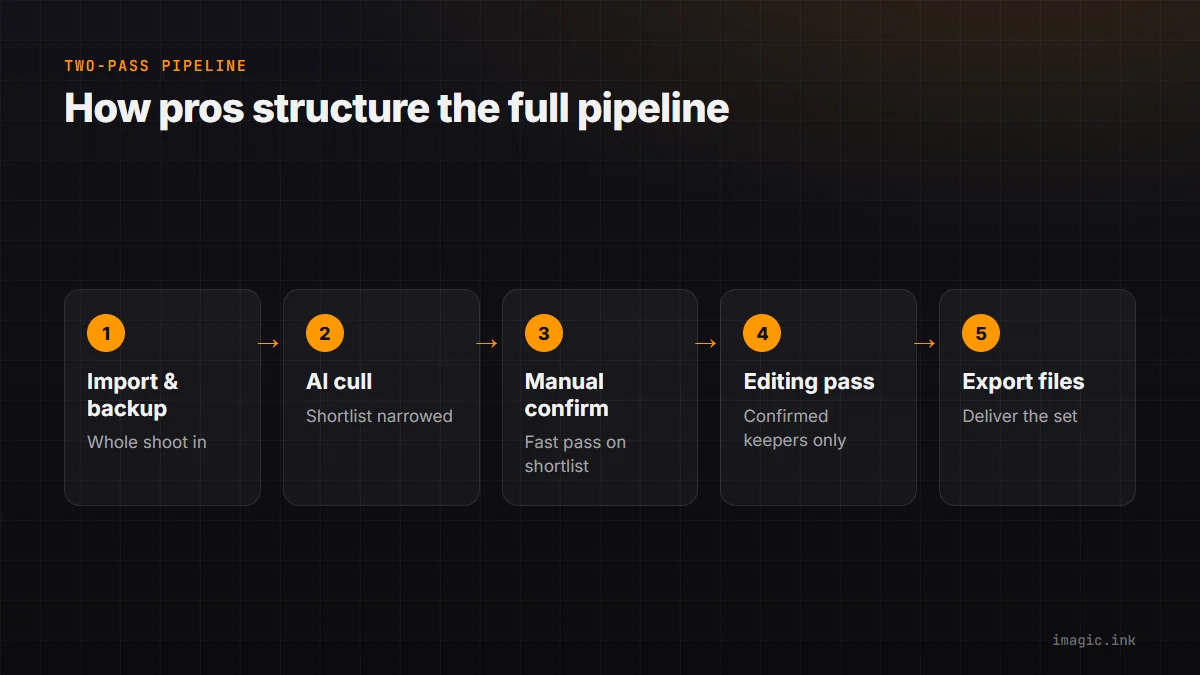
How Pros Structure the Full Pipeline
A typical structure looks like: import and back up, run AI culling to get a shortlist, do a fast manual pass on the shortlist to confirm picks, then a dedicated editing pass on confirmed keepers only, followed by export. Each stage has one job. The temptation to fix a photo the moment you notice a problem, mid-cull, is worth resisting; flag it and keep moving, then fix it in the editing pass where your tools and attention are already set up for adjustment work.
When It Is Fine to Blend the Passes
For very small shoots, a dozen images from a quick personal session, the overhead of formally separating passes is not worth it, just work through them however feels natural. The two-pass discipline pays off specifically at volume: events, weddings, sports bursts, anywhere the shot count runs into the hundreds or thousands. That is also where the mode-switching cost compounds the most, so it is exactly where the fix matters most.
Frequently asked questions
Does separating culling and editing actually save time, or just feel faster?
Both. It feels faster because each pass is cognitively simpler, and it is faster in practice because you stop re-opening the same photo for a second look once it has already been judged. Photographers who track their hours typically see the difference on backlog-heavy weeks.
Should star ratings or flags be used for the culling pass?
Either works as long as it is fast to apply and does not require thought beyond keep or discard. Binary flags are usually quicker for the first pass; finer ratings can come later if you need to prioritize among keepers.
Can AI culling replace the manual pass entirely?
Not for judgment calls like expression, composition, or moment. AI scoring is reliable for objective flaws such as blur or closed eyes, but the final keep decision on close calls still needs a human look.