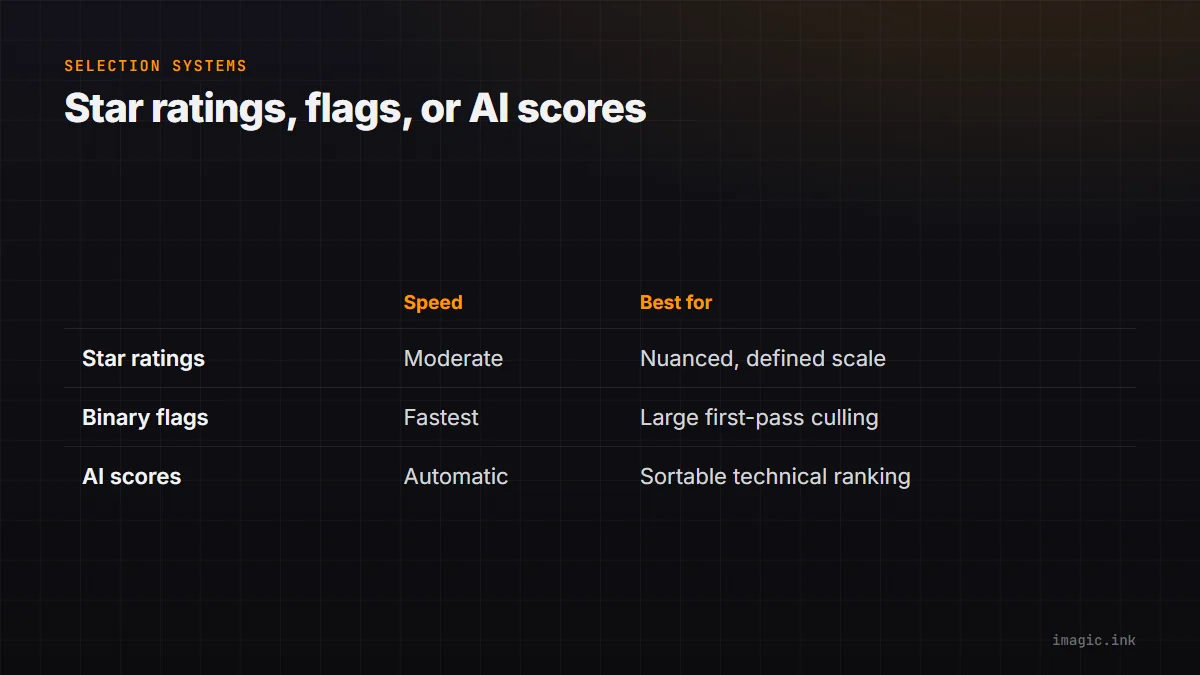
Open ten photographers' catalogs and you will find ten different meanings for three stars. One person uses it for "technically fine," another for "client favorite," a third abandoned the system entirely after month two. The selection system itself, stars, flags, or numeric scores, matters less than picking one with a clear definition and using it consistently, but the three systems do have real tradeoffs worth understanding before you commit.
The Taxonomy Problem With Star Ratings
Five-star systems feel intuitive until you try to define what each level means under pressure. Is a 2-star photo unusable or just mediocre? Does 4 mean "great" or "great enough to show a client"? Without a written definition, star meaning drifts across sessions and especially across time, so a rating you gave six months ago stops being trustworthy today. Star ratings work best when the scale is written down somewhere and kept short, three meaningful levels (reject, maybe, keep) dressed up as stars rather than a full five-point spread nobody can hold consistently in their head.
Binary Flags: Fast but Coarse
A flag system, pick or reject, nothing in between, is the fastest possible culling decision because there is no scale to calibrate against. This speed is the whole appeal: on a large shoot, removing the need to weigh degrees of quality lets you move through frames quickly during the first pass. The tradeoff is that flags collapse all nuance into one bit of information, so if you need to prioritize among 400 keepers for a highlight reel, flags alone will not tell you which are the best of the best; you will need a second pass or a secondary system layered on top.
Continuous Scores: Sortable, but Needs a Source
A numeric score, especially one generated automatically rather than assigned by hand, solves the sorting problem flags cannot. Sort a shoot by score and the strongest technical frames surface immediately, useful for finding a hero image fast or building a highlight set. imagic's AI quality scoring works this way, scoring sharpness, exposure, and composition automatically so you get a sortable ranking without hand-rating a single frame. The catch is that a score reflects technical quality, not artistic judgment or client preference, so it is a starting filter, not a final verdict. How AI photo scoring works covers what the score does and does not measure.
Migrating Between Systems Without Losing History
Switching systems mid-library is common and does not require re-rating everything. The practical approach: freeze the old system's meaning as of a cutoff date, note it somewhere (even a text file in the library root), and apply the new system only going forward. For older shoots you revisit, translate on the fly rather than batch-converting: a legacy 4-star typically maps to "keep" in a flag system or a high score in an automated one, but do not assume a strict formula holds across every photographer's old habits. Common culling mistakes covers a few of the ways rating systems quietly break down over time.
A Reasonable Default
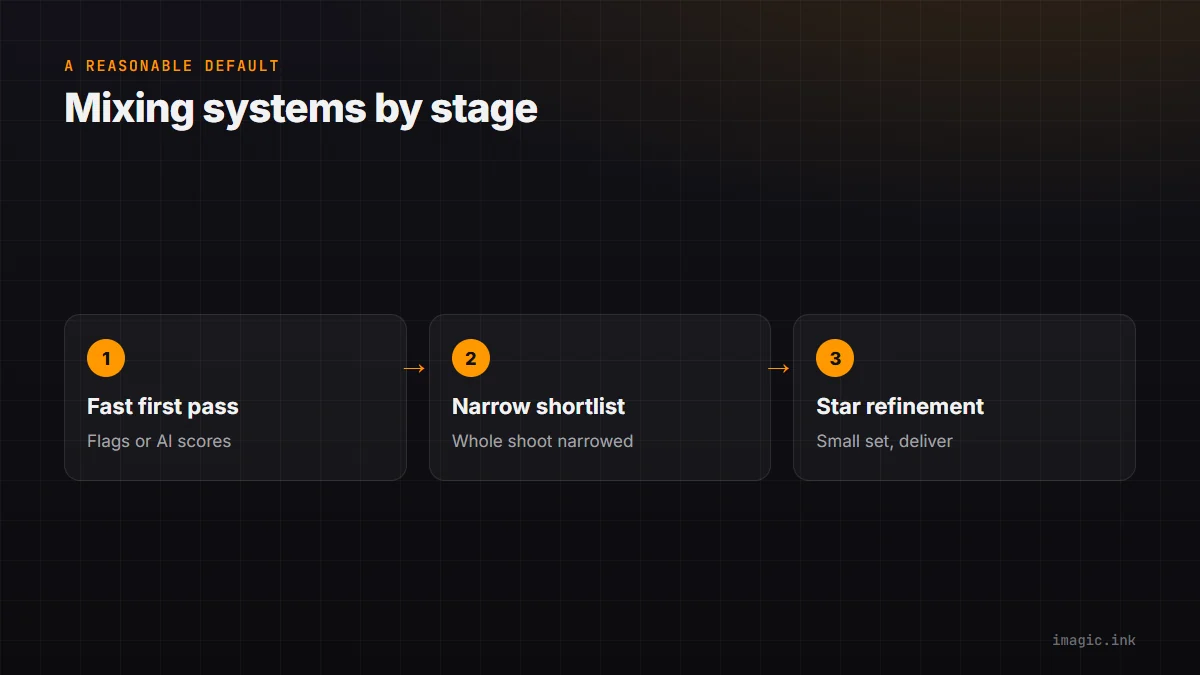
For most working photographers, a hybrid is the practical answer: use AI scores or flags for the fast first pass across the whole shoot, then a small, well-defined star scale (or a second flag, "favorite") for the shortlist you actually deliver or feature. This mirrors the culling-then-editing split covered in the guides section: one system for speed at volume, a second, finer system only for the set small enough to deserve it.
Frequently asked questions
Is a 5-star system ever the wrong choice?
Not wrong exactly, but often more granularity than most photographers actually use consistently. If you find yourself only ever assigning 1, 3, or 5, you effectively already have a 3-level system and could simplify to match.
Do AI scores replace star ratings?
They handle a different job. AI scores are best for technical sorting across a whole shoot; star ratings (or flags) are better for marking client-facing or artistic decisions a model cannot make.
How do I keep rating meaning consistent over a long career?
Write your rating definitions down once, somewhere you will actually see again, and revisit them only when you deliberately change systems. Consistency comes from having a reference to check, not from memory.