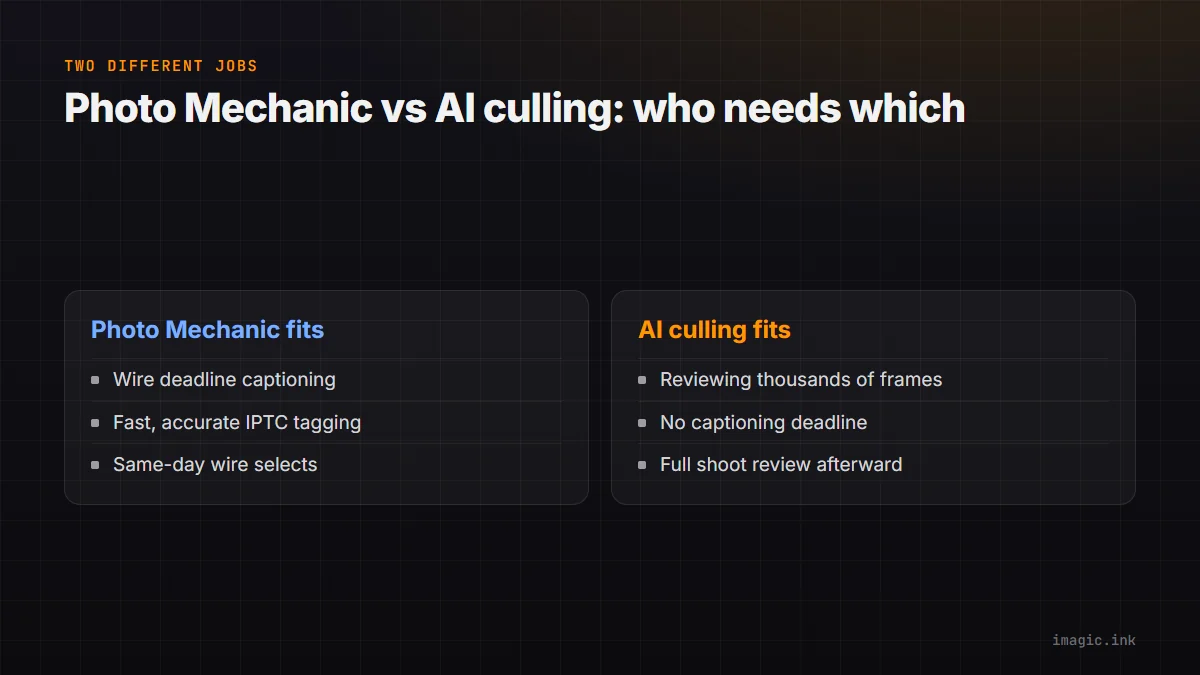
Photo Mechanic has a loyal, long-standing user base, largely because it does one job better than almost anything else on the market: loading and browsing RAW files at speed, with fast IPTC captioning for deadline work. Whether that is still worth the photo mechanic price in 2026 depends heavily on whether you are actually using that specific capability, or paying for a habit formed years ago.
What Photo Mechanic Plus Actually Costs
Photo Mechanic offers both a one-time license path and a Plus subscription tier with added features; check current pricing directly since it has shifted over time and varies by license type. The core value proposition has not changed: near-instant browsing of huge RAW batches and fast, accurate IPTC metadata entry for captioning and wire transmission.
Who Genuinely Still Needs It
Photojournalists and sports photographers filing under real wire deadlines, where a caption has to be accurate and attached within minutes of the shutter closing, are the clearest case where Photo Mechanic's specific speed and IPTC tools earn their cost every time they are used. Anyone working with strict metadata and captioning requirements as a routine part of the job, not an occasional task, is in a similar position. For that workflow, there is genuinely no faster tool doing the same job.
Who Is Paying for Habit
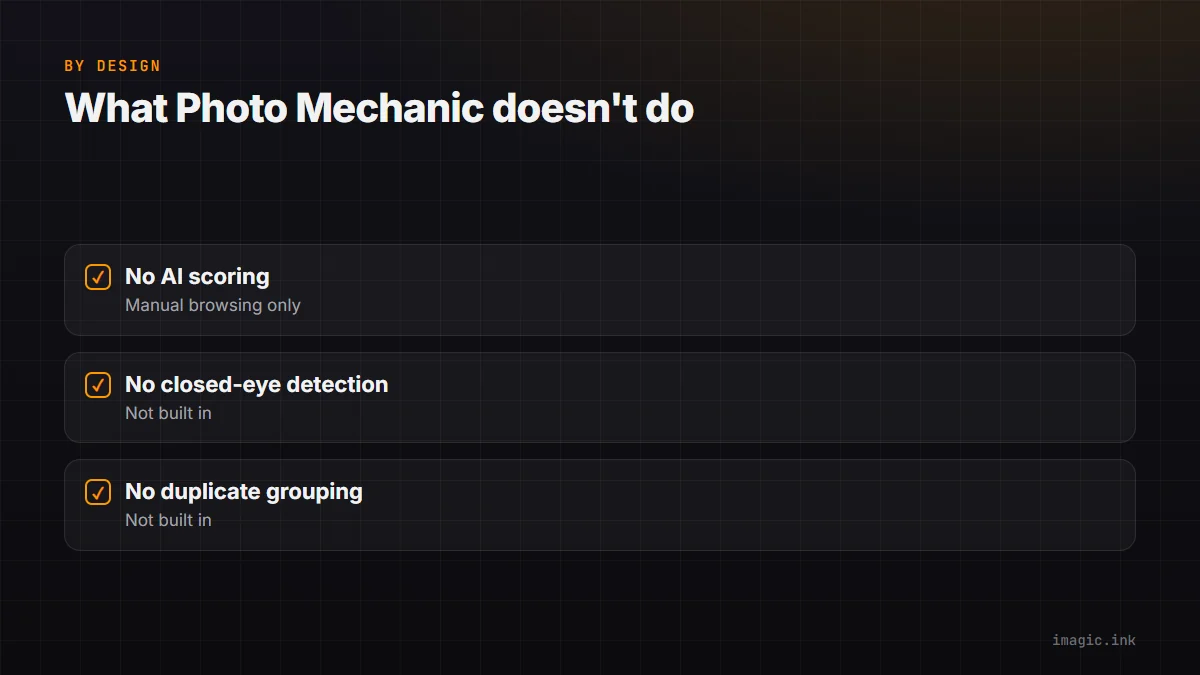
A wedding or portrait photographer who bought Photo Mechanic years ago for its speed, but whose actual bottleneck today is reviewing thousands of frames to decide what is worth editing rather than captioning on a deadline, may be keeping a subscription or paying for updates on a tool solving a problem they no longer have day to day. Photo Mechanic has no AI scoring, no closed-eye detection, no duplicate grouping, it is a manual browsing and tagging tool by design. If your actual time sink is the cull, not the caption, that gap is worth being honest about.
What Changes the Calculation
The honest test is simple: track where your review time actually goes on your last three shoots. If most of it is spent captioning, tagging, and getting files out the door fast, Photo Mechanic's price is easy to justify. If most of it is spent scrolling through frames deciding what is sharp, well-exposed, and not a duplicate of the one next to it, an AI-scoring tool is solving the problem you actually have, and Photo Mechanic's speed advantage matters less. imagic's AI culling, quality scoring, and duplicate detection are included in every tier starting at Lite (EUR 19 one-time), which is worth weighing against a Photo Mechanic renewal if review time, not captioning, is the real bottleneck. See the full imagic vs Photo Mechanic comparison for where each genuinely wins.
A Reasonable Middle Path
Plenty of photographers reasonably keep both: Photo Mechanic for same-day wire selects and metadata on time-critical work, an AI culling tool for the fuller shoot review afterward. That is not double-paying for the same job, it is paying for two different jobs that happen to both involve looking at photos. See Photography Business Software Costs in 2026 for how this fits into a wider software budget, and more industry insights on the blog.
Frequently asked questions
Does Photo Mechanic do AI culling?
No, it is a manual browsing, flagging, and captioning tool with no quality scoring or duplicate detection built in.
Is Photo Mechanic still the fastest tool for wire deadlines?
For loading and captioning RAW files under a tight deadline, it remains widely regarded as the speed standard in that specific niche.
Should I replace Photo Mechanic with an AI culling tool?
Only if captioning speed is not your actual bottleneck. If review time on large shoots is the real cost, an AI-scoring tool solves a different problem than Photo Mechanic was built for.
Try imagic free for 500 exports, no card required, to see if AI culling addresses your actual review bottleneck. Start the free trial.