
Photo Mechanic Plus is no longer available for purchase, Camera Bits confirmed in March 2026, after the catalog feature it depended on relied on third-party technology the company could not keep stable. Standard Photo Mechanic was unaffected and continues to be developed and sold. That leaves a genuinely different question for anyone weighing a purchase today: with Plus off the table, is buying into standard Photo Mechanic in 2026 still worth it, and for whom specifically.
What actually changed, and what did not
Camera Bits was direct about the reason for retiring Plus: the catalog feature's underlying third-party technology became unstable across operating system updates, and the team could not resolve it, a situation the company said worsened after losing the engineer who had built that architecture. Existing Plus subscriptions are not being cancelled outright, and Camera Bits says it will keep providing support for as long as the software remains stable on a subscriber's operating system, with no fixed end date set. Standard Photo Mechanic, the ingest-and-caption tool most users actually run day to day, was not part of the discontinuation at all. Anyone evaluating a purchase in 2026 is evaluating standard Photo Mechanic, not the retired catalog tier.
Current pricing, checked directly
As of September 2026, Camera Bits lists Photo Mechanic on a subscription at 14.99 dollars a month or 149 dollars a year, alongside a perpetual license at 299 dollars, with the perpetual license including a year of updates and support before continuing to work indefinitely on the last compatible operating system without further updates. Check the current figures directly before buying, since Camera Bits has adjusted this pricing before and could again. See the official Photo Mechanic pricing page for the live numbers.
Who genuinely still needs it in 2026
Photojournalists and sports photographers filing under real wire deadlines, where a caption has to be accurate and attached within minutes of the shutter closing, remain the clearest case where Photo Mechanic earns its cost every time it is used. Its combination of fast RAW and JPEG ingest, stationery-template captioning, and variable-driven metadata entry has no direct equivalent among the newer AI-first culling tools, none of which were built around wire-deadline captioning. Anyone whose job routinely involves strict metadata and captioning requirements, not as an occasional task but as the actual daily job, is buying a tool built specifically for that problem. That specificity is also the limit of what the purchase buys: it speeds up getting accurately captioned files out the door, and it does nothing to speed up deciding which files are worth captioning in the first place, a separate step Photo Mechanic leaves entirely to the photographer's own eye. Deciding whether that split matters to you is really a question about where your own two bottlenecks sit, captioning speed and selection speed, rather than a question about Photo Mechanic's quality, which nobody disputes for the job it was built to do.
Who is more likely paying for habit
A wedding or portrait photographer who bought Photo Mechanic years ago for its ingest speed, but whose real bottleneck today is reviewing thousands of frames to decide what is worth editing rather than captioning anything on a same-day deadline, may be keeping a license for a problem they no longer have day to day. Photo Mechanic has no AI quality scoring, no closed-eye detection, and no duplicate or burst grouping; it is, by design, a fast manual browsing and captioning tool, not a review-automation one. If the actual time sink on a typical shoot is scrolling through near-identical frames rather than writing captions, that gap is worth being honest about before renewing or upgrading.
What a wire-deadline workflow actually looks like
It helps to be concrete about what the price is actually buying. A sports photographer at a same-day event ingests a card mid-game, scans a fast contact sheet for the handful of frames worth sending, attaches a caption built from a saved template with the game, teams, and photographer credit already filled in through variables, and transmits selects to an editor or wire service within minutes, all before the final whistle. That entire chain, ingest, caption, transmit, on a strict clock, is the specific problem Photo Mechanic was built to solve, and it is a genuinely different sequence of steps than sitting down after a shoot to slowly work through which of two thousand frames deserve a full edit. Anyone deciding whether the price is worth it should picture their own actual last deadline day, not a generic photo-editing session, since the two workflows justify very different tools. The two can also happen on the same day for the same photographer: a handful of wire selects go out within minutes for the deadline, while the rest of the shoot waits for a calmer, fuller review pass that evening, and pricing the software against only one of those two jobs undercounts what a full working day actually asks of it.
How Photo Mechanic's cost compares to an AI-culling license
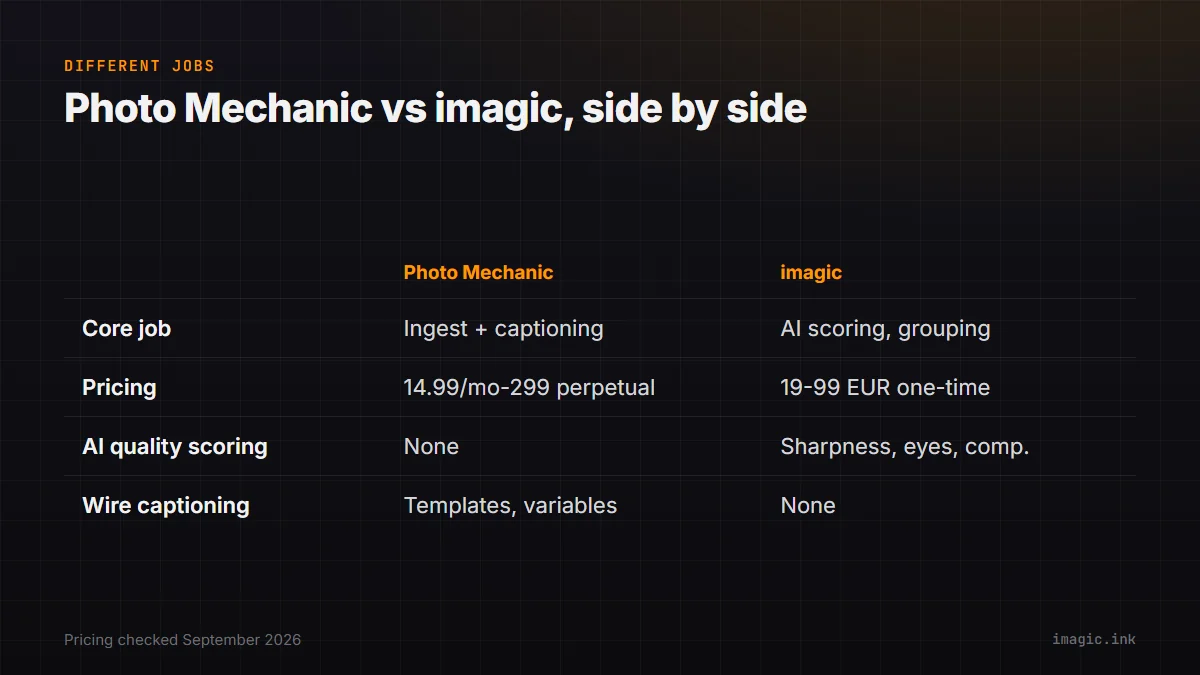
| Photo Mechanic | imagic | |
|---|---|---|
| Core job | Fast ingest and IPTC captioning | AI quality scoring and duplicate grouping |
| Pricing as of Sept 2026 | 14.99 dollars/month, 149 dollars/year, or 299 dollars perpetual | One-time: Lite 19, Plus 49, Max 99 EUR |
| Processing | Local | Local |
| AI quality scoring | None | Sharpness, closed eyes, composition |
| Wire captioning tools | Stationery templates, variables | None |
These solve different problems, so the table is not an argument for picking one over the other, it is a way to see the actual numbers side by side before deciding whether either purchase, or both, fits what a specific shoot day requires.
The subscription versus perpetual license decision
Photo Mechanic's subscription includes ongoing updates and support for as long as it is active, while the perpetual license is a one-time payment that includes a year of updates before the software is frozen on whatever operating system it last supported. For someone confident they will keep using Photo Mechanic for several years and want to avoid a recurring charge, the perpetual license is the more predictable long-term cost, provided the frozen-version tradeoff is acceptable. For someone who wants every camera-compatibility update as new bodies ship, or who is not certain Photo Mechanic will remain the right tool long-term, the subscription is the lower-commitment option. Neither is objectively correct; it depends on how settled the workflow already is.
What changes for agencies and small newsrooms
A single freelancer weighing Photo Mechanic's price against their own usage is a different calculation than an agency or small newsroom licensing it across several desks. Photo Mechanic's per-seat subscription or perpetual pricing scales linearly with headcount, and a shared stationery template across a newsroom keeps captioning format consistent across different photographers filing to the same desk, a consistency benefit that is easy to underweight until several photographers' inconsistent caption habits reach an editor at once. For a team where wire captioning discipline is a genuine editorial requirement, not just a nice habit, standardizing on Photo Mechanic across every seat is often worth the multiplied cost simply to keep caption formatting predictable, independent of whether each individual photographer's personal review speed would justify the purchase alone.
A reasonable middle path
Plenty of photographers reasonably run two tools rather than choosing one: Photo Mechanic for same-day wire selects and captioning on deadline work, and a separate AI-scoring culling tool for the fuller shoot review afterward. That is not double-paying for the same job, it is paying for two different jobs that both happen to involve looking at photos. imagic, sold as a one-time license rather than a subscription, runs its sharpness and closed-eye scoring locally and handles that second job without touching Photo Mechanic's captioning workflow at all, and since it is a one-time purchase rather than a second monthly subscription stacked on top of Photo Mechanic, adding it does not turn into a second recurring line item on a photography business budget. For a full rundown of specific alternatives and who each one actually suits, see Best Photo Mechanic Alternatives in 2026, and the direct feature-by-feature breakdown is on the imagic vs Photo Mechanic comparison page.
If you already own a Photo Mechanic Plus license
Existing Plus owners are in a genuinely different position than someone deciding whether to buy in fresh. Nothing about a working Plus installation changes today: the software keeps running, the catalog keeps functioning, and Camera Bits has committed to support for as long as it stays stable on your current operating system. The planning question worth addressing now, rather than after an operating system update breaks something, is what happens to that catalog data if support eventually lapses on a future OS version. Camera Bits has said it is exploring migration options for user databases, but no specific export or migration tool has shipped as of September 2026, so exporting or backing up your catalog's metadata in a portable format while the software still runs normally is a reasonable precaution rather than something to defer indefinitely.
The honest test before you buy or renew
Track where review time actually goes across a handful of recent or upcoming shoots. If most of it is spent captioning, tagging, and getting files out the door on deadline, Photo Mechanic's price is easy to justify in 2026, Plus discontinuation included, since none of that changed for the standard product. If most of it is spent deciding what is sharp, well-exposed, and not a duplicate of the frame next to it, that is a different problem than Photo Mechanic was built to solve, and an AI-scoring tool is worth evaluating alongside it rather than instead of a renewal decision made on habit. More on how tool pricing adds up over a working year is in the software comparisons section, and imagic's own one-time pricing is on the desktop app page.
Frequently asked questions
Should I still buy Photo Mechanic now that Plus is gone?
Standard Photo Mechanic was not affected by the Plus discontinuation and remains actively developed. If fast ingest and deadline captioning are genuinely your daily bottleneck, buying standard Photo Mechanic in 2026 is still buying a tool built specifically for that job.
What happens to my existing Photo Mechanic Plus subscription?
Camera Bits says existing Plus subscriptions are not being cancelled and will continue receiving support for as long as the software stays stable on your operating system, though no new Plus purchases are being accepted and no fixed end date has been announced.
Is a perpetual license or subscription the better buy in 2026?
A perpetual license is usually the lower long-term cost if you plan to keep using Photo Mechanic for years and can accept the software freezing on your current operating system after a year of updates. A subscription suits anyone who wants ongoing camera-compatibility updates or is less certain about locking in long-term. Whichever you choose, confirm the current price directly on Camera Bits' own pricing page before buying, since both figures have shifted before.