Digital delivery gets treated as the default product in a lot of pricing conversations, with prints framed as a nice add-on if a client happens to want one. The margin math tells a different story: print products, done deliberately rather than as an afterthought, are frequently where a photography business's actual profit lives.
Where the Money Actually Sits
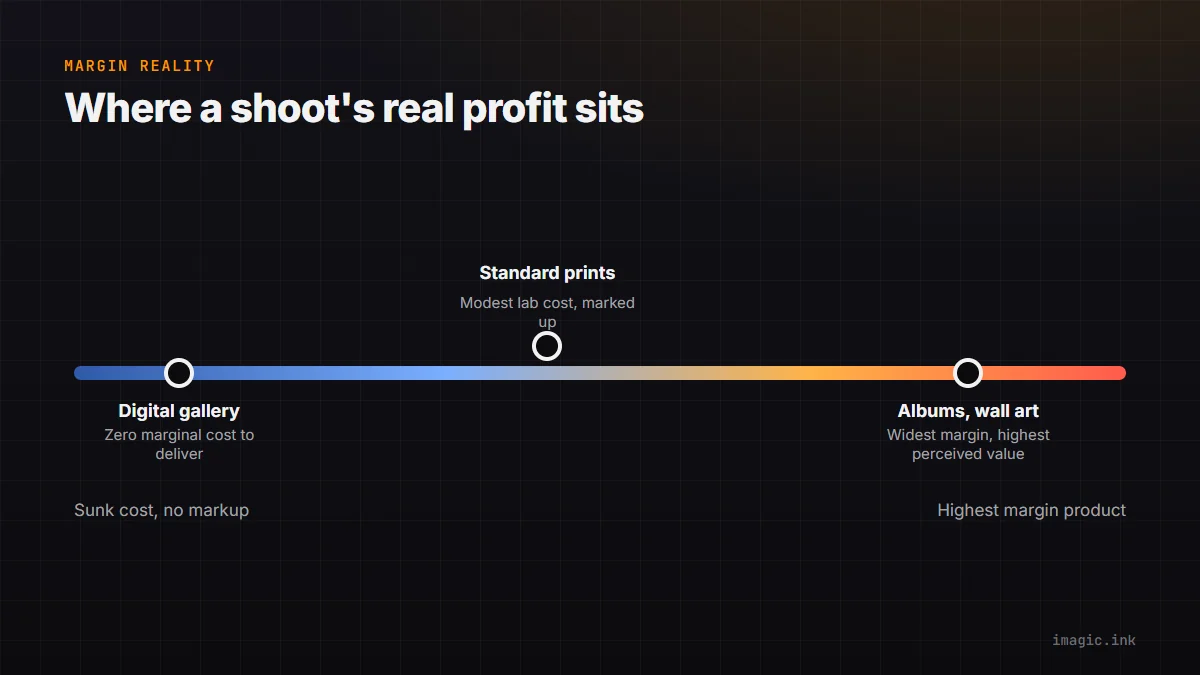
A digital gallery delivery, once shot and edited, has essentially zero marginal cost to deliver again or deliver more of; the cost was already sunk in the shoot and edit. Print products carry a real marginal cost, the lab charges for paper, printing, and shipping, but that cost is usually a modest fraction of what clients are willing to pay for a physical product they will hang on a wall or hold in an album, particularly for wedding and family photography where the emotional value of a tangible print runs well ahead of a lab's production cost. The margin on a well-priced print product frequently exceeds the margin on the digital-only package that got the client in the door in the first place.
The Print Markup Math
A typical retail print lab might charge a photographer somewhere in the range of a few euros for a standard printed and mounted piece, depending on size and finish, while photographers commonly price the same product to clients at several times that lab cost, a markup structure that is standard practice across the industry and generally well understood by clients as the cost of a curated, professionally produced physical product rather than a plain retail print. Album and larger wall-art products often carry even wider margins, since the perceived value (and often the actual production quality) scales up faster than the underlying lab cost does. None of this requires inflated pricing tricks; it reflects that clients are paying for curation, design, and a finished object, not just the raw printing.
How Fast Delivery Feeds Print Sales
The connection between digital delivery speed and print sales is closer than it might seem: a client who receives their gallery while the emotional high of the shoot is still fresh, and while they are actively sharing images with friends and family who react to them, is measurably more likely to act on a print or album offer than a client whose gallery arrives weeks later after the initial excitement has faded. This is one of the more concrete business reasons fast turnaround matters beyond simple client satisfaction; it directly affects the sales window for the highest-margin part of the business. Delivering wedding photos faster covers the mechanics of hitting that window consistently.
Structuring an In-Person or Online Sales Session
Photographers who run a deliberate print sales session, in person or via a well-designed online gallery with print options built in, rather than leaving prints as a passive afterthought link, consistently report meaningfully higher print revenue per client than those who simply mention prints are available somewhere in the delivery email. This does not need to be an aggressive sales pitch; even a well-curated gallery that visually suggests print-worthy images, paired with clear, simple ordering, captures much of this opportunity without feeling like a hard sell.
What This Means for Package Pricing
Given the margin difference, some photographers deliberately price digital-only packages closer to true cost and rely on print and album sales for a larger share of actual profit, effectively using the digital package as the entry point to a client relationship where the highest-margin products get offered afterward. This is a genuine strategic choice worth considering rather than assuming digital delivery alone needs to carry the full margin of the business. More business-economics posts like this one cover related pricing decisions across the industry insights section.
Frequently asked questions
Do clients resist print markups over lab cost?
Generally not, when the markup reflects genuine curation and a finished, professionally produced product rather than a plain retail print. Clients are typically comparing the price to the emotional and physical value, not to the lab's raw cost.
Is it worth offering prints if most clients only want digital files?
Often yes, since even a modest percentage of clients purchasing prints or albums can represent a large share of total profit given the higher margin, especially when the offer is presented well and promptly after delivery.
Does delivery speed really affect print sales meaningfully?
Yes, based on the general pattern that purchase decisions tied to emotional engagement fade as the initial excitement of a shoot fades. Faster delivery keeps the sales window open while that engagement is still high.