Somewhere in a drive from 2019 sits a frame you rejected without a second thought and would now put straight into a portfolio. This is not a rare accident. It happens to almost every photographer who has been shooting long enough for their taste, and their tools, to move on from where they were a few years ago.
Taste Changes More Than People Admit
The eye you cull with today is not the eye you culled with several years ago. Style trends shift (the muted, true-to-life grading many photographers favor now looks different from what was popular a few years back), your own aesthetic matures, and your sense of what makes a strong single frame versus a merely correct one develops with experience. A photo rejected in 2019 for being "too plain" might read today as exactly the quiet, editorial-style frame you would now choose over a busier alternative. Old rejects are not a record of bad photos; they are a record of an earlier, narrower set of preferences.
Better Tools Find Different Keepers
Tooling has also moved. Manual culling under time pressure years ago meant snap judgments, often biased toward technically obvious wins (sharp eyes, clean exposure) over subtler qualities like composition or genuine expression. Modern AI-assisted scoring evaluates sharpness and closed-eye detection with more consistency than a tired eye at 11pm, which means a second pass with current tools can surface technically strong frames that got lumped in with genuine rejects the first time simply because nobody looked closely enough under deadline pressure.
A Practical Archive Re-Scoring Workflow
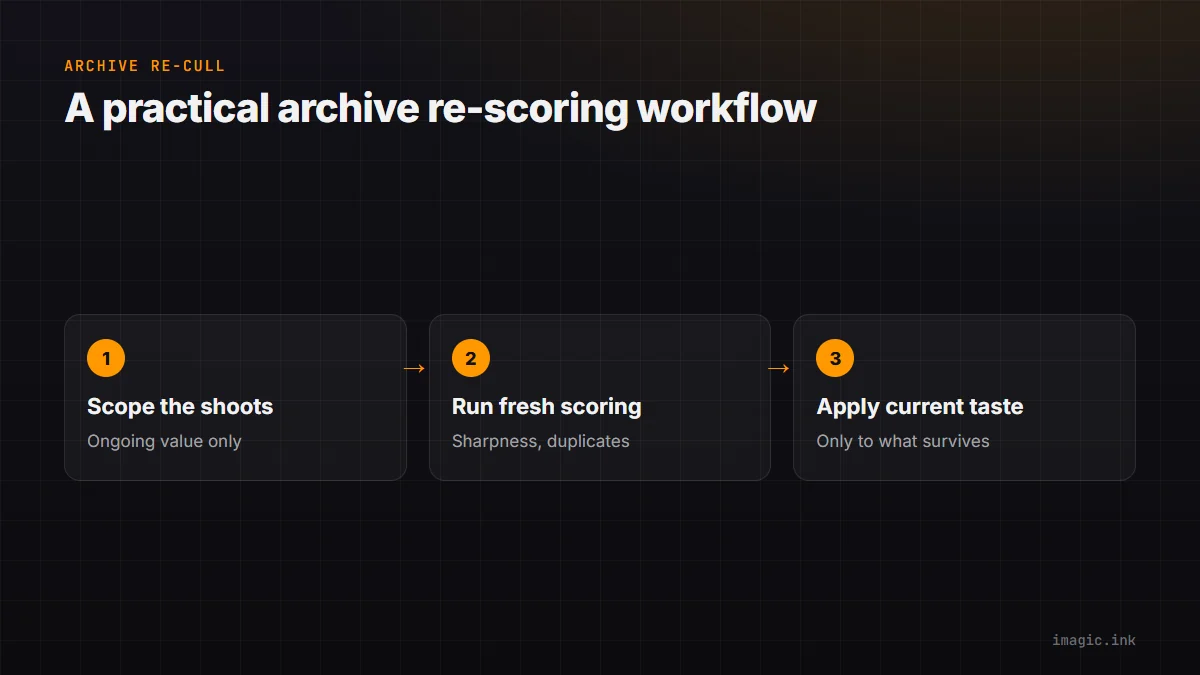
Re-culling an entire archive from scratch is not realistic, so scope it: start with shoots that have some ongoing value, a favorite client, a personal project, a portfolio gap in a genre you want to show more of. Run the archive through fresh quality scoring rather than re-eyeballing every frame manually; let sharpness and duplicate detection do the mechanical filtering again, then apply your current, more developed taste only to what survives that pass. This turns a multi-week slog into a focused afternoon per shoot.
Refreshing a Portfolio From Files You Already Own
The most immediate payoff of re-culling is portfolio work that costs nothing but time: you already own the files, the shoot is already paid for, and you are not booking anything new. A handful of previously rejected frames from strong past shoots can genuinely change how a portfolio or website gallery reads, especially if your current work leans toward a style you have only recently settled into. It is one of the highest-value low-cost projects available to an established photographer with a deep archive.
Frequently asked questions
Is it worth re-culling old shoots instead of just shooting new content?
For portfolio refreshes specifically, often yes, because the cost is just your time on files you already own, versus the cost of a new shoot. It is a good use of a slow week rather than a replacement for ongoing new work.
How do I decide which old shoots are worth revisiting?
Prioritize shoots tied to genres or styles you currently want to showcase more, and skip shoots that are technically dated (older camera, lower resolution) unless the content itself is unusually strong.
Will AI scoring find things a first manual cull missed?
It commonly does, particularly around sharpness and closed-eye detection, since those checks stay consistent regardless of how tired or rushed the original cull was, which is often when the first pass loses accuracy.
See also backup and organize a photo library and managing 10,000+ photos. Archives built on DNG tend to be easiest to revisit years later. More in Tips & Workflow.