
Anyone who has photographed a group of more than about six people knows the problem: across a burst of frames, there is almost always at least one person blinking in each individual shot, and the frame where everyone's eyes are open at once can feel like a matter of luck. Closed eye detection turns that from a luck problem into a scoring problem, and it is worth understanding how.
The Group-Shot Probability Problem
The math behind why group photos are hard is straightforward and a little unforgiving. If any individual person blinks in roughly 5 to 10% of frames (a reasonable range for a natural blink rate during a held expression), the probability that everyone in a group of, say, ten people has their eyes open simultaneously in a single frame drops fast as the group grows, since the chance compounds across every person in the shot. That is exactly why photographing large groups without some kind of systematic approach, more frames, faster bursts, or eye-scoring across the set, is disproportionately harder than photographing a couple or a small family group.
How Closed-Eye Scoring Works Across a Burst
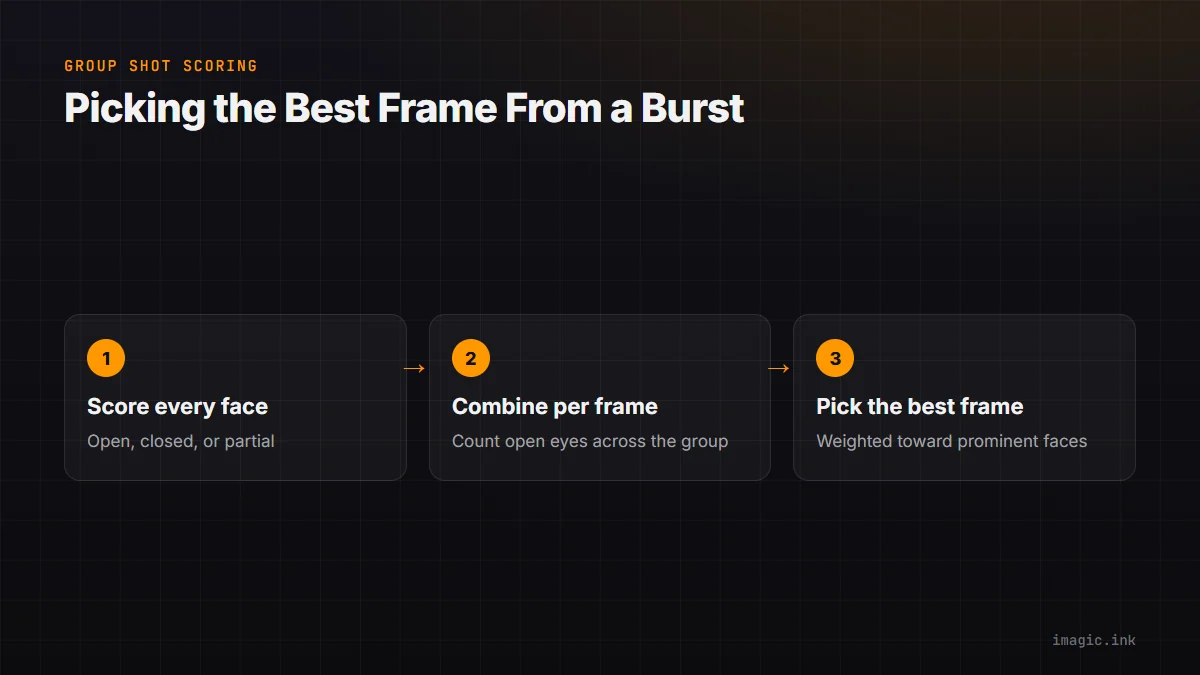
Rather than evaluating a single frame in isolation, closed-eye detection built for this problem scores every detected face in every frame of a burst individually: for each face, is the eye state open, closed, or partially closed. That produces a per-face, per-frame score across the whole sequence rather than a single "good or bad" judgment on each frame as a whole. The advantage of scoring per face rather than per frame is that it lets the system reason about combinations, which specific frame has the highest number of open eyes across the group, rather than treating a burst as a stack of pass/fail frames.
Picking the Frame Where Everyone's Eyes Are Open
Once every face in every frame has an eye-state score, the system can identify the frame in the burst with the best combined result, ideally every face scored open, or failing that, the frame with the fewest closed or partial eyes, weighted toward faces that are more prominent in the frame (closer to camera, more central to the composition). This is the specific value closed-eye detection adds for group work: instead of a photographer manually cross-referencing which face is closed in which frame across a burst of 15 to 20 shots, a task that gets genuinely difficult past a handful of people, the scoring does that cross-referencing automatically and surfaces the best candidate.
Where This Falls Short
Worth being direct about the limits: if no frame in the burst happens to have every eye open (which does happen with large enough groups and short enough bursts), scoring can only surface the closest approximation, not manufacture a frame that does not exist. Composite techniques, blending the best eyes from multiple frames into one final image, are a separate, more manual process that goes beyond frame selection and is not something automated eye scoring alone solves. For genuinely large or important group shots, shooting a longer burst specifically to give the scoring more frames to choose from remains the most reliable mitigation.
Where imagic Fits
imagic's AI culling includes closed-eye detection as part of its quality scoring, running locally across a burst to help identify the best-eyes frame from group and portrait sequences, included at every tier. See How AI Photo Culling Works and AI Photo Culling, Explained Properly for how this fits into the broader scoring system, or wedding photography workflows where group shots are common.
Frequently asked questions
Can closed-eye detection guarantee a perfect group photo?
No. It can only pick the best frame from what was actually captured; if no frame in the burst has every eye open, it surfaces the closest match rather than creating one that does not exist.
Does closed-eye detection work on every face in a frame, or just the main subject?
Good implementations, imagic's included, score every detected face independently, which is what makes it useful for groups rather than just single-subject portraits.
How many frames should I shoot for a large group to give scoring enough options?
There is no fixed rule, but larger groups benefit from longer bursts, since the probability of every face being open in a single frame drops as group size grows, so more frames genuinely improve the odds of a clean result.
Try imagic free for 7 days, no card required, closed-eye detection included in AI culling. Start the free trial.