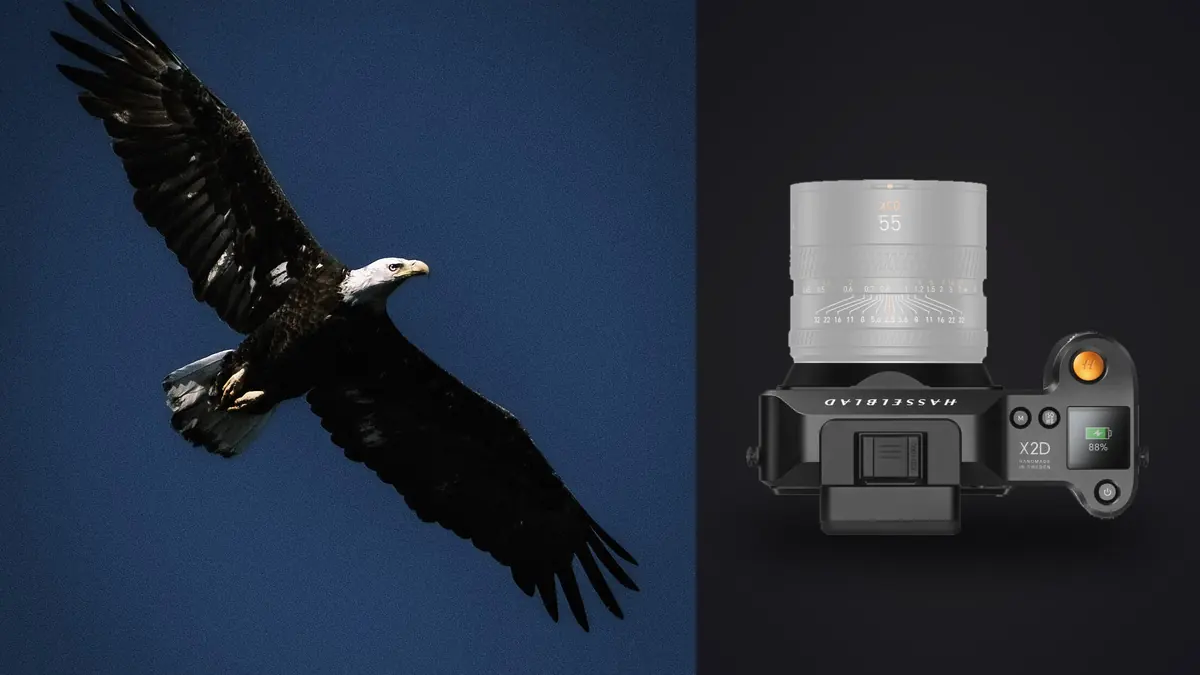
A friend who shoots gulls and terns on the Suffolk coast asked me, half joking, whether he should trade his full-frame mirrorless kit for a Hasselblad X2D 100C because he'd seen someone post a 100-megapixel osprey shot online. My answer took longer than he wanted to hear: yes, sort of, but not for the reasons he assumed, and not for most of what he actually photographs. The X2D 100C was not built as a wildlife camera the way a modern flagship sports body is. It was built for architecture, portraiture and landscape work, where nothing needs to be tracked at fifteen metres a second. Point it at a peregrine stooping on a pigeon and it will mostly demonstrate how honest medium format autofocus still is about its limits. Point it at a heron working a tideline, though, and something more interesting happens.
The Sensor Math Works Against You Here
Start with the number that changes how you plan a whole session: the X2D 100C's sensor measures 43.8 by 32.9mm, noticeably larger than the 36 by 24mm full-frame sensor most bird photographers are used to. A bigger sensor sounds like an advantage until you work through the focal length arithmetic. Hasselblad's XCD lenses are labelled with their actual focal length, and the crop factor relative to full frame runs at roughly 0.79x, not the 1.5x or 2x you get used to on APS-C or Micro Four Thirds bodies. That means the XCD 100-300mm f/4.5-5.6, the longest lens Hasselblad currently makes for this mount, delivers a field of view closer to a 237mm lens on a full-frame body. A birder used to slapping a teleconverter on a 400mm full-frame lens and gaining reach is going the opposite direction here. You are trading reach for sensor area, not the other way round.
In practice this means working distance and habituated subjects matter more with this camera than with almost anything else in a wildlife bag. I've had reasonable luck with harbour gulls that ignore people entirely, herons on managed wetland reserves that have stopped caring about a hide fifteen metres away, and birds of prey at rehabilitation centres and falconry displays where the flight path is fixed and short. Free-flying woodland or moorland species that keep their distance are a different story, and no amount of cropping in post recovers detail the lens never captured at 237mm equivalent in the first place.
Autofocus Finally Works. It's Still Not Built for Erratic Flight
The X2D 100C was the first Hasselblad X-series body with phase-detection autofocus; the original X1D and X1D II relied on contrast detection alone, which made anything moving faster than a browsing deer a lottery. That upgrade genuinely changes what's possible. Locking onto a perched kestrel or a heron standing in shallow water is fast and reliable now, and continuous tracking holds a subject that's crossing the frame at a walking pace or gliding through a wide, steady arc.
Where it falls apart is exactly where dedicated sports and wildlife bodies earn their keep: a bird that changes direction hard, a wing edge sweeping across the eye mid-beat, a subject accelerating out of a dive. The X2D 100C has no dedicated bird-eye detection mode and no subject-recognition training tuned to animal behaviour the way current flagship wildlife bodies have. It hunts, and once it hunts on a fast-moving subject you generally don't get it back before the moment has passed. I treat the autofocus here as very good general-purpose tracking rather than anything purpose-built for flight, and I plan shots around that: predictable flight lines, birds returning to a known perch, subjects riding a thermal in slow, wide circles.
The Frame Rate Number That Changes the Whole Approach
Here's the figure that ends most conversations about this camera as a flight-photography tool: the X2D 100C tops out around 3.3 frames per second with focus locked, and realistically closer to 2 to 2.5fps once you're asking it to keep tracking through a burst. Compare that to what most working bird photographers carry, and the gap is not subtle.
| Camera | Sensor | Resolution | Peak continuous AF-C burst | 300mm-class lens, real-world reach |
|---|---|---|---|---|
| Hasselblad X2D 100C | 43.8×32.9mm medium format | 100MP | ~2-2.5fps tracking (3.3fps focus locked) | ~237mm equivalent |
| Nikon Z9 | 35.9×23.9mm full frame | 45.7MP | 20fps full-res raw, faster in crop JPEG modes | 300mm (450mm in DX crop) |
| Sony a1 II | 35.9×24mm full frame | 50MP | 30fps electronic | 300mm |
| Canon EOS R5 II | 36×24mm full frame | 45MP | 30fps electronic | 300mm |
| OM System OM-1 II | 17.4×13mm Four Thirds | 20.4MP | 50fps AF-C, faster in AF-S burst modes | 600mm equivalent |
Laid out like that, the X2D 100C looks like an odd choice for flight photography, and for most of it, it is. What the table doesn't show is per-frame quality: a sharp 100-megapixel file at base ISO holds more real detail and tonal range than any of the others, and that detail survives heavy cropping in a way none of the smaller-sensor files can match. The trade is fewer chances per second in exchange for more information the moment one of those chances actually lands.
Pick your flight patterns, not just your subject
Species selection matters more here than gear choice ever could. Large soaring birds working thermals (buzzards, red kites, vultures, storks, cranes) move in wide, predictable arcs that give the autofocus time to settle and give you time to time the shutter by eye instead of relying on the burst to carry you. Herons and egrets lifting off from a known perch follow the same line every time once you've watched them for a morning. Gulls over a harbour or a working boat are forgiving simply because there are dozens of them and you only need one good pass to land a frame.
What doesn't work: swifts, swallows, and hirundines generally, anything hawking insects with constant direction changes, and raptors mid-stoop. I've tried all three with this body and come away with single-digit keepers out of hundreds of frames, which is a poor trade against the file sizes involved.
Glass: What "Long" Actually Means on This Mount
The XCD 100-300mm f/4.5-5.6 is currently the practical ceiling for reach on this system, and it's worth being clear about how it handles before assuming it slots straight into an existing wildlife kit. It's a substantial lens, comfortable on a gimbal or a beanbag propped on a vehicle window, less comfortable handheld for a full session the way a 500mm f/5.6 prime is manageable on a full-frame body. There's no Hasselblad-made teleconverter for the XCD mount, so 300mm (237mm equivalent) really is the ceiling unless you're cropping hard afterward, which brings you back to the same detail-versus-reach trade covered above.
Maximum aperture at the long end, f/5.6, is also roughly a stop behind what a dedicated 400mm or 500mm super-telephoto offers, which matters on overcast mornings when you're already fighting for shutter speed against a slow burst rate. I plan around good light for this combination rather than pushing ISO to compensate, both because autofocus hunts more in low contrast and because a slow frame rate gives you fewer chances to make up for a missed exposure.
The File Problem Nobody Mentions Until It's Their Problem
A single X2D 100C raw file runs well over 100MB. A modest three-second burst at the camera's realistic tracking rate produces fifteen to twenty of those files for one flight pass, most of them showing the same bird in nearly the same wing position, because the frame rate is too slow to capture meaningfully different phases of the wingbeat. Multiply that across a morning at a heronry or a gull colony and you're looking at hundreds of gigabytes before lunch, most of it near-duplicate frames of a handful of actual moments.
This is where I've come to rely on imagic instead of scrolling through a folder at full zoom for two hours. It runs local sharpness and focus scoring across the whole take and groups near-identical burst frames automatically, so the fifteen frames of one heron take-off cluster together with the sharpest one flagged, rather than me opening every file individually to judge focus on a screen that lies at thumbnail size. Everything runs on the machine itself, nothing gets uploaded anywhere, which matters when you're handling files this large on a laptop with limited upload bandwidth at a remote hide. If you want the mechanics behind that kind of automated first-pass sort, this breakdown of AI photo culling goes into more detail than I have room for here.
Where This Pairing Actually Earns Its Keep
I wouldn't recommend the X2D 100C to anyone whose primary subject is small, fast, or unpredictable. That's a job for a flagship full-frame or Four Thirds sports body, and pretending otherwise wastes both money and moments. But there's a real niche here for photographers who already shoot medium format for other work, including our own notes on using this body for architectural and interior jobs, and want one body that also handles slow, large-bodied wildlife without buying into a second full system. A heron rookery, a managed raptor centre, a wetland reserve with habituated cranes, a harbour full of gulls: all of these reward patience over speed, and that's exactly the trade this camera makes.
The other place it earns its keep is print and editorial work, where one outstanding 100-megapixel frame of a swan lifting off a lake is worth more than a memory card full of adequate frames of the same bird. For that kind of output I've set up a personal edit preset inside imagic using apply_my_style, trained on my own past edits of Hasselblad files, so the colour and tonal handling stays consistent between a heron session and a portrait session shot on the same body a week later, without me manually matching curves each time. It's a small thing but it saves real time when you're switching between genres on one camera rather than living entirely inside a dedicated wildlife setup.
One practical note for anyone weighing this setup against an all-in-one wildlife body: imagic is a one-time purchase rather than a subscription, which fits the mindset of someone who's already sunk a serious amount into a medium format kit and doesn't want another recurring line item just to sort through the raws it produces.
Frequently Asked Questions
Is the Hasselblad X2D 100C fast enough to freeze a bird's wingbeat?
Shutter speed freezes the wingbeat, not the burst rate. A shutter speed of 1/2000s or faster, alongside decent light, will stop a gull's or heron's wingbeat cleanly. What the slow burst rate costs you isn't sharpness within a single frame, it's the number of different wing positions you get to choose between afterward. Expect two or three usable wing positions from a pass, not the dozen a fast-burst body would hand you.
Can I add a teleconverter to the XCD 100-300mm for more reach?
Hasselblad doesn't currently make a teleconverter for the XCD mount, so there's no first-party route to extending the 300mm end. Some photographers have experimented with extension tubes for close-focus work, but that shortens minimum focus distance rather than adding telephoto reach, and it isn't the same thing. For now, 300mm (roughly 237mm full-frame equivalent) is the real ceiling on this system.
How many keeper frames should I expect from a flight sequence?
On predictable subjects like a heron's known flight line or gulls circling a boat, I budget for one or two genuinely sharp, well-composed frames per pass out of maybe fifteen to twenty captured. On erratic fliers that number drops toward zero more often than I'd like to admit. That ratio is part of why automated first-pass sorting matters so much more with this camera than with a high-burst body, where you're drowning in near-identical frames instead of hunting for the rare sharp one among duplicates.
Is 100 megapixels overkill for bird photography?
For a bird filling most of the frame at close working distance, yes, you're paying for resolution you'll just downsample away. For habituated subjects at moderate distance, where you'll want to crop significantly in post because the effective reach tops out around 237mm, the extra resolution earns its keep, since a crop to half the frame still leaves a roughly 25-megapixel file. It's less about bird photography broadly and more about this specific camera's short effective reach making heavy cropping routine.