
By hour three of culling a wedding shoot, "keep or reject" stops feeling like a judgment call and starts feeling like a coin flip you are too tired to trust. That is not a discipline problem. It is decision fatigue, a well-documented cognitive effect, showing up exactly where you would expect: a task that asks you to make several thousand small judgment calls back to back with no natural break.
The Psychology of Thousands of Judgment Calls
Every decision, however small, draws on the same limited pool of mental resources. Culling a single shoot can mean evaluating sharpness, expression, composition, and duplication across several thousand frames in one sitting, and each of those is a separate judgment. Decision fatigue research consistently shows that judgment quality drops as the number of consecutive decisions rises: people default to easier, lower-effort choices (keep everything, or reject aggressively) rather than genuinely evaluating each one. Culling is close to a worst-case task for this effect, because the decisions are visually similar to each other and repeat for hours.
Why Quality Decays Late in a Session
The practical symptom is familiar to anyone who has culled a full shoot in one sitting: the first few hundred picks feel careful and confident, and the last few hundred feel arbitrary. You start missing closed eyes you would have caught earlier, or rejecting a technically fine frame because you are tired of looking at it. This is not a character flaw, it is a predictable curve, and the fix is not "try harder" but structural: change how the task is broken up so no single stretch asks for too many fresh judgment calls in a row.
Batching Decisions Instead of Grinding Through Them
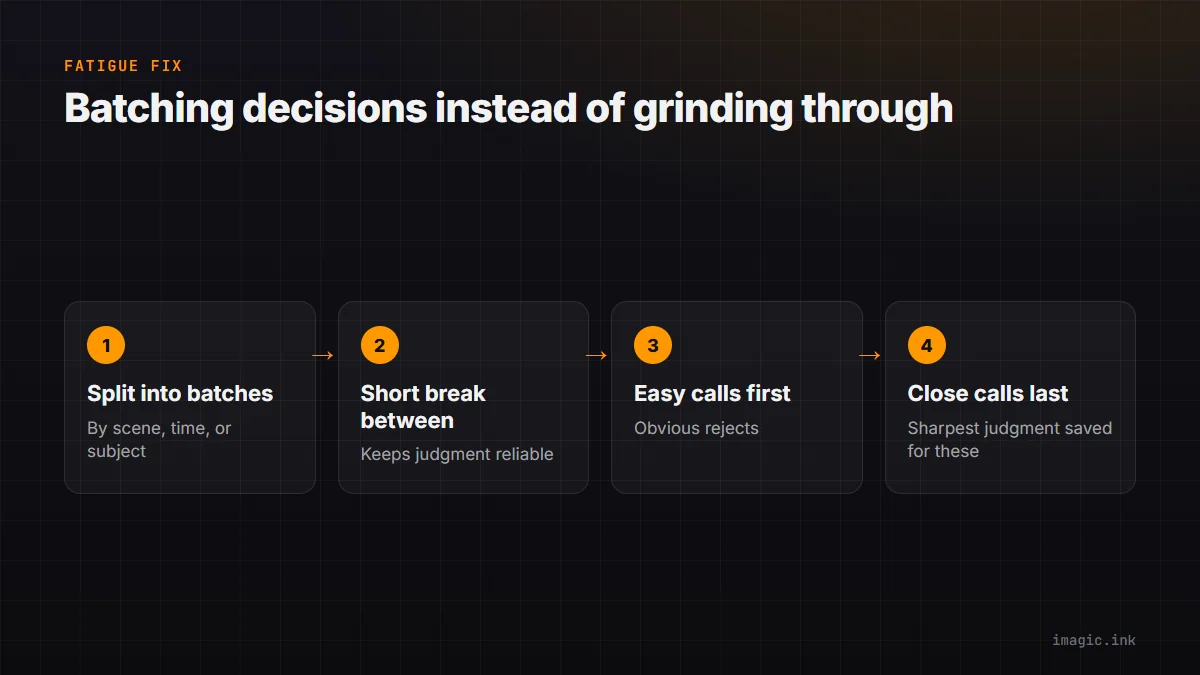
Breaking a shoot into batches by scene, time block, or subject, with a short break between batches, keeps each stretch of decisions inside the range where judgment stays reliable. Culling in order of easiest calls first (obvious rejects: closed eyes, motion blur, duplicates) before moving to genuinely close calls also helps, because it saves your sharpest judgment for the frames that actually need it, rather than spending it evenly across decisions that vary wildly in difficulty.
Pre-Scoring as Fatigue Removal
The most effective fix is removing the easy decisions from your plate entirely before you sit down. Automated quality scoring, the kind imagic runs on sharpness, closed eyes, and duplicate or burst grouping, handles the mechanical first pass so your remaining judgment calls are concentrated on genuinely subjective choices: which expression, which moment, which frame in a burst has the best composition. That is a fundamentally smaller and less fatiguing task than sorting several thousand frames from scratch, and it is the difference between a culling session that ends your evening and one that does not.
Frequently asked questions
Is decision fatigue during culling a real, documented effect?
Yes, it draws on well-established decision fatigue research showing judgment quality declines across a long series of consecutive choices. Culling is a concentrated version of that pattern because the decisions are visually repetitive and dense.
Does taking breaks actually help with culling accuracy?
Generally yes. Splitting a shoot into batches with short breaks between them keeps each stretch inside the range where judgment stays reasonably sharp, rather than letting fatigue compound across an unbroken multi-hour session.
How does automated pre-scoring reduce fatigue specifically?
It removes the mechanical, low-judgment decisions (obvious blur, closed eyes, duplicates) before you start, so the decisions left for you are the genuinely subjective ones, which is a much smaller and less draining set to work through.
Related reading: cull 1,000 photos in 30 minutes and photo culling mistakes to avoid. This applies especially hard to wedding shoots. More workflow pieces are in Tips & Workflow.