
Most culling sessions drag not because the photographer is slow, but because every frame gets evaluated for every possible reason to reject it, all at once. A faster approach is culling in ordered passes, each pass looking for exactly one category of problem. This is a practical photo culling checklist in the order that actually saves time.
Why Passes Beat One Perfectionist Pass
Evaluating a single frame for technical focus, exposure, closed eyes, duplication, and artistic merit all in one look means holding five separate judgment criteria in mind simultaneously, which is slow and mentally tiring across hundreds of frames. Splitting culling into ordered passes, each one looking for a single, specific problem, is faster in aggregate because each pass is simpler to execute and the frame count shrinks with every pass, so later, harder passes are working against a smaller, already-filtered set.
Priority Order
1. Technical Fails First
Motion blur, missed focus, badly blown highlights or crushed shadows beyond recovery. These are objective, fast to spot, and never survive to delivery regardless of anything else about the frame, so removing them first shrinks the pile the most with the least judgment required.
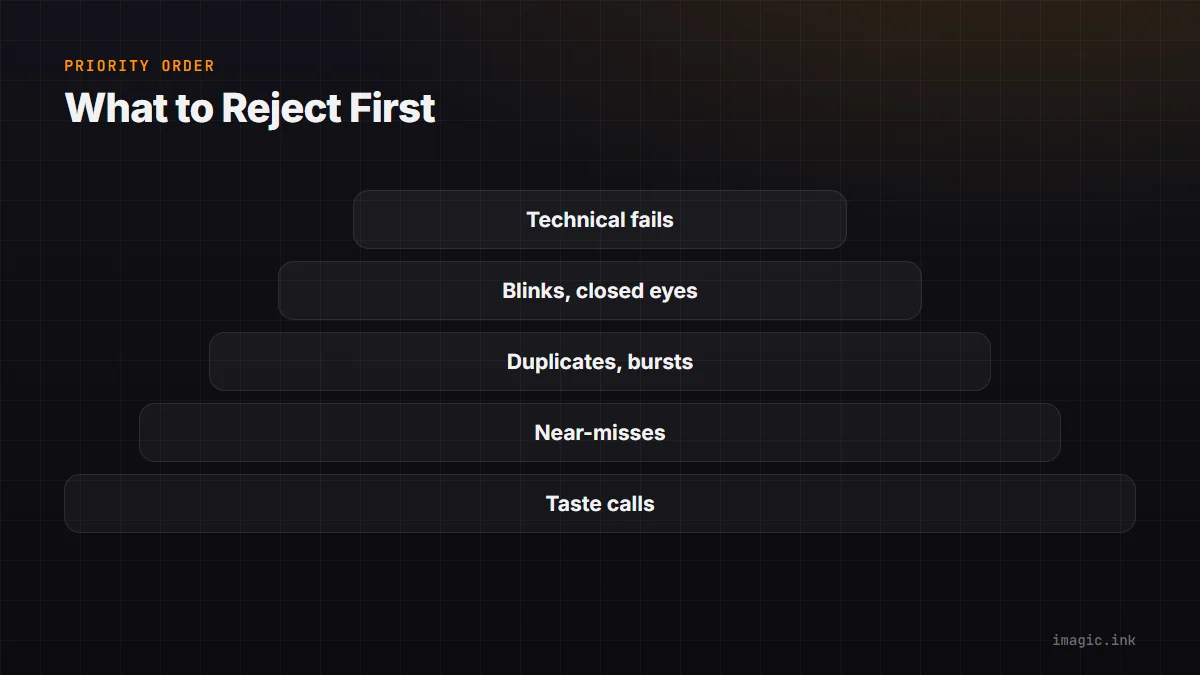
2. Blinks and Closed Eyes
In portraits and group shots specifically, a closed eye is close to an automatic reject unless the frame has no better alternative in its burst. This pass is fast because it is a single, visually obvious check per frame, no comparison to other frames needed yet.
3. Duplicates and Near-Duplicate Bursts
Once technical fails and blinks are gone, group what remains by moment and pick the best representative from each burst rather than carrying every frame of a sequence forward. This is where AI-assisted grouping helps most, since manually comparing 15 similar frames is the slowest part of a culling session by a wide margin.
4. Near-Misses
Frames that are technically fine but slightly weaker than an alternative from the same moment, a marginally softer expression, a slightly less centered composition. This pass requires actual comparison between remaining candidates, which is why it belongs after the shortlist has already been narrowed by the first three passes.
5. Taste Calls
What is left after the first four passes is the genuinely hard part: storytelling weight, emotional resonance, whether a slightly imperfect but authentic moment beats a technically cleaner but flatter one. This is the pass that benefits most from a photographer's judgment and the least from automation, and it should be a small fraction of total frames by the time you reach it.
Why This Order, Specifically
Each pass is ordered from most objective and fastest to most subjective and slowest, and each pass shrinks the pool for the next. Doing taste calls first, before technical fails are removed, wastes judgment time on frames that were never going to survive anyway. Doing duplicate grouping last, after taste calls, means re-comparing frames you already made a decision about.
Where imagic Fits This Checklist
imagic's AI quality scoring and duplicate grouping automate passes one through three (technical fails, closed eyes, duplicates), locally and included at every tier, leaving passes four and five, the genuine judgment calls, to manual review on a much smaller shortlist. See What Is Photo Culling? for the fundamentals this checklist builds on, and Photo Culling Mistakes to Avoid for common ways this order gets skipped.
Frequently asked questions
Should I always cull in this exact order?
It is a strong default, but the core principle, most objective and fastest first, most subjective and slowest last, matters more than the exact five categories. Adapt the order slightly if a specific shoot has an unusual problem pattern.
Can AI handle the taste-call pass?
Not reliably. Quality scoring can flag technical properties well, but storytelling weight and emotional resonance are subjective judgments that remain a manual, human decision.
Does culling in passes take longer overall than one pass per frame?
Generally no, it is faster in aggregate, since each pass is simpler and the frame count shrinks with every pass, so the hardest, slowest judgment calls are made against the smallest remaining set.
Try imagic free for 7 days, no card required, AI culling for the first three passes included. Start the free trial.