
Composition is the part of photo evaluation most resistant to automation, and honestly assessing what AI photo composition analysis can and cannot do matters more here than for almost any other quality metric. Sharpness and exposure are measurable properties; composition brushes up against taste, and taste is a much harder thing to score.
Rule-of-Thirds Heuristics
The simplest form of composition scoring checks a frame against known compositional guidelines: is the main subject positioned near a rule-of-thirds intersection rather than dead center, is the horizon roughly level, is there obvious dead space or crowding at the frame edges. These checks are fast, explainable, and reasonably reliable for what they actually measure, but they are guidelines, not laws of good composition, and a huge amount of genuinely excellent photography deliberately breaks them: centered symmetry, intentional negative space, a subject placed at the very edge of the frame for tension. A heuristic-only scorer would flag some of the most compelling compositions in photography as failures.
Learned Aesthetics: A Different Approach
A more sophisticated approach trains a model on large sets of images with human-provided aesthetic ratings, letting the model learn patterns associated with images people generally rate highly, rather than checking against a fixed rule like rule-of-thirds. This can capture more nuance than a rigid heuristic, but it inherits a different problem: it reflects the aesthetic preferences and biases of whatever dataset and raters it was trained on, which is not the same thing as your personal style or a specific client's taste, and it still cannot explain why a photo works the way a photographer's trained eye can.
Where Composition Scoring Genuinely Helps
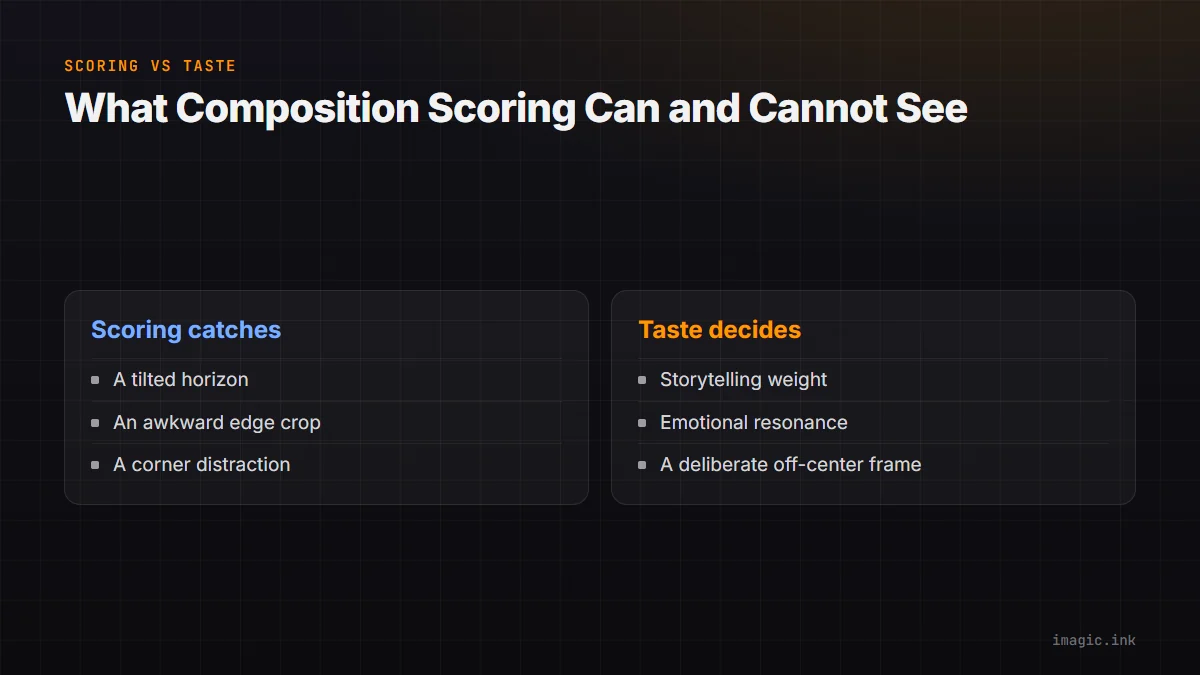
Despite the limits, composition scoring is not useless, it is useful for a specific, narrower job than "judge if this photo is good." It reliably catches the obvious, correctable technical issues: a badly tilted horizon, a subject uncomfortably close to a frame edge with an awkward crop, an unintentional distraction in a corner of an otherwise clean frame. These are the cases where a quick crop or straighten genuinely improves the photo, and flagging them automatically across a large batch saves real review time, especially on frames a photographer might not zoom into individually during a fast cull.
Where Taste Is Irreplaceable
What composition scoring cannot do, and should not be expected to do, is judge storytelling weight, emotional resonance, or whether an unconventional composition is a mistake or a deliberate, successful choice. A photographer choosing to place a subject at the extreme edge of the frame to convey isolation is making an artistic decision that a rule-based or even a learned-aesthetics scorer has no reliable way to distinguish from an accidental bad crop. This is the boundary worth being honest about: composition scoring is a technical assist for catching correctable framing issues, not a substitute for a trained editorial eye on the harder, subjective calls.
A Practical Way to Use It
Treat composition flags as a prompt to look closer, not a verdict. A flagged tilted horizon is worth a quick check and likely a correction. A flagged "off-center subject" is worth a glance to confirm it was intentional, and then leaving alone if it was. Using composition scoring this way, as a fast first pass for obvious technical fixes rather than a final judgment, keeps its real usefulness without over-trusting it on the calls it is not built to make.
Where imagic Fits
imagic's AI quality scoring includes composition signals alongside sharpness and exposure, flagging clearly correctable framing issues as part of AI culling, while leaving genuine artistic judgment to the photographer. See AI Photo Scoring Accuracy, Explained and Exposure Scoring and AI Photo Quality for how composition fits alongside other scoring dimensions.
Frequently asked questions
Can AI tell if a photo is well composed?
It can reliably flag technical composition issues like a tilted horizon or an awkward crop at a frame edge. It cannot reliably judge subjective qualities like storytelling weight or whether an unconventional composition is intentional and successful.
Does composition scoring penalize deliberately unconventional framing?
It can flag it as a heuristic deviation (off-center, breaking symmetry rules), which is why composition flags should be treated as a prompt to check, not an automatic rejection.
Is learned-aesthetic scoring more accurate than rule-of-thirds heuristics?
It can capture more nuance, but it reflects the biases of its training data and raters, which is not the same as your personal style or a client's taste. Neither approach replaces a trained editorial eye on subjective calls.
Try imagic free for 500 exports, no card required, AI composition and quality scoring included in every tier. Start the free trial.