Nikon Z6 III Fashion Troubleshooting: Focus and Skin Exposure
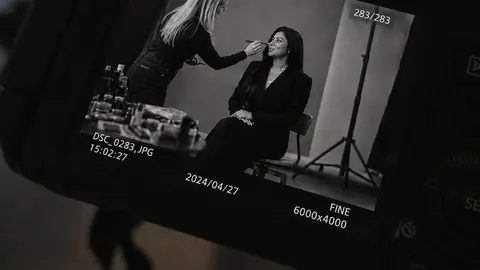
Troubleshoot Nikon Z6 III fashion lookbook focus, skin exposure, studio flash, LED flicker, mixed color, and movement with clear tests.
How AI culling, quality scoring, MCP servers, and agent-driven editing actually work, and how to put them into a real workflow.
Troubleshoot Nikon Z6 III fashion lookbook focus, skin exposure, studio flash, LED flicker, mixed color, and movement with clear tests.
Create a Panasonic S5IIX boudoir RAW workflow that protects privacy while organizing RW2 files, culling expressions, grading skin, and exporting safely.
A Nikon Z6 III macro RAW workflow for insects: planning focus-shift sequences, card backup, culling bursts, preparing stacks and exporting for a stacker.
Build a Nikon Z6 III fashion lookbook RAW workflow for NEF capture, shot-list culling, color matching, retouch versions, approvals, and export.
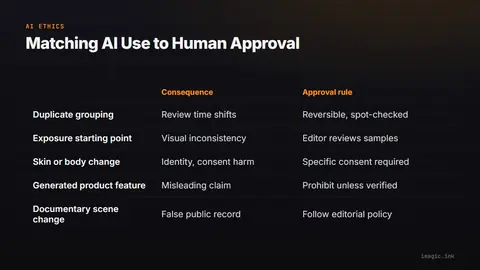
Evaluate AI photography tools by purpose, consent, bias, privacy, truth, labor, security, reversibility, disclosure, and human approval.
Real time savings from AI photo culling with imagic. Honest benchmarks for different shoot types - see what AI culling is worth to your workflow per year.
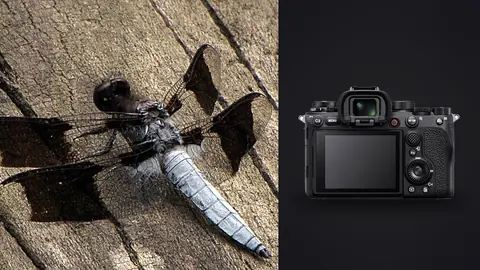
Fix Sony A1 macro and insect photography problems by diagnosing focus plane, subject motion, flash exposure, diffraction, and bursts.
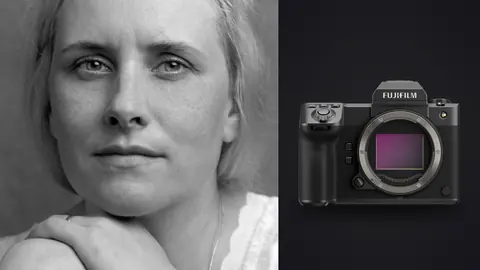
Plan Fujifilm GFX 100 II boudoir sessions around lens choice, room dimensions, window direction, privacy, backgrounds, and working distance.
How AI is transforming portrait photography editing in 2026. From AI culling with imagic to automated retouching - a complete look at the changes.
How AI photo quality scoring works: what it measures, where it fails, and how to use scores without losing creative control.
Automate photo culling from the CLI. imagic supports headless workflows, scripting, and automated photo pipelines for photographers and developers.
Perceptual hashing is how photo software finds near-duplicate images. Learn how the algorithm works and why it powers burst and duplicate detection.
AI is transforming photo editing workflows for professionals. We explore how AI culling, noise reduction, and masking tools are reshaping the industry.
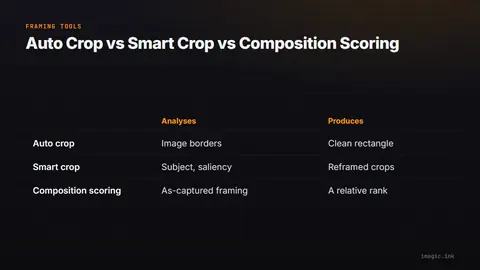
Smart crop and auto crop solve different problems. See how each AI framing tool works, where composition scoring fits, and when to use them.
AI photography tools are everywhere in 2025. We cut through the hype and identify which AI tools actually improve your workflow and which ones to skip.
How does AI score photo exposure quality? We explain histogram analysis, clipping detection, and scene-aware exposure assessment in AI culling tools.
AI scene detection identifies portraits, landscapes, sports, and event photos automatically. Learn how scene classification and subject-aware scoring work.
Professional photographers use AI to cull faster, reduce noise, and spend more time creating. Here is how the best are working faster in 2025.
How does noise reduction work in modern photo editing? We explain traditional vs AI noise reduction methods and which tools produce the best results.
Curious how AI photo culling software scores your images? We break down the algorithms behind sharpness, exposure, noise, and composition scoring.
How does AI detect photo sharpness? We explain the algorithms behind sharpness detection in tools like imagic, from Laplacian variance to deep learning.
Try imagic free for 500 exports with no card required, then keep AI culling, duplicate removal, and batch editing with a one-time license from €19 — no subscription.
Download imagic Desktop