What you are looking at
The bench holds one 50mm lens, pulled apart along the rail so its glass groups and brass helicoid are visible instead of hidden inside a barrel: the rear group by the mount, the iris between the groups, the front group riding on the helicoid. Drag the focus ring (or turn the dial on the console) and the helicoid screws the front group in or out. Pick f/2, f/5.6 or f/16 and the iris opens or closes the cone of light passing through. Switch the lens to Assembled, or press X, and the parts slide back together into one barrel.
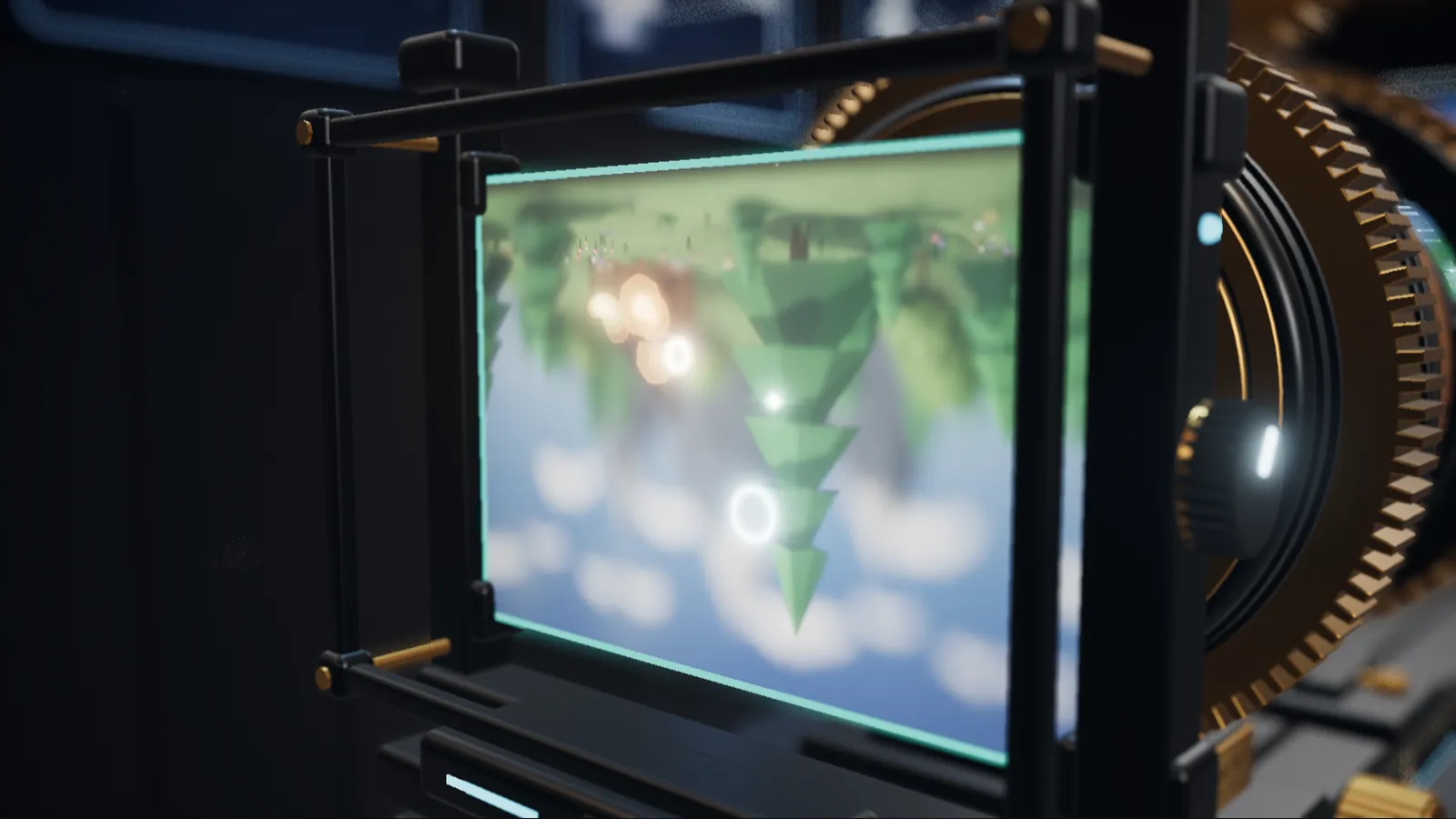
In front of the lens, a sheet of grid glass stands at the true focus distance and cuts straight through a small diorama: a pine at 37cm, a cabin at 55cm and a mountain peak at 95cm, the three stops the Foreground, Middle and Background buttons jump to. Behind the lens, at the other end of the rail, the rays land on the sensor's own ground glass. The picture it shows is upside down, the same way a real lens always projects it before any mirror or screen turns it back the right way up for you.
The plane of focus is a plane, not a point
A lens can only put one distance into true focus at a time. Light from a point at that distance leaves the back of the lens as a cone that closes to a point exactly on the sensor. Light from anything nearer or further closes to a point in front of the sensor or behind it, so by the time it reaches the glass it has opened back out again into a small disc. That is what the glowing grid on the bench is drawing: not a fuzzy zone, but one flat plane, slicing through the scene wherever the focus ring puts it. Everything on that plane is a point. Everything off it is a disc, and the disc grows the further it sits from the plane in either direction.
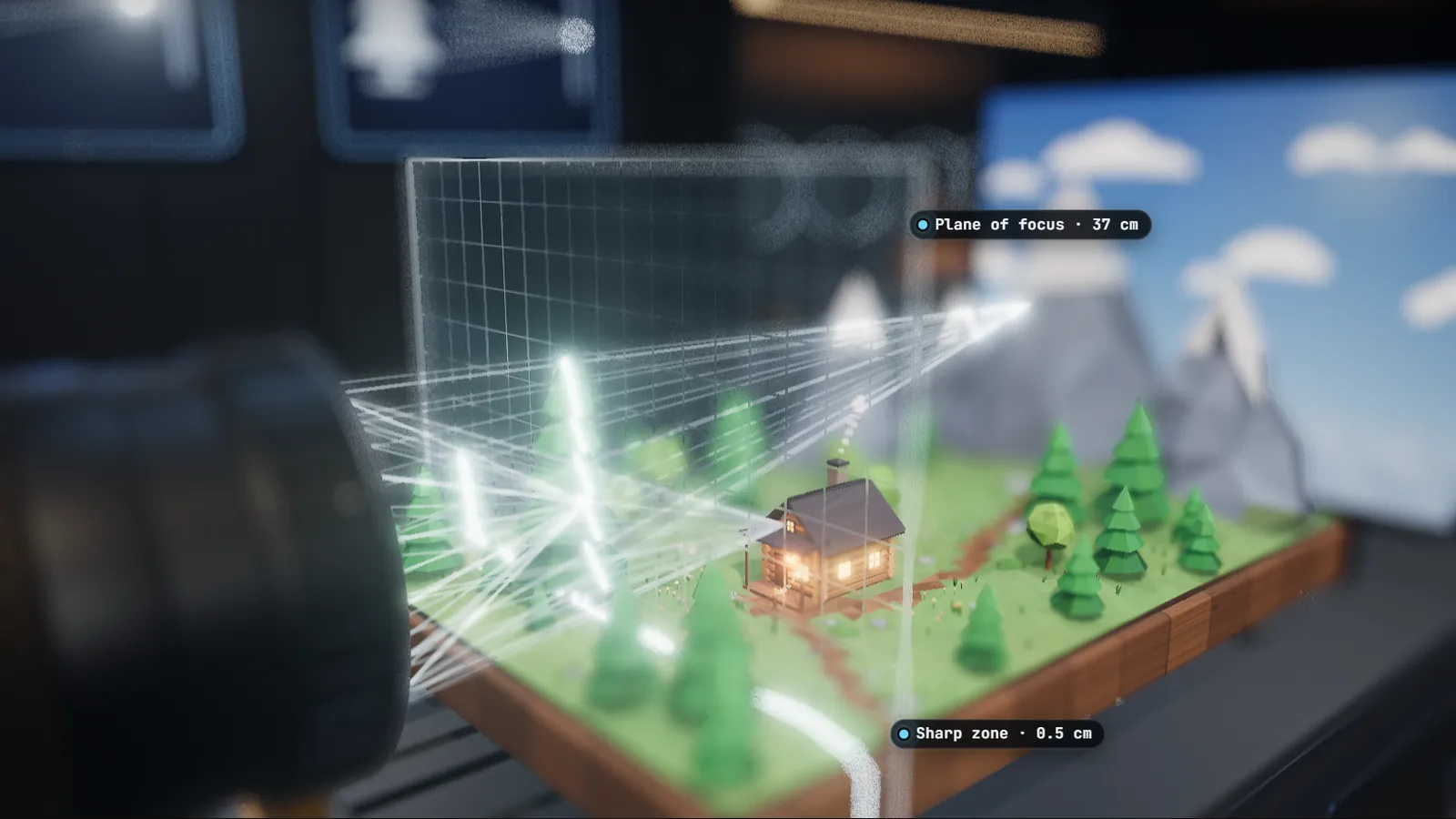
Why the sharp zone is so thin up close, and how aperture opens it up
Focus on the pine at 37cm and set the aperture to f/2 and the zone that still reads as acceptably sharp runs from about 36.7cm to 37.3cm: barely half a centimetre deep. Close down to f/5.6 and it grows to roughly 36.3-37.8cm, about 15mm. Close down further to f/16 and it stretches to about 34.9-39.3cm, close to 44mm, eight times the zone at f/2 from the same spot. That is the whole trick behind stopping down for a macro shot or a product shoot: the lens has not changed, only the width of the cone of light it lets through, and a narrower cone tolerates more distance either side of the plane before its disc grows large enough to notice.
Distance does the same job without touching the aperture at all. Move the focus point out to the peak at 95cm and, even at f/2, the sharp zone is about 4cm deep, roughly seven times as deep as the same f/2 gave you at 37cm. Nothing this close to a lens is ever going to behave like something 95cm away, whatever aperture you pick.
Use both at once and the change is dramatic. Focus on the peak at 95cm, close down to f/16, and the sharp zone runs from about 81cm to 114cm, roughly 32cm deep: nearly sixty times the half centimetre you started with at 37cm and f/2. On the bench, the thin sheet of glass swells into a deep block around the mountain.
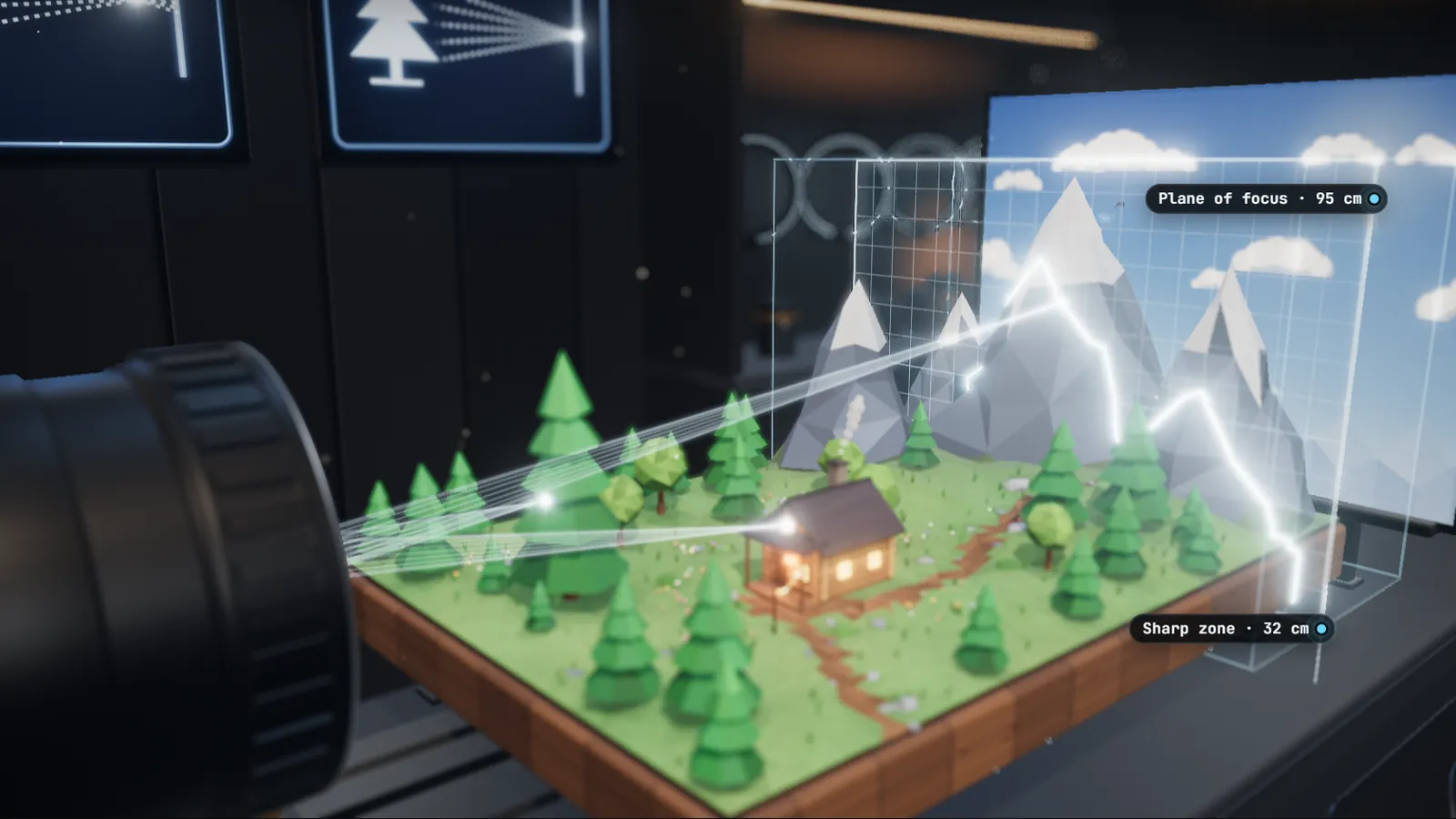
What "sharp enough" means
Depth of field is not really a boundary, it is a judgement call given a number. This bench treats a disc as acceptably sharp once it is smaller than the sensor's circle of confusion, taken here as the standard 43.27mm full-frame diagonal divided by 1500, about 0.029mm on the sensor itself. That is the same convention the Depth of Field Calculator uses, so the two tools never disagree about where a zone ends.
You can watch that judgement being made on the bench itself. Focus on the pine at f/2 and the peak, sitting 58cm further back, lands on the sensor as a disc about 2.4mm across, roughly 6.6% of the frame width: soft enough to read as background blur at a glance. Close down to f/16 with the focus untouched and the same peak shrinks to about 0.3mm, under 1% of the frame width. That is still ten times the circle of confusion, so the bench still keeps it outside the sharp zone: a clear mountain now rather than a smear, but visibly softer than the pine.
Focus bracketing and stacking
The screen in the middle of the console holds five frames of the same scene, focused progressively deeper: 33cm, 42cm, 55cm, 72cm and 95cm, each one taken at whichever aperture you have picked. Click a frame and the lens refocuses to that distance. That is a focus bracket, the sequence a macro or product photographer actually shoots when one aperture cannot put the whole subject in the sharp zone without diffraction softening everything anyway. Stacking software then keeps only the sharpest region from each frame and merges them into a single image that is sharp from front to back in a way no single exposure could manage on its own.
Where missed focus actually comes from
On a real shoot it is rarely the maths that goes wrong. An autofocus point locks onto a fence instead of the face behind it. A subject leans forward the two or three centimetres a f/1.8 portrait has to spare between focus lock and shutter. A body and lens disagree slightly about where their own focus motor thinks "in focus" is, and every frame lands a fraction in front of or behind the plane you meant. None of that shows up as a blurry photo you can fix afterwards, only as a keeper you did not get, sitting next to nine near-identical frames where you did.
Frequently asked questions
It is the one distance from the lens that is projected onto the sensor as a true point. A lens can only focus at one distance at a time, so the plane of focus is that distance drawn out flat across the whole scene. Anything nearer or further lands on the sensor as a small disc rather than a point, which is what depth of field is measuring.
Because only the plane of focus is ever truly sharp. Everything else in the frame is rendered as a blur disc whose size grows with its distance from that plane, and a disc small enough stays under the eye's own resolving limit and still reads as sharp. That tolerance has a name, the circle of confusion, and it is what every depth of field figure is built from.
No. The aperture never moves the plane of focus, only the focus ring does that. What the aperture changes is how quickly a disc grows as you move away from that plane: a wide aperture like f/2 lets a fat cone of light through, so the disc grows fast and the sharp zone is thin. A narrow aperture like f/16 lets a thin cone through, so the disc grows slowly and the sharp zone is much deeper either side of the same plane.
The plane of focus is a single distance: the one place a lens is actually focused. Depth of field is the range of distances in front of and behind that plane whose blur disc is still small enough to call sharp. One plane, one number; depth of field, a zone built around it from the aperture, the focal length and how far away the plane itself is.
A lens bends light that crosses through a single point near its centre, so a ray leaving the top of a scene ends up crossing to the bottom of the image, and a ray from the left ends up on the right. That is simply how a lens forms an image, on a ground glass, on film or on a digital sensor. A camera's viewfinder or an on-screen preview then flips it back the right way up for you, either optically with a mirror and pentaprism or in software.
Yes. No signup, no account, and everything on the bench runs in your browser.
Then let imagic find the frames that actually landed on the plane
imagic scores every photo in a shoot on sharpness, exposure, noise, composition and detail, locally on your machine, nothing uploaded, and picks the sharpest frame out of every burst automatically. Free 500-export trial, no card required.